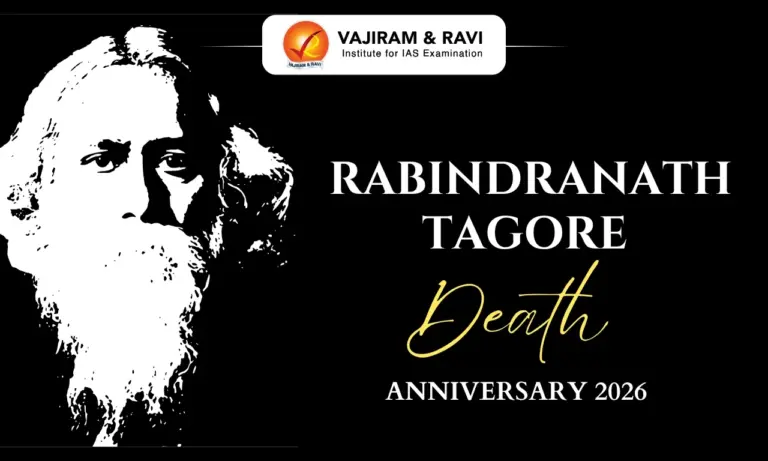
Rabindranath Tagore Death Anniversary 2026 is a day to remember and honor one of India’s greatest literary and cultural figures. Observed every year on August 7, this occasion gives people an opportunity to reflect on Tagore’s remarkable contributions to literature, music, education, and philosophy. He was not just a poet, but a thinker who shaped modern ideas of humanity, creativity, and unity. On this day, people across different regions pay tribute to his legacy through various cultural and literary activities, celebrating the timeless values he shared with the world.
Rabindranath Tagore Death Anniversary 2026 Date and Significance
- Rabindranath Tagore’s Death Anniversary is observed every year on August 7, and 2026 marks his 85th death anniversary, making it a significant day of remembrance across India and around the world.
- He passed away in 1941 at the age of 80 at his ancestral home, Jorasanko Thakur Bari in Kolkata, marking the end of an era in Indian cultural history.
- In the Bengali calendar, this day falls on the 22nd of Srabon, which holds deep emotional and cultural importance, especially in West Bengal and Bangladesh.
- The day is observed by paying tribute to his literary genius, artistic brilliance, and philosophical ideas that shaped modern India.
- Schools, cultural institutions, and literary groups organize poetry recitations, Rabindra Sangeet performances, and discussions to celebrate his legacy.
- It is not just a day of remembrance but also a moment to reflect on his ideals of humanism, harmony, and universal brotherhood.
Rabindranath Tagore: Life, Legacy and Contributions
- Rabindranath Tagore (1861-1941) was a poet, philosopher, artist, educationist, and social reformer, often called Gurudev, Kabiguru, and Biswakabi.
- He became the first non-European to win the Nobel Prize in Literature (1913) for his famous work Gitanjali, bringing global recognition to Indian literature.
- Tagore made a lasting impact on Bengali literature, transforming it with his simple yet deeply emotional and philosophical writing style.
- He composed the national anthems of two nations – “Jana Gana Mana” (India) and “Amar Shonar Bangla” (Bangladesh), reflecting his cultural influence.
- In the field of education, he founded Visva-Bharati University at Shantiniketan, promoting a holistic and nature-based learning system.
- Tagore was also a prolific artist, creating over 2,500 paintings and sketches, exploring themes of nature, spirituality, and human emotions.
- Though he supported India’s freedom struggle, he believed in inclusive nationalism and strongly opposed narrow and aggressive nationalism.
- His philosophy of universal humanism continues to inspire ideas of peace, unity, and global cooperation even today.


Major Works of Rabindranath Tagore
- Poetry: His poetic works like Gitanjali, Manasi, Sonar Tari, Gitimalya, and Balaka are known for their lyrical beauty, spirituality, and deep emotions.
- Novels: Famous novels such as Gora, Ghare-Baire, and Chokher Bali explore themes of identity, society, and nationalism in a simple yet powerful way.
- Short Stories: His collection Galpaguchchha reflects the lives of ordinary people, highlighting social issues with sensitivity and realism.
- Dramas: Plays like Visarjan, Chitrangada, Muktadhara, and Valmiki-Pratibha combine music, poetry, and social messages.
- Songs: He composed over 2,000 songs, known as Rabindra Sangeet, which remain popular for their emotional depth and cultural richness.
- Essays and Lectures: His works such as Nationalism (1917) and The Religion of Man present his ideas on society, spirituality, and global harmony.
- Rabindranath Tagore’s writings stand out for their simplicity, human touch, and universal appeal, making them relevant even in modern times.
Also Read:- Rabindranath Tagore Jayanti 2026
Rabindranath Tagore’s Role in Freedom Struggle
- Rabindranath Tagore strongly opposed British imperialism and supported India’s freedom, but he believed that true independence should be based on moral values and human dignity, not just political power.
- He had a balanced view of nationalism, while he wanted India to be free, he also warned against extreme and narrow nationalism, stressing the importance of learning from other cultures.
- Tagore openly criticized certain aspects of the Swadeshi Movement, especially in his essay “The Cult of the Charkha” (1925), where he questioned blind practices and emphasized rational thinking.
- Through his poetry and songs, he inspired people during the freedom struggle; works like “Chitto Jetha Bhayshunyo” (Where the Mind is Without Fear) and “Ekla Chalo Re” encouraged courage, self-reliance, and fearless action.
- Although he had differences with Mahatma Gandhi’s methods, the two shared mutual respect, and Tagore even played a role in reducing differences between Gandhi and B.R. Ambedkar on important social issues.
- One of his most powerful acts of protest came after the Jallianwala Bagh Massacre (1919), when he renounced his knighthood, sending a strong message against British injustice.
- Rabindranath Tagore’s contribution to the freedom struggle was more intellectual and moral than political, as he focused on shaping ideas of freedom, unity, and universal human values.

 Last updated on Oct, 2026
→ UPSC 2027 Notification will be released on 13 January 2027 at upsconline.nic.in.
→ Asian Games 2026 are being held in Aichi-Nagoya, Japan, from 19 September to 4 October.
→ Check Nobel Prize 2026 Winners List here.
→ Download PIB PRiSM Monthly Magazine 2026 here.
→ Check UPSC Monthly Current Affairs Magazine The Recitals here.
→ Check out the latest UPSC Syllabus here.
→ Download UPSC Model Answers for Mains 2026
→ UPSC Mains Question Paper 2026 is out now for Essay & GS Paper 1, 2, 3 & 4.
→ UPSC Calendar 2027 has been released.
→ Enroll in Vajiram & Ravi’s UPSC Mains Test Series 2027 for structured answer writing practice, expert evaluation, and exam-oriented feedback.
→ Join Vajiram & Ravi’s UPSC Mentorship Program 2027 for personalized guidance, strategy planning, and one-to-one support from experienced mentors.
→ Go through the UPSC Mains Previous Year Papers to enhance your preparation.
→ UPSC has released UPSC Toppers List 2025 with the Civil Services final result on its official website.
→ Also check Best UPSC Coaching in India
Rabindranath Tagore Death Anniversary 2026 FAQs
Q1. When is Rabindranath Tagore’s Death Anniversary observed?+
Q2. Why is August 7 important for Rabindranath Tagore?+
Q3. How is Tagore’s death anniversary observed in 2026?+
Q4. What is the Bengali date of Tagore’s death anniversary?+
Q5. Where did Rabindranath Tagore die?+
Q6. Why is Rabindranath Tagore important in Indian history?+
Q7. What are Rabindranath Tagore’s major contributions?+
Q8. Which national anthems were written by Tagore?+
Q9. What was Tagore’s role in the freedom struggle?+
Q10. Why did Tagore renounce his knighthood?+
Tags: history history notes rabindranath tagore rabindranath tagore death rabindranath tagore death anniversary rabindranath tagore death anniversary 2026