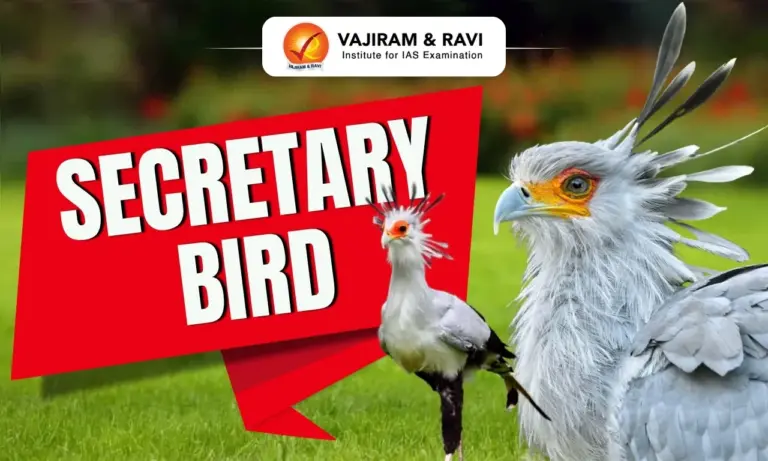
The Secretary Bird is a distinctive terrestrial bird of prey found across the dry uplands and open grasslands of sub Saharan Africa. It is the only living bird of prey with mainly terrestrial habits. The species is known for its long legs, black crest feathers and unusual ability to kill snakes by stamping them against the ground. It also holds cultural significance in South Africa.
Secretary Bird Features
The Secretary Bird has several unique physical, behavioural and ecological features that distinguish it from most other African raptors.
- Scientific name: Its scientific name is Sagittarius serpentarius. It belongs to the family Sagittaridae and is a bird of prey.
- Distribution: The Secretary Bird occurs mainly across the grasslands, savannas and dry uplands of sub Saharan Africa, where open ground supports walking based hunting.
- Physical features: It can reach about 1.2 metres in length with a wingspan of nearly 2.1 metres. Its body is light grey with black thighs and flight feathers.
- Distinctive crest: About 20 black crest feathers resemble quill pens tucked behind the ears, which is commonly linked with its name.
- Hunting method: Unlike most raptors, it hunts mainly on foot. It kills snakes by stamping them or striking them against the ground like a kick, sometimes dropping prey from above.
- Diet: Snakes are important prey, while its diet also includes lizards, grasshoppers, mice, amphibians, small mammals and bird eggs.
- Adaptations: Thick scales on its legs provide protection against snakebites. Its long legs also help it move efficiently through open grasslands.
- Nesting: It usually builds large stick nests in thorn trees. Usually two chicks hatch after about seven weeks and both parents feed them by regurgitation.
- Conservation: The species faces habitat loss, deforestation, grassland decline and collisions with telephone and power lines. It is protected in most African countries and is listed as Endangered on the IUCN Red List.
- Cultural significance: The Secretary Bird appears on the coat of arms of South Africa, where it represents protection and vigilance.
Also Read: Species in News 2026


 Last updated on Oct, 2026
→ UPSC 2027 Notification will be released on 13 January 2027 at upsconline.nic.in.
→ Asian Games 2026 are being held in Aichi-Nagoya, Japan, from 19 September to 4 October.
→ Check Nobel Prize 2026 Winners List here.
→ Download PIB PRiSM Monthly Magazine 2026 here.
→ Check UPSC Monthly Current Affairs Magazine The Recitals here.
→ Check out the latest UPSC Syllabus here.
→ Download UPSC Model Answers for Mains 2026
→ UPSC Mains Question Paper 2026 is out now for Essay & GS Paper 1, 2, 3 & 4.
→ UPSC Calendar 2027 has been released.
→ Enroll in Vajiram & Ravi’s UPSC Mains Test Series 2027 for structured answer writing practice, expert evaluation, and exam-oriented feedback.
→ Join Vajiram & Ravi’s UPSC Mentorship Program 2027 for personalized guidance, strategy planning, and one-to-one support from experienced mentors.
→ Go through the UPSC Mains Previous Year Papers to enhance your preparation.
→ UPSC has released UPSC Toppers List 2025 with the Civil Services final result on its official website.
→ Also check Best UPSC Coaching in India
Secretary Bird FAQs
Q1. What is the scientific name of the Secretary Bird?+
Q2. Where is the Secretary Bird found?+
Q3. Why is the Secretary Bird famous?+
Q4. What does the Secretary Bird eat?+
Q5. What is the conservation status of the Secretary Bird?+
Tags: secretary secretary bird