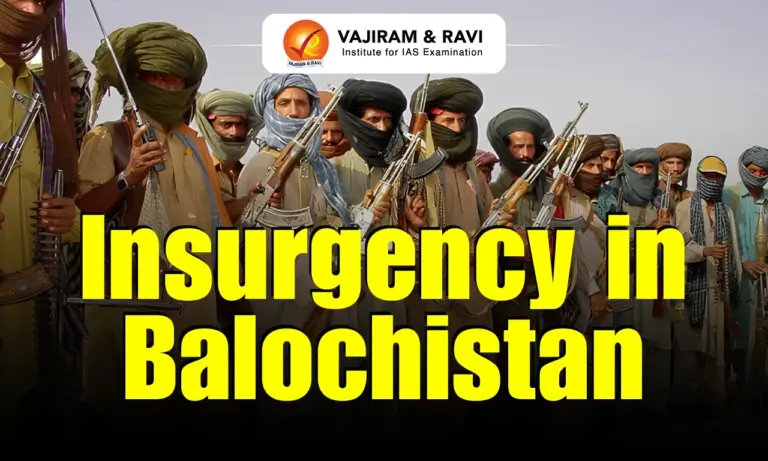
Insurgency in Balochistan is a long running conflict involving Baloch nationalist groups, Pakistani security forces and other militant organisations. The conflict is linked to historical grievances, political marginalisation, resource disputes, enforced disappearances and demands for autonomy or independence.
Balochistan
Balochistan is Pakistan’s largest province by area and covers about 44% of its territory. It contains only around 5% of Pakistan’s population and borders Iran, Afghanistan, Punjab, Sindh and the Arabian Sea.
The region is strategically important because of its location and natural resources. It has major reserves of natural gas, copper, gold and coal, yet around 70% of its population is classified as multidimensionally poor. The province is predominantly inhabited by Sunni Baloch communities and remains Pakistan’s least populated province.
Insurgency in Balochistan
The Insurgency in Balochistan has appeared in several waves since Pakistan’s creation.
- Recent violence: Recent attacks included the July 6 Ziarat incident, where 27 policemen were killed and the Hanna Urak attack a day earlier, where five civilians died.
- Operation Shaban: Pakistan launched Operation Shaban following the police killings. Pakistani authorities claim that 129 “terrorists” have been killed since July 5 during the operation.
- Major militant groups: Balochistan Liberation Army, Balochistan Liberation Front and Baloch Republican Army have operated alongside Islamist and sectarian organisations.
- Nature of attacks: Violence has included guerrilla attacks, bombings, assassinations, attacks on security personnel, infrastructure, civilians, workers and Chinese linked projects.
- Balochistan Independence Day 2026: August 11 is observed by Baloch separatist supporters as Independence Day, based on their claim that Balochistan declared independence on August 11 1947, though internationally it remains a province of Pakistan.


Insurgency in Balochistan Causes
The major reasons and factors responsible for the Insurgency in Balochistan are:
- Political marginalisation: Baloch nationalists argue that decision making remains dominated by powerful central institutions. They demand greater provincial autonomy and control over matters affecting local communities.
- Resource inequality: Balochistan possesses gas, copper, gold and coal resources. Local communities argue that resource extraction has not produced comparable employment, infrastructure or economic benefits.
- Chinese projects: Gwadar Port, CPEC projects and the Saindak copper and gold mine have become major points of controversy. Chinese workers and projects have consequently faced militant attacks.
- Militarisation: Allegations of enforced disappearances, extra judicial killings and fake encounters have deepened mistrust between sections of the population and state institutions.
- Regional militancy: Balochistan also faces Islamist and sectarian violence. Groups such as Al Qaeda, TTP and Lashkar e Jhangvi have contributed to regional insecurity.
Insurgency in Balochistan History
The history of insurgency in Balochistan contains repeated confrontations between Baloch nationalist forces and the Pakistani state. Each major phase added new political and security grievances.
- 1947-48: At Partition, Balochistan consisted of Kharan, Makaran, Las Bela and Kalat. Kalat sought independence, while the other princely states joined Pakistan.
- First major rebellion: Resistance intensified after Pakistan’s One Unit policy. The merger of Balochistan with West Pakistan in 1955 further increased resentment.
- 1958 rebellion: Khan of Kalat, Nawab Nauroz Khan, declared independence. He later surrendered after assurances but was imprisoned, deepening nationalist grievances.
- 1963-69 conflict: A third rebellion demanded withdrawal of Pakistani troops and provincial recognition. Balochistan eventually received provincial status in 1970.
- 1973-77 insurgency: Pakistan’s President dismissed the Balochistan government in 1973. The decision triggered a four year insurgency and intensified demands for autonomy.
- Fifth insurgency: The present major wave emerged in the mid 2000s. The alleged 2005 rape of a Baloch doctor and the 2006 killing of Akbar Bugti became major triggers.
- Post 2021 environment: The Taliban’s return to power in Afghanistan increased Pakistani security concerns. Pakistani authorities have also alleged cooperation between BLA and TTP.
Insurgency in Balochistan Impacts
The Insurgency in Balochistan conflict affects security, development, human rights, regional connectivity and relations between Pakistan and neighbouring states. It also creates risks for major infrastructure projects.
- Security impact: Continuous militant attacks require extensive deployment of Pakistani security forces. Violence affects police personnel, military targets, civilians and critical infrastructure.
- Humanitarian impact: Allegations of disappearances and extra judicial killings have created strong public anger. Activists have repeatedly demanded information about missing persons and greater accountability.
- Economic impact: Persistent violence discourages investment and disrupts development. Resource rich areas remain economically deprived despite substantial mineral and energy potential.
- CPEC security: Baloch militants have repeatedly targeted Chinese interests. This creates additional security costs for Pakistan and challenges the implementation of CPEC projects.
- Regional instability: Balochistan’s location near Iran, Afghanistan and the Arabian Sea gives its internal conflict wider regional security implications.
Insurgency in Balochistan Solutions
A durable solution for the Insurgency in Balochistan requires security measures alongside political dialogue, accountable governance, economic inclusion and credible mechanisms for addressing human rights concerns.
- Political dialogue: Pakistan needs sustained engagement with non violent Baloch political groups. Dialogue can address demands for autonomy, representation and greater provincial decision making.
- Resource sharing: Fairer distribution of revenue from gas, copper, gold and other resources can reduce perceptions of economic exploitation and improve local participation.
- Human rights: Transparent investigations into disappearances and alleged extra judicial killings are necessary. Legal accountability can help rebuild confidence in state institutions.
- Development focus: Better education, healthcare, roads, employment and basic services are essential. Development should provide meaningful opportunities for local communities.
- Local employment: Major projects should increase skilled employment for Baloch residents. This can reduce opposition to foreign investment and strengthen local economic participation.
- Regional cooperation: Pakistan, Iran and Afghanistan need stronger coordination against cross border militant activity. Cooperation can reduce militant sanctuaries and improve border security.
India’s Stand on Insurgency in Balochistan
India officially denies supporting Baloch separatists. Its position has focused on rejecting Pakistan’s allegations while highlighting human rights concerns and the regional security implications.
- India rejects Pakistani allegations that it supports Baloch militants. India has maintained that Pakistan should address its internal political and security problems.
- Prime Minister Narendra Modi raised the human rights situation in Balochistan during his Independence Day speech in 2016.
- India’s approach is influenced by Pakistan relations, regional stability, China’s CPEC presence and broader security considerations in South Asia.
Insurgency in Balochistan International Concerns
The Insurgency in Balochistan has international significance because Balochistan connects South Asia, West Asia and Central Asia. Its instability affects China, Iran, Afghanistan and regional connectivity.
- China: Gwadar Port and CPEC make Balochistan strategically important for China. Chinese personnel and infrastructure have been targeted by Baloch militants.
- Afghanistan: Pakistan has repeatedly alleged that Baloch militants have operated from Afghanistan. Afghan territory has historically been associated with alleged training and sanctuary for separatist groups.
- Iran: Historical Balochistan extends into Iran’s Sistan and Baluchestan province. Iran has separately faced attacks by Baloch militant groups such as Jundallah and Jaysh al Adl.
- Human rights: International concern centres on enforced disappearances, alleged extra judicial killings, militant violence and protection of civilians.
- Geostrategic location: Gwadar lies on the Arabian Sea near the Strait of Hormuz. Instability therefore carries implications for maritime connectivity, energy routes and regional security.
- International terrorism: The United States designated the Balochistan Liberation Army as a global terrorist organisation on July 2, 2019. This reflects the international security dimension of the conflict.

 Last updated on Oct, 2026
→ UPSC 2027 Notification will be released on 13 January 2027 at upsconline.nic.in.
→ Check Nobel Prize 2026 Winners List here.
→ Download PIB PRiSM Monthly Magazine 2026 here.
→ Check UPSC Monthly Current Affairs Magazine The Recitals here.
→ Check out the latest UPSC Syllabus here.
→ Download UPSC Model Answers for Mains 2026
→ UPSC Mains Question Paper 2026 is out now for Essay & GS Paper 1, 2, 3 & 4.
→ UPSC Calendar 2027 has been released.
→ Enroll in Vajiram & Ravi’s UPSC Mains Test Series 2027 for structured answer writing practice, expert evaluation, and exam-oriented feedback.
→ Join Vajiram & Ravi’s UPSC Mentorship Program 2027 for personalized guidance, strategy planning, and one-to-one support from experienced mentors.
→ Go through the UPSC Mains Previous Year Papers to enhance your preparation.
→ UPSC has released UPSC Toppers List 2025 with the Civil Services final result on its official website.
→ Also check Best UPSC Coaching in India
Insurgency in Balochistan FAQs
Q1. What is the Insurgency in Balochistan?+
Q2. Why is Balochistan facing insurgency?+
Q3. When did the Insurgency in Balochistan begin?+
Q4. Which groups are involved in the Balochistan Insurgency?+
Q5. Why is Balochistan strategically important?+
Tags: Balochistan insurgency in balochistan