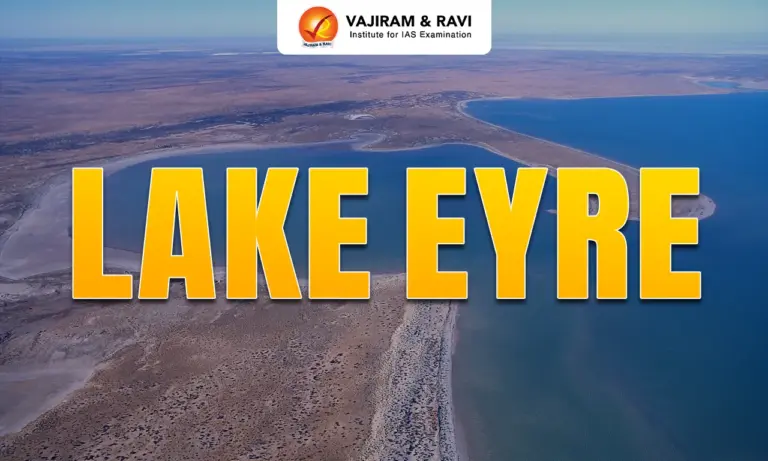
Lake Eyre, officially known as Kati Thanda-Lake Eyre, is a major salt lake in South Australia. It is an endorheic lake because its waters have no natural outlet to the sea. The lake lies about 15 metres below sea level at its deepest point. It is the lowest natural point on the Australian continent. Its basin covers about 1,140,000 km² and receives highly variable rainfall.
Lake Eyre (Kati Thanda-Lake Eyre)
Lake Eyre is a shallow, saline and highly variable lake located within one of the world’s largest internal drainage systems.
- Location: Lake Eyre lies in South Australia. It is located around 700 km north of Adelaide and forms the lowest part of the Lake Eyre basin.
- Size: The lake has a total surface area of about 9,690 km². Lake Eyre North covers 8,430 km², while Lake Eyre South covers 1,260 km².
- Structure: Lake Eyre has two sections, Lake Eyre North and Lake Eyre South. The narrow Goyder Channel connects them. Lake Eyre North is 144 km long.
- Depth and Volume: The combined volume is about 30.1 km³. Lake Eyre North has a maximum depth of 5.7 m, while Lake Eyre South reaches 3.7 m.
- Climate: The surrounding region is extremely dry. The annual mean temperature is 21.2°C and annual precipitation averages only 167 mm.
- Rainfall and Flooding: Rainfall varies sharply across the catchment. Floodwater can travel from Queensland through Channel Country and reach the lake after major rainfall events.
- Water level: Lake Eyre normally remains dry or partly flooded.
- Endorheic Character: Lake Eyre is an endorheic lake because it has no outflowing rivers or channels. Water entering the basin is mainly lost through evaporation.
- Salinity: Evaporation concentrates salts on the lake floor. The salt crust can become very thick in the southern sections and forms the characteristic salt-pan landscape.
- Human Use: Most non desert areas of the Lake Eyre basin support low intensity sheep and cattle grazing. Irrigated agriculture remains very limited.
How Was Lake Eyre Formed?
Lake Eyre developed within a long lived tectonic depression where crustal movement, sediment deposition, evaporation and changing drainage patterns shaped the present lake.
- Tectonic Depression: The basin developed through downward movement of the Earth’s crust. Evidence indicates that downfaulting created the present saline depression and altered an earlier drainage outlet.
- Tectonic Changes: Tectonic upwarping to the south after the Pleistocene changed regional drainage patterns. This helped create the internally drained depression occupied by Lake Eyre.
- Sediment Accumulation: Rivers and wind transported sediments into the depression over long periods. The basin became a major centre for sediment deposition within inland Australia.
- Development of Salt Flats: Water accumulated in the lowest parts but could not escape to the sea. Repeated evaporation left dissolved minerals and salts behind.
- Modern Lake System: Rainfall now feeds the lake through an extensive internal drainage network. Floodwaters from rivers including the Diamantina, Georgina and Warburton can temporarily transform the salt pan.


Lake Eyre Biodiversity
Lake Eyre supports specialised desert and saline ecosystems, while temporary flooding creates important feeding and breeding conditions for waterbirds.
Flora
- Dunaliella: Species of Dunaliella occur among the lake’s phytoplankton. Dunaliella can tolerate highly saline conditions that develop as lake water evaporates.
- Nodularia spumigena: This phytoplankton occurs in Lake Eyre and forms part of the aquatic biological community during suitable water conditions.
- Salt tolerant vegetation: Plants around the lake are adapted to arid conditions and high soil salinity. Vegetation responds strongly to changes in rainfall and available water.
Fauna
- Australian pelican: Pelicans gather in large numbers after major floods when fish and other aquatic food become abundant. Around 200,000 pelicans were estimated during the 1989-1990 flood.
- Banded stilt: Flooded Lake Eyre provides important breeding conditions for banded stilts. The species is one reason the lake is recognised as an important bird area.
- Other waterbirds: Red necked avocets, sharp tailed sandpipers, red necked stints, silver gulls and Caspian terns occur in significant numbers during suitable flooding.
- Freshwater fish: Temporary freshwater conditions allow species such as bony bream, golden perch and hardyhead species to survive when floodwaters enter the lake.
- Lake Eyre dragon lizard: The surrounding arid landscape supports specialised reptiles, including the Lake Eyre dragon lizard, adapted to the harsh desert environment.
- Lake Eyre Basin biodiversity: Floodwaters transport aquatic organisms and crustaceans from upstream river systems. These temporary ecological connections support rapid biological activity across the basin.

 Last updated on Oct, 2026
→ UPSC 2027 Notification will be released on 13 January 2027 at upsconline.nic.in.
→ Asian Games 2026 are being held in Aichi-Nagoya, Japan, from 19 September to 4 October.
→ Check Nobel Prize 2026 Winners List here.
→ Download PIB PRiSM Monthly Magazine 2026 here.
→ Check UPSC Monthly Current Affairs Magazine The Recitals here.
→ Check out the latest UPSC Syllabus here.
→ Download UPSC Model Answers for Mains 2026
→ UPSC Mains Question Paper 2026 is out now for Essay & GS Paper 1, 2, 3 & 4.
→ UPSC Calendar 2027 has been released.
→ Enroll in Vajiram & Ravi’s UPSC Mains Test Series 2027 for structured answer writing practice, expert evaluation, and exam-oriented feedback.
→ Join Vajiram & Ravi’s UPSC Mentorship Program 2027 for personalized guidance, strategy planning, and one-to-one support from experienced mentors.
→ Go through the UPSC Mains Previous Year Papers to enhance your preparation.
→ UPSC has released UPSC Toppers List 2025 with the Civil Services final result on its official website.
→ Also check Best UPSC Coaching in India
Lake Eyre FAQs
Q1. What is Lake Eyre?+
Q2. Where is Lake Eyre located?+
Q3. Why is Lake Eyre called an endorheic lake?+
Q4. How deep is Lake Eyre?+
Q5. How often does Lake Eyre fill with water?+
Q6. How was Lake Eyre formed?+
Q7. What are the important facts about Lake Eyre?+
Q8. Where can I find Lake Eyre information?+
Q9. How big is Lake Eyre?+
Q10. Is Lake Eyre a freshwater or saltwater lake?+