Indus Waters Treaty (IWT) Latest News
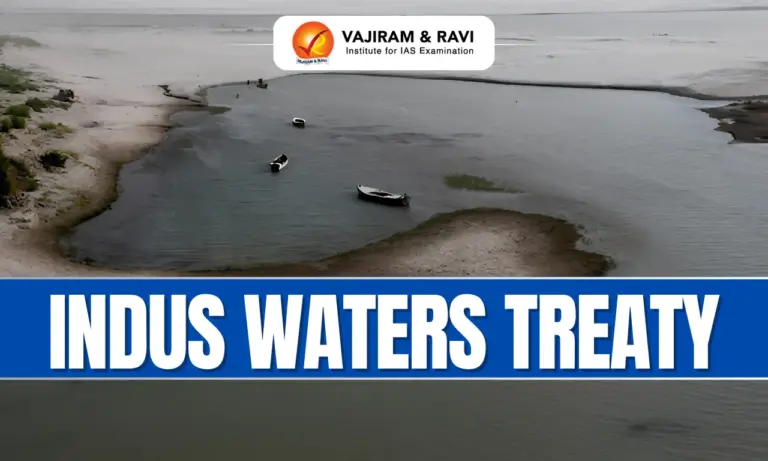
- The Permanent Court of Arbitration (PCA), The Hague, has ruled that the 1960 Indus Waters Treaty (IWT) between India and Pakistan remains “fully in force” and that India must continue observing its obligations under the treaty.
- India, however, has categorically rejected the ruling, maintaining that the Court of Arbitration itself was constituted in violation of the IWT and therefore has no jurisdiction over India.
- The dispute marks a significant escalation in the long-standing India–Pakistan contest over transboundary water governance, hydroelectric projects and the interpretation of the IWT.
Indus Waters Treaty – A Brief Framework
- The IWT, brokered by the World Bank in 1960, allocates the six Indus-system rivers between the two countries:
- Eastern rivers — Ravi, Beas and Sutlej: primarily allocated to India.
- Western rivers — Indus, Jhelum and Chenab: primarily allocated to Pakistan, while India retains specified rights for domestic use, irrigation and run-of-the-river hydropower projects.
- The treaty also establishes mechanisms for resolving disputes, including a Permanent Indus Commission, Neutral Expert and Court of Arbitration, depending upon the nature of the dispute.


What Has the Hague Court Ruled?
- The Court issued two decisions on August 31, 2026.
- Status of the Treaty:
- India announced on April 23, 2025, following the Pahalgam terror attack, that the IWT would remain in “abeyance” until Pakistan “credibly and irrevocably” ended its support for cross-border terrorism.
- The Court held that –
- The IWT does not provide for unilateral suspension or termination by either party.
- “Abeyance” cannot be used to suspend the treaty’s operation.
- The treaty remains binding unless India and Pakistan jointly modify or terminate it through a subsequent treaty.
- India’s cited grounds—including terrorism, sovereignty, material breach, demographic and technological changes, climate change and armed conflict—did not legally justify suspension or termination.
- Consequently, the Court held that India remains bound by treaty obligations concerning its hydroelectric projects on the Western Rivers and the treaty’s dispute-settlement mechanisms.
- Ratle Hydroelectric Project:
-
- The Court also imposed interim measures concerning the Ratle Hydro-Electric Plant (RHEP) on the Chenab.
- India has been directed to temporarily refrain from concreting the dam wall and power-intake structure above specified levels and to report changes to the construction schedule.
- These restrictions are to continue until 90 days after the Neutral Expert’s final decision, expected around July 2027.
Why Does India Reject the Court?
- India has never participated in the Court of Arbitration proceedings and disputes its very constitution.
- New Delhi argues that –
- The Court was established by the World Bank in breach of the IWT.
- Pakistan’s invocation of the Court created parallel proceedings on issues that were already before the Neutral Expert.
- The treaty does not permit simultaneous dispute-resolution mechanisms for the same questions.
- The Court therefore lacks jurisdiction to rule upon India’s sovereign decisions.
- India has consequently described the Court’s pronouncements as “null and void” and reiterated that its decision to keep the IWT in abeyance remains operative.
The Ratle-Kishenganga Dispute
- Pakistan has challenged design features of India’s Ratle and Kishenganga hydroelectric projects, arguing that they violate the IWT’s restrictions on India’s use of the Western Rivers.
- These disputes involve highly technical issues such as reservoir storage/pondage, dam design and operational parameters.
- A Neutral Expert, appointed through the World Bank mechanism at India’s request, was separately examining technical questions.
- India argues that this mechanism is the treaty-consistent route, whereas the Court of Arbitration represents an impermissible parallel process.
Strategic and Geopolitical Significance
- Water as a strategic instrument:
- Pakistan is heavily dependent on the Indus river system; the rivers covered by the treaty support a substantial share of its agriculture and water security.
- Consequently, any alteration in India’s approach to the treaty has significant implications for Pakistan’s food security, irrigation and economy.
- India’s security argument:
- India’s position reflects the linkage it has drawn between cross-border terrorism and bilateral agreements, particularly after the Pahalgam attack.
- New Delhi has repeatedly argued that “blood and water cannot flow together” and has maintained that the treaty requires reconsideration because circumstances have changed substantially since the 1950s.
International Legal Challenge
- The episode highlights a larger question of treaty law versus unilateral sovereign action.
- While the PCA has interpreted the IWT according to its legal provisions, India disputes the tribunal’s jurisdiction itself.
- Thus, the immediate issue is not merely water allocation but also the legitimacy and applicability of the dispute-settlement mechanism.
What Lies Ahead?
- The ruling is unlikely to immediately resolve the dispute because India does not recognise the tribunal’s jurisdiction.
- The central contest is therefore likely to continue through –
- India’s continued implementation of its “abeyance” position;
- Pakistan’s efforts to internationalise the issue;
-
- Parallel proceedings involving the Neutral Expert;
- Disputes over Indian hydroelectric projects on the Western Rivers; and
- Broader negotiations over the future of the IWT.

 Last updated on August, 2026
→ UPSC Mains 2026 commenced on 21st August 2026 and will continue through 30th August 2026, as per the official examination schedule.
→ UPSC Mains Question Paper 2026 is out now for Essay & GS Paper 1, 2, 3 & 4.
→ UPSC Mains GS Paper 1 2026 is out now.
→ UPSC Mains GS Paper 2 2026 is out now.
→ UPSC Mains GS Paper 3 2026 is out now.
→ UPSC Mains GS Paper 4 2026 is out now.
→ UPSC Mains Indian Language Paper & English Compulsory Paper are out now.
→ Check out the latest UPSC Syllabus 2026 here.
→ UPSC Mains Admit Card 2026 is now out.
→ Enroll in Vajiram & Ravi’s UPSC Mains Test Series 2027 for structured answer writing practice, expert evaluation, and exam-oriented feedback.
→ Join Vajiram & Ravi’s UPSC Mentorship Program 2027 for personalized guidance, strategy planning, and one-to-one support from experienced mentors.
→ Go through the UPSC Mains Previous Year Papers to enhance your preparation.
→ Download UPSC Mains Essay Paper 2025, UPSC Mains GS Paper-I 2025, UPSC Mains GS Paper-II 2025, UPSC Mains GS Paper-III 2025, UPSC Mains GS Paper-IV 2025, UPSC Mains English (Compulsory) Paper 2025, UPSC Mains Hindi (Qualifying) Paper 2025 here.
→ UPSC has released UPSC Toppers List 2025 with the Civil Services final result on its official website.
→ UPSC Calendar 2027 has been released.
→ Also check Best UPSC Coaching in India
Indus Waters Treaty FAQs
Q1. What are the key provisions of the Indus Waters Treaty (IWT) governing the use of the Indus river system?+
Q2. Why has India rejected the recent Permanent Court of Arbitration ruling on the IWT?+
Q3. What is the significance of the Ratle Hydroelectric Project in the India–Pakistan water dispute?+
Q4. How does the IWT illustrate the complexities of international water diplomacy?+
Q5. What are the broader strategic implications of India keeping the IWT in abeyance?+
Tags: indus waters treaty (iwt)