NVS-03 Satellite Latest News
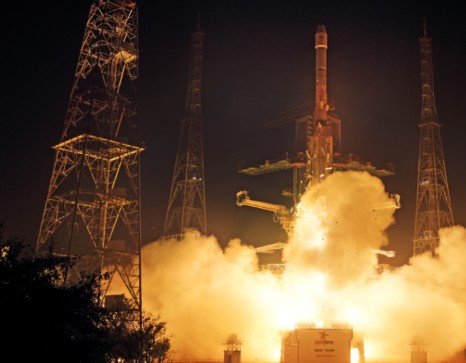
- ISRO successfully launched NVS-03, its third new-generation navigation satellite, aboard GSLV-F18 from the Satish Dhawan Space Centre, Sriharikota.
- The launch is crucial: NavIC, India’s regional satellite navigation system, had stopped providing positioning data after repeated atomic clock failures and failed replacement satellite launches.
- NVS-03 aims to restore the minimum four operational satellites NavIC needs to function.
What Is NavIC?
- NavIC (Navigation with Indian Constellation) is the operational name for the Indian Regional Navigation Satellite System (IRNSS).
- A seven-satellite constellation covering India and up to 1,500 km beyond its borders — similar in concept to the US’s GPS, but regional rather than global.
- With all satellites functional, it offers public accuracy up to 10 metres, plus a more accurate restricted service (for authorised users like the military) — roughly ten times more precise.
- Origins: Development began in 1999, after the Kargil War, when the US reportedly restricted GPS data access to India — exposing the risks of depending on a foreign-controlled navigation system during conflict.
- Applications: Civilian navigation, transportation, disaster management, telecommunications, financial clock synchronisation, and real-time tracking of ~12,000 trains (8,700 already equipped).
- NavIC also offers better coverage over Indian terrain (valleys, forests) compared to GPS, whose signals arrive at India at an angle.


Why NavIC Stopped Working
- Since July 2013, ISRO has launched 11 navigation satellites — but six have failed, mainly due to defective imported atomic clocks and some orbital issues.
- July 2025: Five satellites were found completely defunct, with all onboard clocks non-functional.
- March 2026: The last functioning clock aboard IRNSS-1F failed — just three days after completing its 10-year mission life — leaving only three operational satellites (minimum four needed for positioning service).
- Government told Parliament the constellation cannot provide standalone positioning service, though timing service remained functional.
- Delayed consumer rollout: A 2018 CAG report found that development of consumer-end receivers (for devices like phones) began only in 2017 — wasting years of satellite mission life.
Replacement Failures
- IRNSS-1H couldn’t reach orbit — its heat shield failed to open.
- NVS-02 (January 2025) was placed in transfer orbit but its thrusters/propulsion system failed, preventing it from reaching final orbit.
- A review committee found the cause: a signal failing to reach the pyro valve of the oxidiser line, likely due to a disengaged connector contact (“loose connection”).
What’s Different About NVS-03 and the Second-Generation Satellites
- Carry at least one indigenously developed rubidium atomic clock (by ISRO’s Space Applications Centre), replacing imported clocks from Swiss firm SpectraTime.
- Longer mission life: 12 years (vs. 10 for first-generation satellites).
- Added L1 frequency band (alongside existing L5, S frequencies) — improves interoperability with GPS and enables use in low-power devices like smartwatches.
- ISRO plans to increase atomic clocks per satellite from 3 to 5 for added redundancy.
- Launch details: GSLV-F18 placed the 2,250 kg NVS-03 satellite into its intended geosynchronous transfer orbit within 18 minutes of liftoff.
- Pipeline: NVS-04 and NVS-05 are expected to follow, purportedly by December 2026, to fully restore the constellation.
Deeper Structural Challenges
- Indigenous clock supply issues: Despite moving to domestic rubidium clocks, procurement of flight-ready equipment remains unreliable.
- Institutional gap: Unlike the US GPS Directorate or the EU Agency for the Space Programme, ISRO acts as both designer and operator of NavIC, with no dedicated counterpart agency.
- Resource strain: ISRO simultaneously juggles human spaceflight, Earth observation, new launch vehicles, and R&D — alongside the absence of a national space law.
- Broader launch setbacks: Two consecutive PSLV failures (May 2025 — EOS-09; January 2026 — N1 satellite) forced a pause. Of seven major missions scheduled since December 2025, only two succeeded before NVS-03.
How NavIC Compares Globally
- India is the only country with a regional-only navigation system; Japan’s Quasi-Zenith Satellite System merely augments GPS in Asia-Oceania.
- Four global systems exist: GPS (USA, ~32 satellites), GLONASS (Russia, 24), Galileo (EU, 27), BeiDou (China, 30).
- Most use middle-earth orbit (19,000-24,000 km); BeiDou uniquely combines middle and higher orbits — NavIC, like Japan’s system, uses higher orbits.
Conclusion
- NVS-03’s successful launch marks a critical, if partial, step toward restoring NavIC’s operational capability after a string of technical setbacks exposed deep vulnerabilities in India’s indigenous navigation ambitions.
- Beyond the immediate fix of adding a functional satellite, the episode highlights structural issues — ISRO’s dual role as both builder and operator, reliance on still-maturing indigenous clock technology, and an overstretched space agency juggling multiple missions simultaneously.
- With NVS-04 and NVS-05 expected by December 2026, India’s path to a fully self-reliant, strategically significant regional navigation system remains promising but incomplete — a reminder that technological sovereignty in space requires not just successful launches, but sustained institutional and manufacturing reliability.

 Last updated on Oct, 2026
→ UPSC 2027 Notification will be released on 13 January 2027 at upsconline.nic.in.
→ Check Nobel Prize 2026 Winners List here.
→ Download PIB PRiSM Monthly Magazine 2026 here.
→ Check UPSC Monthly Current Affairs Magazine The Recitals here.
→ Check out the latest UPSC Syllabus here.
→ Download UPSC Model Answers for Mains 2026
→ UPSC Mains Question Paper 2026 is out now for Essay & GS Paper 1, 2, 3 & 4.
→ UPSC Calendar 2027 has been released.
→ Enroll in Vajiram & Ravi’s UPSC Mains Test Series 2027 for structured answer writing practice, expert evaluation, and exam-oriented feedback.
→ Join Vajiram & Ravi’s UPSC Mentorship Program 2027 for personalized guidance, strategy planning, and one-to-one support from experienced mentors.
→ Go through the UPSC Mains Previous Year Papers to enhance your preparation.
→ UPSC has released UPSC Toppers List 2025 with the Civil Services final result on its official website.
→ Also check Best UPSC Coaching in India
NVS-03 Satellite FAQs
Q1. What is the NVS-03 satellite? +
Q2. Why is the NVS-03 satellite important for NavIC? +
Q3. What are the key technological improvements in the NVS-03 satellite? +
Q4. How does the NVS-03 satellite improve India’s navigation independence? +
Q5. What challenges remain after the NVS-03 satellite launch? +
Tags: mains articles NVS-03 satellite upsc current affairs upsc mains current affairs