E100 Vehicle Rules Latest News
- The Ministry of Road Transport and Highways has amended the Central Motor Vehicles Rules, 1989, to permit the use of fuels containing up to 100% ethanol (E100), enabling the regulatory pathway for flex-fuel vehicles in India.
Understanding Ethanol-Blended Fuels
- Ethanol is an alcohol-based fuel produced through the fermentation of plant biomass, including sugarcane, maize and broken rice. It can be blended with petrol in different proportions to reduce dependence on conventional fossil fuels.
- Ethanol blending is represented through an ‘E’ classification, indicating the percentage of ethanol in the fuel.
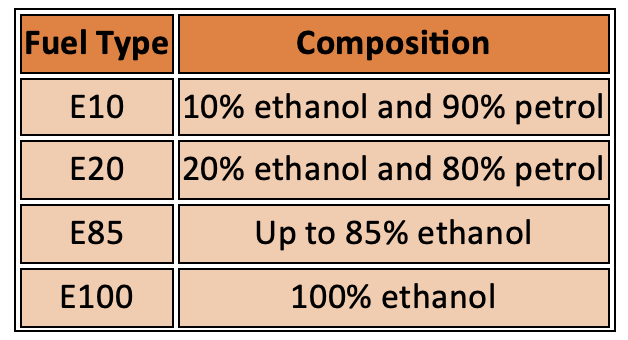
- The use of higher ethanol blends requires specially designed engines and compatible vehicle components.


New E100 Vehicle Rules
- The Ministry of Road Transport and Highways has amended the Central Motor Vehicles Rules, 1989, to include E100 alongside E85 in several tables under Rule 115, which deals with emission standards and related requirements for motor vehicles.
- A key provision clarifies that E85 and E100 can be used only in flex-fuel vehicles designed by original equipment manufacturers (OEMs).
- The amendment establishes the regulatory basis for introducing vehicles capable of operating on petrol, varying ethanol blends and pure ethanol. It does not mean that all existing petrol vehicles can use these fuels.
No Mandatory Conversion for Existing Vehicles
- The Ministry has clarified that owners of existing vehicles are not required to switch to E85 or E100 or modify their vehicles.
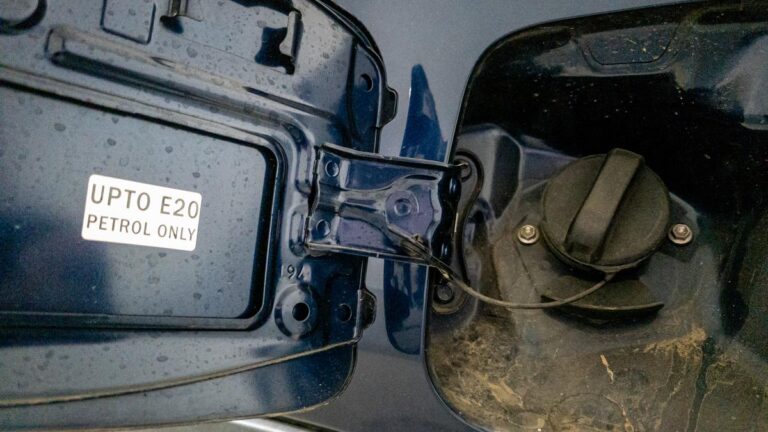
- Compatibility with E10 or E20 does not automatically establish compatibility with E85 or E100.
- Motorists must check their vehicle’s fuel-compatibility sticker and follow the manufacturer’s instructions in the owner’s manual.
- This distinction is important because higher ethanol concentrations can require specialised engine components and fuel-system materials.
Flex-Fuel Vehicles and Their Significance
- Flex-fuel vehicles are designed to operate on petrol, ethanol blends of varying proportions or pure ethanol, depending on their technical specifications.
- The regulatory amendment is expected to facilitate homologation, the official certification process through which authorised agencies, such as the Automotive Research Association of India (ARAI), verify compliance with technical, safety and environmental standards.
- This will enable type approval for E100-powered vehicles and support their introduction and wider consumer adoption.
- The amendment also corrects fuel classifications by incorporating a reference to E20 in place of an earlier E10 notation in the relevant provisions.
India’s Ethanol Blended Petrol Programme
- India’s Ethanol Blended Petrol (EBP) Programme aims to reduce dependence on imported crude oil, promote domestic biofuel production and diversify the country’s energy mix.
- The National Policy on Biofuels, 2018, originally envisaged achieving 20% ethanol blending by 2030. India achieved the E20 target in 2025, five years ahead of the original deadline.
- From April 2026, all Bharat Stage-VI (BS-VI) vehicles are required to fully meet E20 emission standards, while petrol sold across India is mandated to contain 20% ethanol.
- The policy focus is now expanding beyond E20, with the regulatory pathway for E85 and E100 vehicles being enabled. However, their adoption will require compatible flex-fuel vehicles and suitable fuel-storage and dispensing infrastructure.
Consumer Concerns and Challenges
- Despite the potential benefits of ethanol blending, the transition has raised several technical, economic and environmental concerns.
- Vehicle Compatibility and Maintenance
- Owners of older or non-E20-compliant vehicles have expressed concerns about possible damage to engine components, increased maintenance costs and the availability of lower-ethanol petrol.
- The use of higher ethanol blends in vehicles not designed for them can create compatibility and performance problems.
- Fuel Efficiency
- Ethanol has a lower energy density than conventional petrol. Consequently, vehicles running on ethanol-blended fuel may deliver lower mileage.
- The government estimates a decline of approximately 5% in fuel efficiency, although some consumers report greater reductions.
- Storage and Contamination
- Ethanol has an affinity for water, raising concerns about fuel contamination, particularly during the monsoon. This strengthens the case for appropriate storage, handling and separate dispensing infrastructure for higher ethanol blends.
- Impact on Retail Fuel Prices
- Consumers have questioned why increased ethanol blending has not translated into lower retail petrol prices.
- The government has argued that ethanol procurement costs can be relatively high. For instance, maize-based ethanol procurement was cited at ₹71.86 per litre, compared with an estimated ₹37-₹40 per litre equivalent for crude oil priced at $70 per barrel.
- Food Security and Environmental Concerns
- Large-scale ethanol production requires substantial land and water resources. The choice of agricultural feedstock also raises concerns about competition between food production and fuel production.
- The expansion of ethanol production must therefore consider agricultural sustainability, water availability and the potential impact on food security.
Source : TH

 Last updated on Oct, 2026
→ UPSC 2027 Notification will be released on 13 January 2027 at upsconline.nic.in.
→ Check Nobel Prize 2026 Winners List here.
→ Download PIB PRiSM Monthly Magazine 2026 here.
→ Check UPSC Monthly Current Affairs Magazine The Recitals here.
→ Check out the latest UPSC Syllabus here.
→ Download UPSC Model Answers for Mains 2026
→ UPSC Mains Question Paper 2026 is out now for Essay & GS Paper 1, 2, 3 & 4.
→ UPSC Calendar 2027 has been released.
→ Enroll in Vajiram & Ravi’s UPSC Mains Test Series 2027 for structured answer writing practice, expert evaluation, and exam-oriented feedback.
→ Join Vajiram & Ravi’s UPSC Mentorship Program 2027 for personalized guidance, strategy planning, and one-to-one support from experienced mentors.
→ Go through the UPSC Mains Previous Year Papers to enhance your preparation.
→ UPSC has released UPSC Toppers List 2025 with the Civil Services final result on its official website.
→ Also check Best UPSC Coaching in India
E100 Vehicle Rules FAQs
Q1. What is E100 fuel?+
Q2. What are flex-fuel vehicles?+
Q3. Do existing petrol vehicles need to switch to E85 or E100?+
Q4. What is India's E20 target?+
Q5. What is vehicle homologation?+
Tags: E100 Vehicle Rules mains articles upsc current affairs upsc mains current affairs