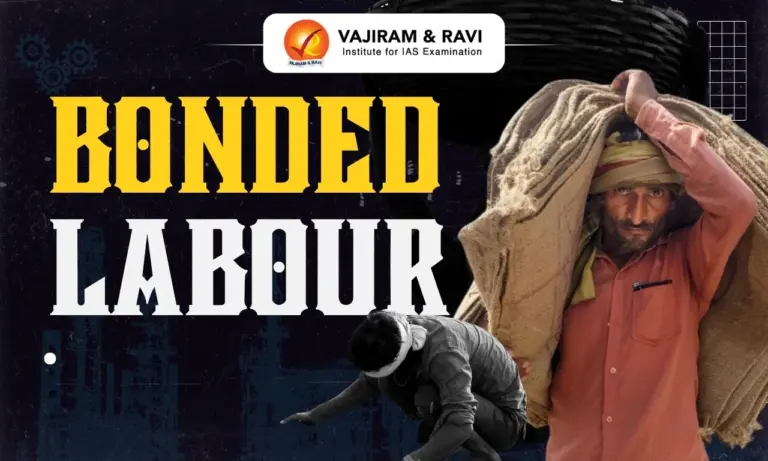
Bonded labour is a form of forced labour in which a person is made to work to repay a loan or debt, often for very low or no wages. It can trap individuals and families in long periods of exploitation, especially when they have limited access to education, stable employment and formal sources of credit. Although Bonded Labour is prohibited in India, poverty, debt, lack of awareness and weak enforcement can allow the practice to continue in some sectors. It is therefore not only a labour issue but also a serious concern related to human dignity, social justice and basic rights.
What is Bonded Labour?
- Bonded labour refers to a situation where a person is forced to work to repay a loan or debt, often receiving little or no wages. The worker may have very limited freedom to leave the job until the debt is considered repaid.
- The National Commission on Labour has described Bonded Labour as labour performed under bondage for a specific period against a debt incurred by the worker.
- In many cases, the debt becomes a means of controlling the worker rather than simply a financial obligation.
- People may enter Bonded Labour after being misled about wages or working conditions. Workers can also be trapped by excessive charges for recruitment, accommodation, food, transportation or other basic needs.
- In such situations, most or all of the worker’s earnings may be used to repay the so-called loan. Because the debt can continue to increase through high interest or additional charges, workers may remain trapped for years.
- Bonded labour can also affect entire families. In some cases, family members work together to repay a debt, while children may also be forced to work. In extreme situations, the debt may pass from one generation to another.
- Workers facing debt bondage may be threatened with violence, intimidation or legal consequences if they try to leave.
- Bonded labour is closely linked with other forms of modern slavery, including human trafficking, forced labour and exploitation of vulnerable workers.
- Globally, debt bondage remains a significant form of forced labour. According to estimates from 2022, around one-fifth of people experiencing forced labour exploitation in the private economy were in situations involving debt bondage.
Causes and Forms of Bonded Labour in India
- Poverty and financial insecurity: Poor families with limited access to formal credit may borrow money from employers, contractors or informal lenders. This can create a cycle in which repayment becomes extremely difficult.
- Lack of access to formal employment and credit: People who cannot easily access banks, formal loans or stable employment are more vulnerable to exploitative loans and recruitment arrangements.
- Recruitment-related debt: Labour brokers and recruitment agencies may charge workers high fees for securing employment, training, transportation or other services. Workers can then become trapped because they must repay these costs from their wages.
- Low wages and unfair deductions: Workers may receive very low wages, while large amounts are deducted for food, accommodation, transport or other expenses. As a result, their earnings may never be enough to clear the debt.
- Lack of education and awareness: Limited education and awareness about labour rights can make workers more vulnerable to false promises, exploitative contracts and fraudulent recruitment practices.
- Weak enforcement of laws: Although Bonded Labour is prohibited by law, poor implementation, local-level corruption and limited access to justice can allow the practice to continue.
- Social discrimination: Vulnerable and marginalised communities may face greater risks because of poverty, discrimination, limited employment opportunities and poor access to public services.
- Common sectors: Bonded Labour has been reported particularly in sectors such as agriculture, brick kilns, mines, mills and factories. Migrant workers can also be vulnerable when they depend heavily on labour contractors.
- Bonded child labour: Children may become involved when families are trapped in debt. Sometimes employers present child labour as an “apprenticeship”, making exploitation less visible.
- Gender-based vulnerability: Women and girls can face additional risks because of gender discrimination, unequal access to education and employment, and their dependence on household income.
- Family and inherited debt: In some cases, a debt taken by one family member becomes the responsibility of the entire household. Children may eventually be forced to work to repay debts that were originally taken by their parents.
- Historical roots: Bonded and indentured labour has existed for centuries. After the abolition of the transatlantic slave trade in the 19th century, many formerly enslaved people were subjected to forms of indentured labour and debt bondage in plantations across parts of Africa, the Caribbean and Southeast Asia.


Constitutional and Legal Provisions Against Bonded Labour
The Constitution and various laws provide safeguards to prevent Bonded Labour and protect workers from exploitation. The key provisions are discussed below.
Constitutional Provisions
- Article 21: Guarantees the right to life and personal liberty. The right to live with human dignity has also been recognised as an important part of this protection.
- Article 23: Prohibits human trafficking, begar and other forms of forced labour. It is one of the most important constitutional safeguards against Bonded Labour.
- Article 24: Prohibits the employment of children below 14 years in factories, mines and hazardous occupations, helping protect children from exploitative labour.
- Article 42: Directs the State to ensure just and humane conditions of work.
- Article 43: Calls for conditions that provide workers with a living wage and decent working conditions.
- Article 46: Directs the State to promote the educational and economic interests of Scheduled Castes, Scheduled Tribes and other weaker sections and protect them from social injustice and exploitation.
Major Laws Related to Bonded Labour
- Bonded Labour System (Abolition) Act, 1976: This is the principal law dealing with Bonded Labour in India. It abolishes the Bonded Labour system, frees Bonded Labourers from their debt obligations and prohibits the creation of new Bonded Labour arrangements.
- The Act also provides for Vigilance Committees at different administrative levels to help identify Bonded Labourers, secure their release and support their rehabilitation.
- Child and Adolescent Labour (Prohibition and Regulation) Act, 1986, as amended in 2016: Prohibits the employment of children below 14 years and restricts adolescents between 14 and 18 years from working in hazardous occupations and processes.
- Juvenile Justice (Care and Protection of Children) Act, 2015: Provides mechanisms for the care, protection, rehabilitation and social reintegration of children who are vulnerable or in need of protection.
- Bharatiya Nyaya Sanhita (BNS), 2023: Contains provisions dealing with unlawful compulsory labour, strengthening the criminal-law framework against forced labour practices.
International Framework
- UN Convention on the Rights of the Child, 1989: Protects children from economic exploitation and work that is harmful to their health, education or development.
- ILO Convention No. 182: Deals with the worst forms of child labour, including forms of exploitation that threaten children’s safety and dignity. India has ratified the Convention.
- ILO Forced Labour Convention, 1957: Seeks to eliminate forced or compulsory labour and strengthen international efforts against labour exploitation.
Government Measures to Eliminate Bonded Labour in India
- Central Sector Scheme for Rehabilitation of Bonded Labourers: The government provides assistance for the rehabilitation of people rescued from Bonded Labour. Financial support can vary depending on the nature and severity of the case, along with non-cash assistance such as housing, land, livelihood support and other rehabilitation measures.
- Identification and rescue: State governments and district-level authorities are responsible for identifying Bonded Labourers, securing their release and taking steps towards their rehabilitation.
- Vigilance Committees: These committees help authorities identify cases of Bonded Labour, monitor implementation of the law and support the rehabilitation of released workers.
- Strengthening law enforcement: Effective implementation of the Bonded Labour System (Abolition) Act, 1976 is essential. Better coordination between labour departments, police, district administrations and other agencies can help detect cases and take timely action.
- Education and skill development: Providing children with regular access to education and skill development can reduce their dependence on labour and create better livelihood opportunities for vulnerable families.
- Social security support: Schemes such as the Public Distribution System (PDS) and employment programmes can provide greater economic security to poor households and reduce their dependence on exploitative borrowing.
- Direct financial assistance: Timely financial support and direct transfers can help vulnerable families meet basic needs without relying on high-interest loans or exploitative employers.
- Awareness campaigns: Workers need to be informed about their legal rights, minimum wages, recruitment practices and available government support so that they can identify and report exploitation.
- Role of NGOs: NGOs and civil society organisations can assist in identification, rescue, rehabilitation and social reintegration of Bonded Labourers, particularly in areas where government outreach is limited.
- Protection of migrant workers: Stronger monitoring of labour contractors and recruitment agencies, along with better documentation and grievance mechanisms, can reduce the exploitation of migrant workers.
- Action against modern forms of bondage: Government efforts also need to address newer forms of exploitation, including forced recruitment, domestic servitude, forced marriage and organised begging.
Status of Bonded Labour and Modern Slavery in India
- According to the Global Slavery Index 2023, India was estimated to have around 11 million people living in modern slavery. Modern slavery includes forced labour, debt bondage, forced marriage, human trafficking and other slavery-like practices.
- India has the highest estimated number of people living in modern slavery globally, while its prevalence rate was ranked 34th among 160 countries in the Global Slavery Index 2023.
- The persistence of Bonded Labour shows that legal prohibition alone is not sufficient. Poverty, informal employment, lack of awareness, discrimination and weak enforcement can continue to create conditions for exploitation.
- The COVID-19 pandemic also increased vulnerability to debt bondage in some situations, as many workers faced loss of income and had difficulty accessing formal sources of credit.
Measures to Eliminate Bonded Labour in India
- Improve enforcement: Laws should be implemented effectively at the local level, with stronger accountability for officials and employers involved in exploitation.
- Break the cycle of poverty: Better access to employment, social security, education, healthcare and formal credit can reduce the economic conditions that push families towards debt bondage.
- Strengthen rehabilitation: Rescue should be followed by proper financial, social and livelihood rehabilitation so that released workers do not fall back into exploitative employment.
- Improve inter-state coordination: Since labour trafficking can cross state borders, government agencies should improve information sharing, tracking and coordination between states.
- Protect children: Stronger monitoring of vulnerable families, schools and workplaces can help prevent children from being drawn into Bonded Labour.
- Empower workers: Greater awareness of labour rights, minimum wages and grievance mechanisms can help workers recognise exploitation and seek timely assistance.
- Strengthen community participation: Local communities, NGOs, labour organisations and government agencies should work together to make Bonded Labour socially unacceptable and easier to identify.
- Ensure access to justice: Victims should be able to report exploitation safely and receive legal assistance without fear of retaliation, violence or further economic hardship.

 Last updated on Oct, 2026
→ UPSC 2027 Notification will be released on 13 January 2027 at upsconline.nic.in.
→ Check Nobel Prize 2026 Winners List here.
→ Download PIB PRiSM Monthly Magazine 2026 here.
→ Check UPSC Monthly Current Affairs Magazine The Recitals here.
→ Check out the latest UPSC Syllabus here.
→ Download UPSC Model Answers for Mains 2026
→ UPSC Mains Question Paper 2026 is out now for Essay & GS Paper 1, 2, 3 & 4.
→ UPSC Calendar 2027 has been released.
→ Enroll in Vajiram & Ravi’s UPSC Mains Test Series 2027 for structured answer writing practice, expert evaluation, and exam-oriented feedback.
→ Join Vajiram & Ravi’s UPSC Mentorship Program 2027 for personalized guidance, strategy planning, and one-to-one support from experienced mentors.
→ Go through the UPSC Mains Previous Year Papers to enhance your preparation.
→ UPSC has released UPSC Toppers List 2025 with the Civil Services final result on its official website.
→ Also check Best UPSC Coaching in India
Bonded Labour FAQs
Q1. What is Bonded Labour?+
Q2. What are the main causes of Bonded Labour in India?+
Q3. Which Article of the Indian Constitution prohibits Bonded Labour?+
Q4. What is the Bonded Labour System (Abolition) Act, 1976?+
Q5. What is the role of Vigilance Committees in preventing Bonded Labour?+
Q6. Which constitutional provisions protect workers from exploitation?+
Q7. Which laws in India deal with bonded and forced labour?+
Q8. Which sectors are commonly associated with Bonded Labour in India?+
Q9. What measures has the government taken to eliminate Bonded Labour in India?+
Tags: bonded labour indian polity indian polity notes