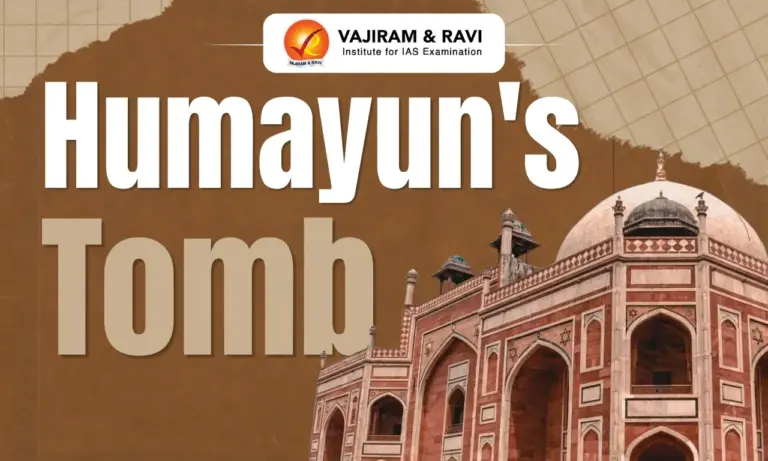
Humayun’s Tomb is located in Nizamuddin East, Delhi. It is a landmark of early Mughal architecture. It was commissioned by Empress Bega Begum after Emperor Humayun’s death. The monument introduced the large scale garden tomb concept to the Indian subcontinent. Its Persian design elements were combined with Indian craftsmanship. The complex later influenced the development of Mughal architecture, including the Taj Mahal.
Humayun’s Tomb History
Humayun’s Tomb emerged from the Mughal tradition of commemorating rulers through monumental mausoleums and carefully planned gardens.
- Commissioning: Empress Bega Begum, also known as Haji Begum, commissioned the tomb after Humayun’s death. Construction began in 1565 and was completed in 1572.
- Architects: Persian architect Mirak Mirza Ghiyas designed the monument with his son Sayyid Muhammad. Persian and Indian craftsmen worked together on the project.
- Construction Cost: The monument was constructed at a cost of 1.5 million rupees. The entire expenditure was funded by Empress Bega Begum.
- Historical Setting: Humayun was initially buried at his palace in Purana Qila. His remains were later moved to Sirhind before the construction of the present mausoleum.
- Later History: During the Revolt of 1857 uprising, Bahadur Shah Zafar took refuge at Humayun’s Tomb with three princes. He was later captured and exiled to Rangoon.
- Garden Decline: The original Charbagh deteriorated during the 18th century. Parts of the garden were converted into vegetable cultivation areas as Mughal political and financial power declined.
- Colonial Alteration: British authorities changed the garden design in 1860. The original Mughal layout was restored during a major project between 1903 and 1909 under Lord Curzon.
- Partition Impact: During the Partition of India in 1947, the monument and nearby Purana Qila became refugee camps. The occupation damaged gardens, water channels and parts of the historic setting.
Humayun’s Tomb
Humayun’s Tomb forms the centre of a major heritage complex containing several Mughal and pre Mughal monuments, gardens and associated structures.
- Location: The monument is located in Nizamuddin East, Delhi, near the Yamuna and the Nizamuddin Dargah. It stands close to Purana Qila, associated with Humayun’s Dinapanah.
- Garden Tomb: The monument is the first major garden tomb of the Mughal tradition in the Indian subcontinent. Its monumental scale established a model for later imperial mausoleums.
- Complex: The 27.04 hectare World Heritage property contains Humayun’s Tomb and other monuments, including Isa Khan’s Tomb, Nila Gumbad, Bu Halima, Afsarwala, Barber’s Tomb and Arab Serai.
- Royal Burials: The complex contains more than 100 graves and is popularly called the “Dormitory of the Mughals”. Several Mughal rulers and members of the imperial family are buried here.
- Religious Setting: The tomb stands near the shrine of Hazrat Nizamuddin Auliya. The area developed into a major concentration of medieval Islamic monuments because burial near the saint was considered auspicious.
- Conservation: The Aga Khan Trust for Culture and Archaeological Survey of India began major conservation work after extensive research. The programme restored monuments, gardens, water channels and traditional building techniques.
- Garden Restoration: The restoration replanted about 12 hectares of gardens with more than 2,500 trees and plants. Historic water circulation was also revived.
- Protection: The monument is protected through Indian heritage and urban laws. Its conservation is managed through cooperation between the Archaeological Survey of India and the Aga Khan Trust for Culture.
- Conservation Challenge: Modern construction, visitor pressure, encroachments and inappropriate materials have posed risks. Conservation therefore focuses on traditional materials, structural stability and controlled visitor management.
- Storm Damage: A heavy storm damaged the dome finial on 30 May 2014. The restored finial was unveiled on 19 April 2016, while the original was preserved in the site museum.


Humayun’s Tomb Architecture
Humayun’s Tomb combines Persian planning with Indian architectural features and established several elements that became characteristic of later Mughal monuments.
- Overall Form: The mausoleum is a red sandstone, double storeyed structure standing on a high terrace. Its chamfered corners create an essentially octagonal visual character.
- Terrace: The monument rises from a terrace about 7 metres high. The terrace contains vaulted cells and provides the massive elevated base characteristic of the monument.
- Double Dome: The central dome rises to about 42.5 metres. Its double shell construction supports the exterior marble surface while creating a spacious interior chamber.
- Materials: Red sandstone dominates the structure, while white and black marble provide borders, panels, screens, flooring and decorative details. Yellow sandstone adds further contrast.
- Chhatris: Pillared kiosks or chhatris surround the central dome. These features reflect Indian architectural traditions and give the monument a distinctive pyramidal appearance.
- Charbagh: The garden follows the Persian Charbagh concept. Four major divisions are created by intersecting pathways and water channels representing the four rivers associated with the Islamic concept of paradise.
- Interior Plan: The central octagonal chamber is surrounded by interconnected chambers and corridors. The repeated geometric arrangement creates a highly symmetrical ninefold plan.
- Jaalis: Perforated stone screens regulate light and air while adding decorative detail. They are an important feature of the interior and exterior architectural composition.
- Isa Khan’s Tomb: Built in 1547, Isa Khan Niyazi’s octagonal tomb predates Humayun’s Tomb by about two decades. Its architecture shows the development of forms later used on a larger scale.
- Other Structures: The complex includes Bu Halima’s Tomb, Afsarwala Tomb and Mosque, Arab Serai, Nila Gumbad and Nai ka Gumbad or Barber’s Tomb.
Humayun’s Tomb UNESCO World Heritage Site
Humayun’s Tomb received international recognition for its architectural innovation, monumental scale, garden setting and importance in the evolution of Mughal architecture.
- Inscription: Humayun’s Tomb was declared a UNESCO World Heritage Site in 1993. The designation recognises its outstanding cultural and architectural importance.
- Architectural Influence: The monument represents an early major expression of Mughal garden tomb architecture. Its design established principles that later reached their highest expression in the Taj Mahal.
- Outstanding Value: Its combination of monumental architecture, Charbagh planning and integrated garden setting represented a major development in Islamic funerary architecture in India.
- Authenticity: The monument retains its original architectural form, design, materials and setting to a substantial degree. Conservation has relied on traditional materials and techniques.
- Conservation Partnership: Major conservation efforts have involved the Archaeological Survey of India and Aga Khan Trust for Culture. Restoration included gardens, structures, water systems and removal of unsuitable modern materials.
Humayun’s Tomb Museum
The Humayun’s Tomb World Heritage Site Museum presents the history of Humayun, Mughal culture, architecture and the wider Nizamuddin heritage landscape.
- Design: The underground museum follows a baoli inspired design. It includes a 100 seat auditorium, temporary galleries, cafés, meeting rooms and a library.
- Personal Artefacts: Displays include a pear shaped water vessel associated with Jauhar Aftabchi and a helmet reportedly used by Humayun as a cooking vessel during his travels to Persia.
- Mughal Coins: The collection includes coins representing the reigns of 18 Mughal era kings. Exhibits include coins associated with Akbar, Jahangir and Bahadur Shah Zafar.
- Bahadur Shah Zafar: The museum displays the throne of Bahadur Shah Zafar. Rare coins from his reign are also part of the collection.
- Cultural Heritage: The museum highlights Hazrat Nizamuddin Auliya, Amir Khusrau Dehalvi, Rahim and Dara Shikoh. These figures represent important religious, literary and cultural traditions of Nizamuddin.
- Conservation Context: The museum forms part of the wider conservation programme covering the Humayun’s Tomb Sunder Nursery Nizamuddin Basti area. Its collections include artefacts loaned from the National Museum for 10 years.
Who was Humayun?
Humayun was the second Mughal emperor and the eldest son of Babur. His reign was marked by military setbacks, exile, Persian influence and the eventual restoration of Mughal authority.
- Birth and Succession: Nasiruddin Muhammad Humayun succeeded Babur as emperor. He inherited an expanding empire but faced administrative difficulties and challenges from Afghan and regional powers.
- Siege of Chunar: In 1532, Humayun achieved victory against Afghan forces and besieged Chunar Fort. The campaign formed part of his efforts to consolidate Mughal authority.
- Battle of Chausa: Humayun was defeated by Sher Shah Suri at Chausa in 1539. He narrowly escaped the battlefield and subsequently faced increasing political pressure.
- Battle of Kannauj: In 1540, Sher Shah Suri defeated Humayun at Kannauj, also called the Battle of Bilgram. Humayun was forced into exile after the defeat.
- Exile: Humayun remained in exile for about fifteen years. During this period, he married Hamida Banu Begum and became the father of Akbar.
- Persian Support: Humayun sought assistance from the Shah of Persia. With Persian support, he captured Kandahar and Kabul in 1545.
- Cultural Influence: Humayun strengthened Persian cultural influence at the Mughal court. He brought Persian artists Mir Sayyid Ali and Abdal Samad to India and established the Nigaar Khana.
- Literary Record: Gul Badan Begum, Humayun’s sister, wrote the Humayun Nama. The work provides an important account of Humayun’s life, reign and family.
- Architecture: Humayun founded Dinapanah and supported architectural and cultural projects. His Persian experiences also influenced the architectural environment that developed during the Mughal period.
- Death: Humayun died in 1556. His death led to the eventual accession of his son Akbar, under whom the Mughal Empire expanded substantially.

 Last updated on Sep, 2026
→ UPSC 2027 Notification will be released on 13 January 2027 at upsconline.nic.in.
→ Check out the latest UPSC Syllabus 2026 here.
→ Download UPSC Model Answers for Mains 2026
→ UPSC Mains Question Paper 2026 is out now for Essay & GS Paper 1, 2, 3 & 4.
→ UPSC Calendar 2027 has been released.
→ Enroll in Vajiram & Ravi’s UPSC Mains Test Series 2027 for structured answer writing practice, expert evaluation, and exam-oriented feedback.
→ Join Vajiram & Ravi’s UPSC Mentorship Program 2027 for personalized guidance, strategy planning, and one-to-one support from experienced mentors.
→ Go through the UPSC Mains Previous Year Papers to enhance your preparation.
→ UPSC has released UPSC Toppers List 2025 with the Civil Services final result on its official website.
→ Also check Best UPSC Coaching in India
Humayun's Tomb FAQs
Q1. What is Humayun's Tomb?+
Q2. Who built Humayun's Tomb?+
Q3. When was Humayun's Tomb declared a UNESCO World Heritage Site?+
Q4. What is special about Humayun's Tomb Architecture?+
Q5. Which monuments are located in the Humayun's Tomb complex?+
Q6. Where is Humayun's Tomb located?+
Q7. What is the Charbagh garden at Humayun's Tomb?+
Q8. Who designed Humayun's Tomb?+
Tags: humayun's tomb