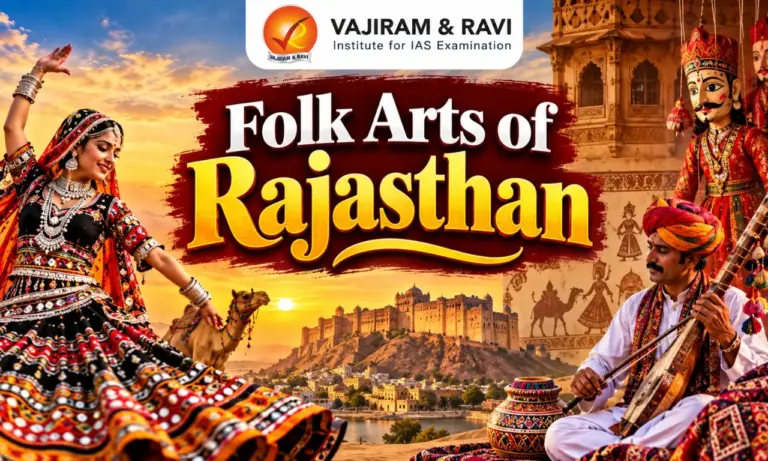
The Folk Arts of Rajasthan are closely connected with the state’s history, religious beliefs, festivals and way of life. Shaped by its desert environment and diverse communities, these traditions express local stories, devotion, social customs and everyday experiences. They have been preserved through generations and continue to play an important role in Rajasthan’s cultural and artistic identity.
Major Folk Arts of Rajasthan
Rajasthan has a wide variety of traditional art forms, ranging from folk paintings and puppetry to dances, music, textiles, pottery and handicrafts. Some of the most important forms are discussed below.
Folk Painting Traditions
Rajasthan has a rich painting tradition ranging from narrative scrolls used by travelling performers to devotional paintings and courtly miniature schools.
- Phad Painting: Phad is a large narrative scroll painting on cloth depicting the heroic stories of folk deities, especially Pabuji and Devnarayan. It is traditionally associated with the Bhopa priest-singer community, who narrate the stories through song and performance. Shahpura near Bhilwara is an important centre, with the Joshi family traditionally associated with its painting.
- Pichwai Painting: Pichwai is a devotional cloth painting tradition of Nathdwara. It is traditionally placed behind the image of Shrinathji, a form of Lord Krishna. Common themes include Krishna, cows, lotus flowers and religious festivals.
- Mewar School: The Mewar school of miniature painting developed around Udaipur and is known for bold colours and religious and literary themes.
- Bundi-Kota School: This school is known for hunting scenes, courtly life, animals and lush landscapes.
- Kishangarh School: The Kishangarh school is famous for the Bani Thani portrait, recognised by its elongated eyes, arched eyebrows and stylised facial features.
- Marwar School: Centred around Jodhpur, the Marwar school developed under Rajput court patronage and depicted religious, literary and courtly themes.
- Bikaner School: The Bikaner school shows strong Mughal and Deccani influences, reflecting the political and cultural connections of the Bikaner court.
- Mandana Painting: Mandana is a traditional wall and floor painting practised mainly by women. Geometric designs, animals and auspicious motifs are created during festivals and ceremonies.
Folk Puppetry and Theatre
- Kathputli: Kathputli is Rajasthan’s famous string-puppetry tradition, traditionally associated with the Bhat/Nat communities. The puppets are generally made of wood and controlled through strings. Stories of Amar Singh Rathore are among its popular themes. Nagaur is traditionally associated with its origins, while Kathputli Nagar in Jaipur is a major contemporary centre.
- Khyal: Khyal is a Rajasthani folk-theatre form combining dialogue, music and dance. It deals with themes such as heroism, romance and mythology. Kuchamani Khyal and Shekhawati Khyal are important regional forms.
- Rammat: Rammat is a folk-theatre tradition particularly associated with Bikaner. It combines storytelling, music, poetry and dance and is especially performed during festivals such as Holi.
- Bhavai: Bhavai combines dance, music and theatrical performance. A distinctive feature is the balancing of multiple pots on the performer’s head. The tradition is also associated with Gujarat.
Folk Dances of Rajasthan
The folk dances of Rajasthan are closely linked with festivals, weddings, religious ceremonies and community celebrations. Several dances are also associated with particular communities.
- Ghoomar: Ghoomar is a famous women’s folk dance involving graceful circular movements and swirling skirts. It is performed during weddings, festivals and other celebrations and was historically associated with the Bhil community.
- Kalbelia: Kalbelia is performed by women of the Kalbelia community, traditionally associated with snake charming. The dancers imitate the sinuous movement of a serpent. Kalbelia folk songs and dances of Rajasthan were inscribed on UNESCO’s Representative List of the Intangible Cultural Heritage of Humanity in 2010.
- Terah Taali: Terah Taali is traditionally performed by women of the Kamar/Kamad community while seated. The performers use 13 manjiras, or small cymbals, tied to different parts of the body.
- Chari Dance: Chari is performed by women while balancing decorated brass pots, sometimes containing a burning lamp, on their heads. It is associated particularly with the Gujjar community of the Kishangarh region.
- Gair: Gair is a vigorous group dance associated with Holi, particularly among rural and tribal communities including the Bhils.
- Dhamal: Dhamal is a lively group dance performed during Holi and other festive occasions, particularly among rural communities.
- Chang: Chang is a traditional festive dance particularly associated with the Shekhawati region. It is performed around Holi to the rhythm of the chang, a large frame drum, and combines dancing with folk singing.
Folk Music and Storytelling
Rajasthan’s folk music is closely connected with oral traditions, religious beliefs, heroic narratives and community life.
- Manganiyar: Manganiyars are a hereditary Muslim musician community of western Rajasthan, particularly associated with the Thar region. Traditionally, they performed for patron families, including Hindu Rajput families, making their tradition an important example of cultural syncretism.
- Langa: Langas are another hereditary Muslim musician community of western Rajasthan. Their traditional music is particularly associated with the Jaisalmer-Barmer-Jodhpur region.
- Kamaicha: Kamaicha is a bowed string instrument strongly associated with the Manganiyar musical tradition.
- Khartal: Khartal consists of wooden clappers played rhythmically by hand and is widely used in Rajasthani folk music.
- Ravanhatta: Ravanhatta is a bowed string instrument traditionally used by Bhopas while narrating the stories of folk heroes such as Pabuji.
- Maand: Maand is an important vocal tradition of Rajasthan, associated with the state’s folk and courtly musical heritage.
Traditional Crafts of Rajasthan
Rajasthan has a diverse craft tradition based on textiles, pottery, metalwork, jewellery and decorative arts.
- Blue Pottery: Jaipur Blue Pottery is a distinctive craft that uses quartz instead of clay. Its origins lie in Turko-Persian craft traditions, and it developed under royal patronage in Jaipur. Kripal Singh Shekhawat played an important role in its revival. Jaipur Blue Pottery has a GI tag.
- Thewa Art: Thewa is a traditional jewellery craft of Pratapgarh in which intricately worked gold is fused with coloured glass. It is traditionally associated with the Raj-Soni community and received a GI tag in 2014.
- Molela Terracotta: Molela terracotta is associated with Molela village in Rajsamand district. The Kumhar community makes terracotta plaques and figures of folk deities, particularly Devnarayan, for religious and votive purposes.
- Bandhani: Bandhani is a tie-and-dye textile technique in which small portions of cloth are tied before dyeing to create distinctive dotted patterns. It is widely practised in Rajasthan.
- Sanganeri Block Printing: Sanganeri printing is associated with Sanganer near Jaipur and is known for delicate floral and geometric designs created using hand-carved wooden blocks.
- Bagru Block Printing: Bagru printing is associated with Bagru near Jaipur and is known for traditional hand-block printing, including the use of natural and vegetable dyes.
- Meenakari: Meenakari is the art of decorating metal surfaces, especially jewellery, with coloured enamel. Jaipur is an important centre of Meenakari, where the craft developed through the interaction of Mughal and Rajput artistic traditions and royal patronage.
- Kota Doria: Kota Doria is a lightweight textile associated with Kota and is recognised for its distinctive checked or square-patterned weave.


 Last updated on Oct, 2026
→ UPSC 2027 Notification will be released on 13 January 2027 at upsconline.nic.in.
→ Check Nobel Prize 2026 Winners List here.
→ Download PIB PRiSM Monthly Magazine 2026 here.
→ Check UPSC Monthly Current Affairs Magazine The Recitals here.
→ Check out the latest UPSC Syllabus here.
→ Download UPSC Model Answers for Mains 2026
→ UPSC Mains Question Paper 2026 is out now for Essay & GS Paper 1, 2, 3 & 4.
→ UPSC Calendar 2027 has been released.
→ Enroll in Vajiram & Ravi’s UPSC Mains Test Series 2027 for structured answer writing practice, expert evaluation, and exam-oriented feedback.
→ Join Vajiram & Ravi’s UPSC Mentorship Program 2027 for personalized guidance, strategy planning, and one-to-one support from experienced mentors.
→ Go through the UPSC Mains Previous Year Papers to enhance your preparation.
→ UPSC has released UPSC Toppers List 2025 with the Civil Services final result on its official website.
→ Also check Best UPSC Coaching in India
Folk Arts of Rajasthan FAQs
Q1. What are the major Folk Arts of Rajasthan?+
Q2. Which Rajasthani folk art is recognised by UNESCO?+
Q3. What is Phad Painting?+
Q4. Which community is associated with Manganiyar music?+
Q5. What is Thewa Art?+
Tags: folk arts of rajasthan