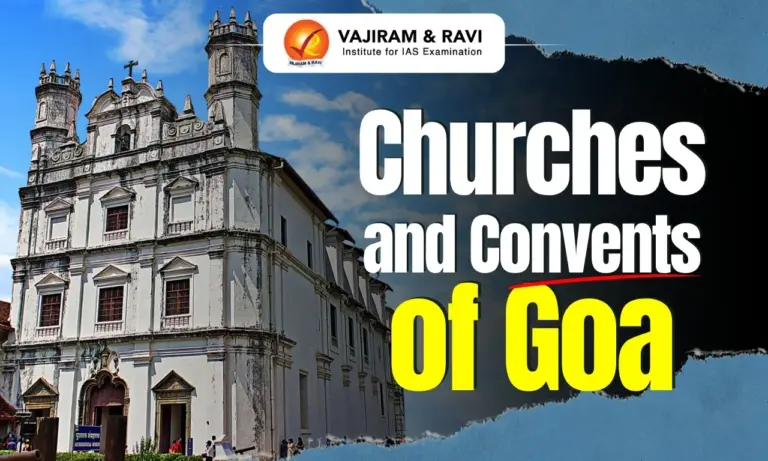
Churches and Convents of Goa are a remarkable group of religious monuments at Old Goa. They were built mainly between the 16th – 17th centuries and reflect Portuguese rule and the spread of Christianity in Asia. These monuments combine European architectural traditions with local materials, craftsmanship, paintings, carvings and religious art. Their historical, architectural, cultural and artistic importance earned them UNESCO World Heritage recognition in 1986.
Churches and Convents of Goa History
Old Goa developed from the earlier settlement of Ella after Portuguese forces captured Goa in 1510, making it an important centre of administration, trade and Christian evangelisation.
The historical background of the development and evolution of the Churches and Convents of Goa has been discussed below:
- Portuguese Conquest: Afonso de Albuquerque captured Goa in 1510. Portuguese control continued for more than 450 years until Goa became part of India in 1961.
- Rise of Old Goa: Goa became the capital of Portuguese territories in Asia. At its peak, the city had more than 200,000 inhabitants and was widely known as the ‘Rome of the East’ because of its numerous Catholic religious buildings.
- Christian Evangelisation: Jesuits, Franciscans, Dominicans, Augustinians, Carmelites and Theatines established religious institutions in Goa from the 16th century. The city became a major centre for spreading Catholicism across India and other parts of Asia.
- Local Artistic Influence: European architectural forms were adapted to local conditions. Goan artists and workers contributed to paintings, wooden carvings, sculptures, furniture and decorative elements, creating a distinctive Indo-Portuguese Architectural character.
- Decline of Old Goa: Competition from Dutch and British traders weakened Goa’s economy. Epidemics also affected the city, while the Mandovi River became unsuitable for larger ships.
- Loss of Capital Status: The Portuguese Viceroy shifted to Pangim, or Nova Goa, in 1759. Old Goa officially lost its capital status in 1843, accelerating its decline as an urban centre.
Churches and Convents of Goa Monuments
The Churches and Convents of Goa UNESCO property comprises seven major surviving monuments that demonstrate Manueline, Mannerist, Baroque, Renaissance, Gothic and Classical influences adapted to local conditions.
The 7 Monuments under the UNESCO Recognised Churches and Convents of Goa include:
1. Church of Our Lady of Rosary
- Construction: Built in 1543, the Church of Our Lady of Rosary is among the oldest surviving churches of Old Goa and represents the early Manueline tradition.
- Architecture: Its exterior resembles a small fortress. Cylindrical towers with cupolas and the entrance arrangement show influences associated with late Gothic and Manueline Portugal.
- Interior: Manueline vaults mark the chapels. A carved alabaster cenotaph commemorates Dona Catarina, wife of Garcia de Sá, whose grave lies beneath the floor.
2. Se’ Cathedral
- Origin: The first cathedral began as a small mud and straw chapel ordered after Afonso de Albuquerque’s conquest. It was later rebuilt on a much larger scale.
- Construction: Reconstruction began in 1562. The main body was completed by 1619, while the facade was finished in 1631.
- Architecture: The cathedral has three naves of equal height, a Tuscan exterior, Corinthian columns, three portals, vaulted interiors and a richly decorated gilded chancel altarpiece.
- Bell Tower: The cathedral originally had two towers. One tower was destroyed by a storm in 1766, leaving the present structure with one surviving tower.
- Principal Chapel: The chapel contains engraved pillars and pilasters. Its religious imagery includes Senhora d’Esperanca, Christ crucified, St. Catherine, St. Peter and St. Paul.
3. Basilica of Bom Jesus
- Construction: The Basilica of Bom Jesus was begun in 1594 and consecrated in 1605. It became the most important surviving Jesuit monument of Old Goa.
- Architecture: The basilica has a Mannerist facade and incorporates Ionic, Doric and Corinthian elements. Its black granite facade is elaborately carved and its ceiling is richly decorated.
- St. Francis Xavier: The basilica preserves the remains of Francisco Xavier in a silver urn. The mausoleum was created by Florentine artist Giovanni Battista Foggini in 1697.
- Mausoleum: The monument was associated with the Grand Duke of Tuscany, Cosimo III de Medici. Artist Placido Francesco Ramponi came to Goa in 1698 to install it.
- Main Altar: The high altar is dedicated to the Infant Jesus. It dates to around 1699 and includes an image of Ignatius of Loyola, founder of the Jesuit Order.
4. Church and Convent of St. Francis of Assisi
- Franciscan Foundation: The Franciscan Order received permission from King Manuel I to establish a convent in Goa in 1517. The early church was completed in 1521.
- Rebuilding: The church was completely rebuilt from 1661. Its earlier Manueline doorway was retained and incorporated into the later Mannerist facade.
- Interior: The church contains a single vaulted nave, side chapels, a transept, stucco work, paintings and numerous graves with inscriptions and coats of arms.
- Altarpiece: The main chapel has paintings depicting the life of St. Francis of Assisi. Its gilded altarpiece dates to around 1670 and depicts Jesus embracing Francis Xavier.
5. Chapel of St. Catherine
- Historical Site: The chapel stands near the location where Afonso de Albuquerque entered Goa in 1510. A stone inscription records the historical association of the site with the conquest.
- Cathedral Status: Pope Paul III raised the chapel to cathedral status in 1534. It was subsequently rebuilt and developed into its present simple architectural form.
- Architecture: The rectangular structure has a single nave, stone chancel, cylindrical vaulted ceiling, pilasters, a central entrance, triangular pediment and two square bell towers.
6. Church of St. Augustine
- Foundation: Augustinian religious members arrived in Goa during the 16th century. They established the convent and began constructing the church in 1597.
- Ruins: The church complex later fell into ruins. Its vault collapsed in 1842, while the facade collapsed in 1936.
- Bell Tower: Only part of the original bell tower survives. The former facade had two massive five storey towers, while the church included a nave, side chapels and a transept.
7. Church of Divine Providence (São Caetano or Saint Cajetan)
- Construction: The Theatines arrived in Goa in 1639. They established a convent and built the Church of St. Cajetan by 1665.
- Design: Italian architects Carlo Ferrarini and Francesco Maria Milazzo designed the church with a Greek cross plan. Its facade follows the design tradition of St. Peter’s Basilica in Rome.
- Architecture: A large hemispherical dome dominates the church. Two quadrangular towers replace the paired cupolas associated with the Roman model.
- Sculptures: Four basalt statues of St. Paul, St. Peter, St. John the Evangelist and St. Matthew occupy niches on the facade.
- Religious Inscription: The portal carries the Latin inscription “Domus mea, domus orationis,” meaning “My House is a House of Prayer.”


Churches and Convents of Goa Conservation
Conservation focuses on protecting architectural integrity, historic functions, structural stability, artistic elements and the wider setting of the Churches and Convents of Goa.
- National Protection: The Archaeological Survey of India manages the centrally protected monuments.
- Development Regulation: Goa’s Planning and Development Authority regulates conservation and preservation zones through the Development Plan Regulations of 1989 and 2000.
- Protected Areas: The 2010 Amendment and Validation Act restricts construction and mining activities within prohibited and regulated zones of 100 metres and 200 metres respectively from protected monuments.
- Conservation Challenges: Weathering, capillary action and termite activity remain important threats. Wooden carvings and panel paintings require particular attention because of their vulnerability.
- Conservation Cooperation: India, Goa authorities, local experts and Portuguese heritage institutions have worked toward developing a more coherent conservation approach and inventory for the historic site.
Churches and Convents of Goa UNESCO Recognition
UNESCO recognised the Churches and Convents of Goa as a World Heritage Site in 1986 for their exceptional architectural, artistic, missionary and historical significance.
- World Heritage Property: Seven monuments collectively represent the architectural heritage of the former Portuguese capital.
- UNESCO Criteria: The Churches and Convents of Goa were recognised under Criteria (ii), (iv) and (vi) for their influence on Asian art and architecture, outstanding missionary architectural ensemble and the universal significance of Saint Francis Xavier’s tomb.
- Authenticity: Systematic conservation has helped retain the structures, historic functions, religious ceremonies and occasional services. Excavation and in situ conservation have also supported the preservation of the St. Augustine complex.
- Integrity: The property boundary includes the structures necessary to demonstrate the assimilation of Manueline, Mannerist and Baroque styles with local practices. Regular monitoring and conservation support their continued protection.

 Last updated on Sep, 2026
→ UPSC 2027 Notification will be released on 13 January 2027 at upsconline.nic.in.
→ Check out the latest UPSC Syllabus here.
→ Download UPSC Model Answers for Mains 2026
→ UPSC Mains Question Paper 2026 is out now for Essay & GS Paper 1, 2, 3 & 4.
→ UPSC Calendar 2027 has been released.
→ Enroll in Vajiram & Ravi’s UPSC Mains Test Series 2027 for structured answer writing practice, expert evaluation, and exam-oriented feedback.
→ Join Vajiram & Ravi’s UPSC Mentorship Program 2027 for personalized guidance, strategy planning, and one-to-one support from experienced mentors.
→ Go through the UPSC Mains Previous Year Papers to enhance your preparation.
→ UPSC has released UPSC Toppers List 2025 with the Civil Services final result on its official website.
→ Also check Best UPSC Coaching in India
Churches and Convents of Goa FAQs
Q1. What are the Churches and Convents of Goa?+
Q2. Why are the Churches and Convents of Goa famous?+
Q3. How many monuments are included in the Churches and Convents of Goa?+
Q4. When did Churches and Convents of Goa get UNESCO recognition?+
Q5. Which architectural styles are found in the Churches and Convents of Goa?+
Q6. Where are the Churches and Convents of Goa located?+
Q7. Which is the oldest church in Old Goa?+
Q8. Which church in Goa contains the tomb of Saint Francis Xavier?+
Q9. Which church in Goa is modelled on St. Peter’s Basilica in Rome?+
Q10. Which city is called the ‘Rome of the East’?+
Tags: churches and convents of goa unesco UNESCO world heritage site