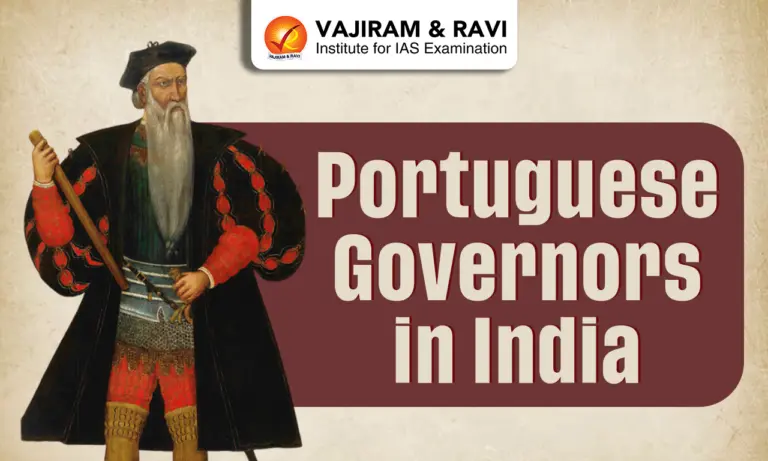
The arrival of the Portuguese in India marked the beginning of European colonial expansion in the Indian subcontinent. The Portuguese governors played a major role in establishing maritime supremacy, controlling trade routes, and expanding Portuguese influence across the Indian Ocean. Among them, Francisco De Almeida and Alfonso de Albuquerque are considered the most important figures in consolidating Portuguese power in India.
Portuguese Arrival in India
The Portuguese arrived in India after the discovery of the sea route to India by Vasco da Gama in 1498. Their main objective was to control the profitable spice trade and establish dominance over Indian Ocean commerce. To strengthen Portuguese authority in India, the King of Portugal appointed governors and viceroys who were responsible for military expansion, administration, and trade regulation.
Portuguese Governors in India
The Portuguese Governors in India were representatives of the Portuguese Crown who played a key role in establishing colonial rule, strengthening naval power, controlling Indian Ocean trade routes. The list of these governors have been tabulated below.
| Portuguese Governors in India | ||
|
Governors |
Period |
Major Contributions |
|
Francisco De Almeida |
1505-1509 |
Introduced Blue Water Policy and strengthened naval supremacy |
|
Alfonso de Albuquerque |
1509-1515 |
Founder of Portuguese power in India; captured Goa |
|
Lopo Soares de Albergaria |
1515-1518 |
Established forts in Colombo and Kollam |
|
Diogo Lopes de Sequeira |
1518-1522 |
Built forts and expanded diplomatic relations |
|
D. Duarte de Menezes |
1522-1524 |
Former captain of Tangier; later dismissed |
|
Nino da Cunha |
1529-1538 |
Shifted headquarters from Cochin to Goa |


Francisco De Almeida (1505-1509)
- Francisco De Almeida was the first Portuguese Governor in India, appointed in 1505 by the King of Portugal.
- He was given military support to protect Portuguese trade interests in the Indian Ocean.
- His main objective was to establish Portuguese naval supremacy over Asian trade routes.
- Almeida aimed to weaken Muslim merchants and control maritime commerce.
- He planned to capture important trading centres such as Aden, Ormuz, and Malacca.
- He faced resistance from the Zamorin of Calicut and the Mameluke Sultan of Egypt.
- The Egyptian navy received support from Gujarat rulers and Venetian merchants.
- In 1507, the Portuguese fleet was defeated near Diu, and Almeida’s son lost his life in the battle.
- Almeida later defeated the combined Egyptian-Gujarat fleet in the famous Battle of Diu.
- He introduced the Blue Water Policy, focusing on naval control instead of territorial expansion.
- Under the Cartaze System, Indian ships needed Portuguese permits for sea trade.
- His policies helped Portugal dominate the Indian Ocean trade routes.
- Almeida strengthened Portuguese influence along the western coast of India.
- His administration laid the foundation for future Portuguese expansion in India.
Alfonso de Albuquerque (1509-1515)
- Alfonso de Albuquerque is regarded as the real founder of Portuguese power in India.
- He became the Governor of Portuguese India in 1509 after Francisco De Almeida.
- Albuquerque focused on expanding Portuguese political and military control in Asia.
- In 1510, he captured Goa from the Sultan of Bijapur.
- Goa became the headquarters and administrative centre of Portuguese India.
- He strengthened Portuguese control over important sea trade routes in the Indian Ocean.
- Albuquerque introduced a permit system for ships to regulate maritime trade.
- He established Portuguese authority over major ports and shipbuilding centres.
- His policies helped Portugal dominate the Arabian Sea trade network.
- He encouraged Portuguese soldiers to marry local Indian women to strengthen settlement in India.
- Albuquerque worked to reduce the influence of Arab and Muslim traders in Indian Ocean commerce.
- During his rule, the Portuguese expanded their influence in Malacca and the Persian Gulf region.
- He attempted to stop the practice of Sati in Portuguese-controlled territories.
- Albuquerque’s administrative and military reforms laid the foundation of the Portuguese colonial empire in India.
Lopo Soares de Albergaria (1515-1518)
- Lopo Soares de Albergaria succeeded Alfonso de Albuquerque as the Governor of Portuguese India.
- He established Portuguese forts in Colombo in present-day Sri Lanka and strengthened control in Kollam.
- His administration mainly focused on improving coastal defense and protecting Portuguese trade routes.
- He continued the expansion of Portuguese influence in the Indian Ocean region.
Diogo Lopes de Sequeira (1518-1522)
- Diogo Lopes de Sequeira was a Portuguese explorer who served as Governor of India from 1518 to 1522.
- He strengthened Portuguese coastal defense by establishing forts at Chaul, Maldives, and Pacem.
- He expanded diplomatic relations by sending embassies to Ethiopia, Pegu, and China.
- His administration focused on improving Portuguese trade networks and overseas influence in Asia.
D. Duarte de Menezes (1522-1524)
- Duarte de Menezes served as the Governor of Portuguese India from 1522 to 1524.
- He belonged to a noble Portuguese family and had earlier experience as the captain of Tangier.
- His administration faced political instability and challenges in maintaining Portuguese authority in India.
- Due to poor governance outcomes, he was eventually removed from office and recalled to Portugal.
Nino da Cunha (1529-1538)
- Nuno da Cunha served as the Governor of Portuguese India from 1529 to 1538.
- He shifted the Portuguese administrative headquarters from Cochin to Goa, strengthening its importance as the capital.
- He received Bassein from Bahadur Shah of Gujarat in 1534, along with its revenues and dependent territories.
- He expanded Portuguese influence in western India and encouraged settlements in Hooghly, Bengal.
Impact of Portuguese Governors in India
- The Portuguese governors established the first strong European colonial presence in India by creating coastal settlements and fortifying key ports like Goa.
- They developed a powerful naval system that allowed Portugal to dominate the Indian Ocean trade routes and control maritime commerce.
- The Cartaz System (trade permit system) was introduced, forcing Indian and foreign ships to take Portuguese licenses for safe sea trade.
- They weakened the influence of Arab, Persian, and Venetian traders in the Indian Ocean, reshaping global trade patterns.
- Portuguese governors expanded Christianity in coastal regions through missionaries and church establishments.
- They introduced new agricultural crops in India, including chilli, potato, tomato, pineapple, and tobacco, which transformed Indian cuisine and farming practices.
- They promoted intermarriage policies, leading to the emergence of Luso-Indian (Indo-Portuguese) communities.
- Portuguese rule led to the construction of forts, churches, and administrative buildings, influencing Indo-European architecture.
- Goa became a major administrative and commercial hub, acting as the capital of Portuguese India.
- Their naval dominance encouraged the rise of European colonial competition in India, later followed by the Dutch, British, and French.
- They significantly influenced Indian food culture, introducing new ingredients and flavors that permanently changed regional cuisines.
- Overall, Portuguese governors laid the foundation of European colonialism in India and transformed trade, agriculture, religion, and culture in the subcontinent.

 Last updated on Oct, 2026
→ UPSC 2027 Notification will be released on 13 January 2027 at upsconline.nic.in.
→ Check Nobel Prize 2026 Winners List here.
→ Download PIB PRiSM Monthly Magazine 2026 here.
→ Check UPSC Monthly Current Affairs Magazine The Recitals here.
→ Check out the latest UPSC Syllabus here.
→ Download UPSC Model Answers for Mains 2026
→ UPSC Mains Question Paper 2026 is out now for Essay & GS Paper 1, 2, 3 & 4.
→ UPSC Calendar 2027 has been released.
→ Enroll in Vajiram & Ravi’s UPSC Mains Test Series 2027 for structured answer writing practice, expert evaluation, and exam-oriented feedback.
→ Join Vajiram & Ravi’s UPSC Mentorship Program 2027 for personalized guidance, strategy planning, and one-to-one support from experienced mentors.
→ Go through the UPSC Mains Previous Year Papers to enhance your preparation.
→ UPSC has released UPSC Toppers List 2025 with the Civil Services final result on its official website.
→ Also check Best UPSC Coaching in India
Portuguese Governors in India FAQs
Q1. Who was the first Portuguese Governor in India?+
Q2. Who is considered the real founder of Portuguese power in India?+
Q3. When was Goa captured by the Portuguese?+
Q4. What was the Blue Water Policy?+
Q5. What was the Cartaz System?+
Tags: modern indian history portuguese governors in india