Ramanathaswamy Temple Corridor Latest News
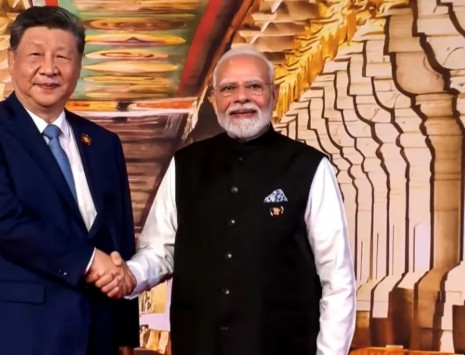
- On Day 1 of the 18th BRICS Summit in New Delhi, PM Modi and Chinese President Xi Jinping shook hands at Bharat Mandapam in front of a high-quality projection of the 1,212-pillar corridor of the Ramanathaswamy temple in Tamil Nadu’s Ramanathapuram district.
- Tamil Nadu is also where the two leaders last met in India, in October 2019. While the reason for choosing this backdrop is unclear, the temple and its corridor carry deep historical, religious and architectural significance.
Location and Religious Importance
- The Ramanathaswamy temple stands in the town of Rameswaram on Pamban Island.
- It is one of India’s most important religious sites and is counted among the 12 Jyotirlingas, the shrines across the country dedicated to Lord Shiva.
- According to tradition, Lord Ram worshipped Lord Shiva at this site on his return from Lanka. This dual association with Rama and Shiva gives the temple its sacred importance.


Historical Evolution
- The temple began as a simple brick and thatch structure and evolved over centuries into its present grandeur. Key stages:
- 12th century: The Chola kings built the first stone temple.
- Later additions: Kings of the Pandya dynasty and rulers of Vijayanagar expanded it.
- 1513: Krishna Deva Raya of Vijayanagar visited after conquering Lanka and made magnificent gifts to the temple.
- Nayaka period: The Sethupati kings of Ramnad became guardians of the temple and finally completed it.
- The Sethupathi rulers of Ramanathapuram played a key role in shaping its present form.
- Henry Hardy Cole (1843–1916), a superintendent of the Archaeological Survey of India, noted in an 1885 report that the temple in its current form was rebuilt in the 17th century after repeated sackings in earlier centuries.
- The temple’s third and outermost corridor, the one with over a thousand pillars, was added much later to the original structure.
Key Architectural Features
- The Ramanathaswamy Temple in Rameswaram, Tamil Nadu, is a masterwork of Dravidian architecture. It is celebrated globally for having the longest pillared corridor in the world.
- The Grand Corridors – The outer corridor stretches over 1,200 metres. It contains 1,212 massive, intricately carved sandstone pillars.
- Lofty Gopurams – Massive gateway towers (gopurams) stand on the eastern and western sides of the temple. The eastern Rajagopuram is the tallest, rising 126 feet across nine levels.
- High Compound Walls – Massive stone walls, known as madil, enclose the complex. The complex spans about 15 acres, measuring roughly 865 feet by 657 feet.
- Sacred Water Tanks – The complex reflects sophisticated ancient hydraulic planning. It has 36 distinct water bodies in total. Of these, 22 are sacred wells (theerthams) located inside the temple.
The Corridor at Scale
- The famous outer corridor is largely credited to the 18th-century ruler Muthuramalinga Sethupathi, the zamindar of the Ramnad estate.
- Its key features:
- 1,212 pillars, each rising to approximately 6.9 metres.
- The combined length of the temple’s corridors is commonly cited as about 3,850 feet, or roughly 1.17 km.
- It is regarded as the longest temple corridor in the world.
- Why exactly 1,212 pillars were chosen remains unknown.
Structure and Ornamentation
- The corridor is built as a sequence of stone columns standing on raised platforms. These platforms support the beams and the continuous roof.
- But the pillars are more than functional supports:
- Each pillar is individually carved and ornamented.
- Sculptural detailing includes floral motifs and figures of mythical creatures.
- The columns, capitals, brackets and beams fit into a carefully organised grid, working together structurally while maintaining the temple’s visual language.
- The intricate carvings are a fine example of Dravidian architecture.
The Visual Effect
- The rows of pillars create a striking visual as they appear to recede towards a single point in the distance.
- The parallel lines converge, and each successive pillar seems progressively smaller. Though the individual units are repetitive, together they produce a constantly changing spatial view.
- The corridor was designed to be walked through rather than admired from afar.
- This is why the image works so well as a backdrop: the repeated columns create immediate depth on a screen, while the enormous scale and distinctive Dravidian style make it instantly recognisable.
Conclusion
- The choice of the Ramanathaswamy corridor as the summit backdrop projects India’s civilisational heritage onto the global diplomatic stage.
- Beyond its symbolism, the temple is a valuable study in Dravidian architecture, regional patronage under the Sethupathis and the evolution of sacred space into monumental design.
Source: IE

 Last updated on Sep, 2026
→ UPSC 2027 Notification will be released on 13 January 2027 at upsconline.nic.in.
→ Check out the latest UPSC Syllabus here.
→ Download UPSC Model Answers for Mains 2026
→ UPSC Mains Question Paper 2026 is out now for Essay & GS Paper 1, 2, 3 & 4.
→ UPSC Calendar 2027 has been released.
→ Enroll in Vajiram & Ravi’s UPSC Mains Test Series 2027 for structured answer writing practice, expert evaluation, and exam-oriented feedback.
→ Join Vajiram & Ravi’s UPSC Mentorship Program 2027 for personalized guidance, strategy planning, and one-to-one support from experienced mentors.
→ Go through the UPSC Mains Previous Year Papers to enhance your preparation.
→ UPSC has released UPSC Toppers List 2025 with the Civil Services final result on its official website.
→ Also check Best UPSC Coaching in India
Ramanathaswamy Temple Corridor FAQs
Q1. Why was the Ramanathaswamy Temple corridor used as the Modi-Xi handshake backdrop?+
Q2. Where is the Ramanathaswamy Temple located?+
Q3. What makes the Ramanathaswamy Temple corridor architecturally significant?+
Q4. Who contributed to the development of the Ramanathaswamy Temple?+
Q5. Why is the Ramanathaswamy Temple corridor visually distinctive?+
Tags: mains articles ramanathaswamy temple corridor upsc current affairs upsc mains current affairs