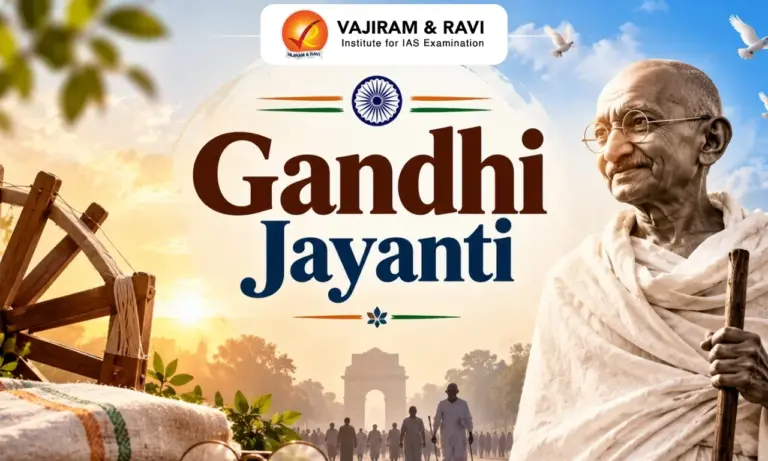
Gandhi Jayanti 2026 will be observed on 2 October 2026, marking the 157th birth anniversary of Mohandas Karamchand Gandhi, popularly known as Mahatma Gandhi. He was born on 2 October 1869 in Porbandar, present-day Gujarat.
Gandhi Jayanti commemorates the contribution of Mahatma Gandhi to India’s freedom struggle and his philosophy of truth, non-violence, Satyagraha and self-rule. The day also has international significance as the United Nations observes 2 October as the International Day of Non-Violence.
About Mahatma Gandhi
Mahatma Gandhi was one of the most prominent leaders of India’s freedom struggle.
- Mohandas Karamchand Gandhi was born on 2 October 1869 in Porbandar, in the Kathiawar region of present-day Gujarat.
- He was the youngest child of Karamchand Gandhi, who served as a Diwan in several princely states, and Putlibai, whose religious outlook influenced his emphasis on truth and self-discipline.
- Mahatma Gandhi married Kasturba Gandhi in 1883, and they had four sons, Harilal, Manilal, Ramdas and Devdas.
- He received his early education in Porbandar and Rajkot before travelling to England to study law.
- In 1888, Mahatma Gandhi travelled to England to study law and was called to the Bar in 1891.
- After returning to India, he initially attempted to practise law before travelling to South Africa in 1893 for a legal case.
- Mahatma Gandhi spent more than two decades in South Africa, where he experienced racial discrimination and organised the Indian community against discriminatory laws. His removal from a first-class railway compartment at Pietermaritzburg became an important experience in his understanding of racial discrimination and injustice. During his years in South Africa, Mahatma Gandhi developed Satyagraha, a method of resisting injustice through truth and non-violence.
- Mahatma Gandhi returned to India in 1915 and gradually emerged as a major leader of the Indian national movement.
- His political and social ideas included Satyagraha, Ahimsa, Swaraj, Swadeshi, Sarvodaya and Trusteeship, connecting political freedom with social and ethical reform.
- Mahatma Gandhi was assassinated on 30 January 1948 in New Delhi by Nathuram Godse.
Mahatma Gandhi and the National Movement
Mahatma Gandhi played a central role in transforming the Indian national movement into a mass movement. He brought ordinary people into the struggle against colonial rule and combined non-violent resistance with constructive work and social reform.
Mahatma Gandhi’s Early Movements in India
After returning to India in 1915, Mahatma Gandhi initially focused on local grievances involving peasants and workers. These campaigns helped him develop a method of connecting local economic problems with the wider struggle against colonial rule.
- The Champaran Satyagraha of 1917 involved Mahatma Gandhi’s support for peasants facing exploitation under the indigo cultivation system.
- The Kheda Satyagraha of 1918 involved the demand for relief from land revenue during a period of crop failure.
- The Ahmedabad Mill Strike of 1918 involved Mahatma Gandhi’s intervention in a dispute between textile workers and mill owners.
These early campaigns established Mahatma Gandhi as a leader who could connect the national movement with the economic and social concerns of ordinary Indians.
Mahatma Gandhi’s Contribution to the National Movement
Mahatma Gandhi changed the nature of Indian politics by placing mass participation, non-violence and civil disobedience at the centre of the struggle against colonial rule.
- Mahatma Gandhi encouraged peasants, workers, women, students and other sections of society to participate in the national movement.
- He promoted Swadeshi, khadi and spinning as means of economic self-reliance and resistance to colonial economic policies.
- He used Satyagraha and civil disobedience to challenge unjust colonial laws without relying on armed resistance.
- He connected the struggle for political freedom with social reform, removal of untouchability, communal harmony and rural development.
- He emphasised discipline and non-violence and was prepared to suspend movements when they departed from these principles.
Through this approach, Mahatma Gandhi broadened the social base of the freedom struggle and made mass mobilisation, non-violent resistance and everyday economic issues important instruments of the national movement.
Non-Cooperation Movement and Mahatma Gandhi’s Role
The Non-Cooperation Movement (1920-22) emerged in the aftermath of the Jallianwala Bagh massacre of 1919 and the Khilafat issue. Mahatma Gandhi argued that British rule depended partly on the cooperation of Indians and that withdrawing this cooperation could weaken colonial authority.
- The movement brought together students, teachers, lawyers, peasants, workers, traders and other sections of society.
- Mahatma Gandhi encouraged people to boycott government institutions, promote Swadeshi and khadi, and withdraw cooperation from colonial institutions.
- The movement was withdrawn in February 1922 after the Chauri Chaura incident, in which protesters attacked a police station and killed policemen.
- The withdrawal reflected Mahatma Gandhi’s belief that mass political action had to remain non-violent and disciplined.
The movement demonstrated the potential of nationwide mass mobilisation and brought large numbers of ordinary Indians into active participation in the freedom struggle.
Civil Disobedience Movement and the Dandi March
The Civil Disobedience Movement was launched in 1930 to challenge British laws and colonial authority through the deliberate and non-violent violation of unjust laws. Mahatma Gandhi selected the salt tax as a central issue because salt was an essential commodity affecting people across social and economic groups.
- Mahatma Gandhi began the Dandi March on 12 March 1930 from Sabarmati Ashram with a group of volunteers.
- After walking approximately 240 miles, Mahatma Gandhi reached Dandi and broke the colonial salt law.
- The Salt Satyagraha turned salt into a powerful symbol of resistance and helped mobilise people against colonial rule.
- The movement witnessed participation from peasants, women, students, workers, traders and other sections of society.
- Women played a particularly visible role in picketing and other forms of protest during the movement.
The Civil Disobedience Movement led to widespread arrests and repression but also increased pressure on the British government. It was followed by negotiations that resulted in the Gandhi-Irwin Pact of 1931.
Mahatma Gandhi and the Round Table Conference
The Gandhi-Irwin Pact of 1931 led to the suspension of the Civil Disobedience Movement and enabled Mahatma Gandhi to attend the Second Round Table Conference in London as the sole representative of the Indian National Congress.
-
- Mahatma Gandhi demanded a responsible government for India and argued that Indians should have the right to determine their own constitutional future.
- He represented the Congress as a national organisation and opposed constitutional arrangements based on separate electorates for different communities, arguing that they could deepen political divisions.
- The conference, however, witnessed sharp differences over the representation and political safeguards of minorities, particularly the question of separate electorates.
- No agreement could be reached on these constitutional questions, and the conference ended without a settlement between the British Government and the Congress.
- Mahatma Gandhi returned to India without achieving the Congress’s demands, and the Civil Disobedience Movement was resumed in 1932.
Quit India Movement and Mahatma Gandhi’s Role
The Quit India Movement was launched in August 1942 after the failure of the Cripps Mission to secure an agreement on India’s constitutional future during the Second World War.
- Mahatma Gandhi gave the famous “Do or Die” call and demanded an immediate end to British rule.
- Mahatma Gandhi and other national leaders were arrested soon after the movement began, but protests and resistance spread across several parts of India.
- The movement became the final major nationwide mass movement led by Mahatma Gandhi against British colonial rule.
The Quit India Movement demonstrated the depth of popular opposition to continued British rule, although it was met with severe colonial repression.


Mahatma Gandhi as Congress President
Mahatma Gandhi presided over the Indian National Congress session at Belgaum in 1924.
The Belgaum Session of 1924 was the only Congress session over which Mahatma Gandhi presided as President. The session reflected his emphasis on khadi, spinning, communal harmony, removal of untouchability and constructive work.
Core Ideas of Gandhian Philosophy
Gandhian thought placed ethical principles at the centre of political action. These ideas connected political freedom with personal responsibility, social justice and the welfare of society.
- Satyagraha: Satyagraha refers to adherence to truth and resistance to injustice through non-violent means. Mahatma Gandhi regarded it as a moral approach to confronting injustice rather than merely a political technique.
- Ahimsa: Ahimsa, or non-violence, was central to Mahatma Gandhi’s political and ethical philosophy. It required resistance to injustice without hatred or physical violence.
- Swaraj: Swaraj means self-rule. Mahatma Gandhi understood it not only as political freedom from colonial rule but also as self-discipline, responsibility and control over one’s own conduct.
- Sarvodaya: Sarvodaya refers to the welfare of all. Mahatma Gandhi placed particular emphasis on the welfare of the weakest and most disadvantaged sections of society.
- Trusteeship: The Trusteeship principle held that people who possessed wealth should regard it as a social trust and use their resources for the wider welfare of society.
- Swadeshi: Swadeshi emphasised self-reliance and the promotion of indigenous production. Mahatma Gandhi promoted khadi and the charkha as symbols of economic self-reliance and resistance to colonial economic structures.
Important Works of Mahatma Gandhi
Mahatma Gandhi expressed his political and philosophical ideas through several important writings.
- Hind Swaraj (1909) presents Mahatma Gandhi’s views on civilisation, modernity and Swaraj.
- The Story of My Experiments with Truth is Mahatma Gandhi’s autobiography.
Mahatma Gandhi and the International Day of Non-Violence
Mahatma Gandhi’s philosophy of non-violence received international recognition through the United Nations.
The United Nations General Assembly adopted a resolution in 2007, establishing 2 October as the International Day of Non-Violence. The observance seeks to disseminate the message of non-violence and promote a culture of peace, tolerance and understanding.
Mahatma Gandhi’s methods of non-violent resistance also influenced later movements for civil rights and political freedom across the world.
Gandhi Jayanti as a National Holiday
Gandhi Jayanti is one of India’s three national holidays, along with Republic Day and Independence Day. The Government of India’s 2026 holiday calendar lists Mahatma Gandhi’s Birthday on 2 October 2026 as a gazetted holiday.
The day is observed across the country through commemorative programmes and tributes to Mahatma Gandhi. Rajghat in New Delhi, where Mahatma Gandhi’s memorial is located, is an important site for national commemorations.
Gandhi Jayanti is also associated with restrictions on alcohol sales in several parts of India. However, specific dry-day regulations are determined by the excise laws of the concerned State or Union Territory.
Gandhi Jayanti and the Swachh Bharat Mission
Gandhi Jayanti has acquired contemporary relevance through its association with national efforts towards cleanliness and sanitation.
The Swachh Bharat Mission was launched on 2 October 2014, the birth anniversary of Mahatma Gandhi, with a focus on sanitation, cleanliness and behavioural change.
The rural component, Swachh Bharat Mission (Grameen), has focused on improving sanitation and sustaining behavioural changes in rural communities. Its second phase emphasises sustaining Open Defecation Free (ODF) status and improving solid and liquid waste management.
The association between Gandhi Jayanti and the Swachh Bharat Mission provides a contemporary context for understanding Mahatma Gandhi’s emphasis on cleanliness, self-reliance and community participation.
Contemporary Relevance of Gandhian Thought
Gandhian ideas continue to provide an ethical framework for examining contemporary social, political and environmental concerns.
- Non-violent conflict resolution can draw upon Mahatma Gandhi’s emphasis on dialogue, Satyagraha and resistance without physical violence.
- Ethical governance can be linked with Mahatma Gandhi’s emphasis on self-discipline, responsibility and service to society.
- Social justice can be examined through the idea of Sarvodaya and Mahatma Gandhi’s concern for disadvantaged sections.
- Sustainable development can be connected with Mahatma Gandhi’s emphasis on moderation, responsible consumption and restraint in the pursuit of material wants.
- Local development and self-reliance can be examined through the principles of Swadeshi, village industries and community participation.

 Last updated on Sep, 2026
→ UPSC 2027 Notification will be released on 13 January 2027 at upsconline.nic.in.
→ Asian Games 2026 are being held in Aichi-Nagoya, Japan, from 19 September to 4 October.
→ Check out the latest UPSC Syllabus here.
→ Download UPSC Model Answers for Mains 2026
→ UPSC Mains Question Paper 2026 is out now for Essay & GS Paper 1, 2, 3 & 4.
→ UPSC Calendar 2027 has been released.
→ Enroll in Vajiram & Ravi’s UPSC Mains Test Series 2027 for structured answer writing practice, expert evaluation, and exam-oriented feedback.
→ Join Vajiram & Ravi’s UPSC Mentorship Program 2027 for personalized guidance, strategy planning, and one-to-one support from experienced mentors.
→ Go through the UPSC Mains Previous Year Papers to enhance your preparation.
→ UPSC has released UPSC Toppers List 2025 with the Civil Services final result on its official website.
→ Also check Best UPSC Coaching in India
Gandhi Jayanti 2026 FAQs
Q1. Why is Gandhi Jayanti celebrated on 2 October?+
Q2. What was Mahatma Gandhi’s role in the Indian freedom struggle?+
Q3. What were the major movements led by Mahatma Gandhi?+
Q4. Why is 2 October observed as the International Day of Non-Violence?+
Q5. What is the significance of Gandhi Jayanti 2026?+
Tags: gandhi jayanti gandhi jayanti 2026