About E-Way Bill:
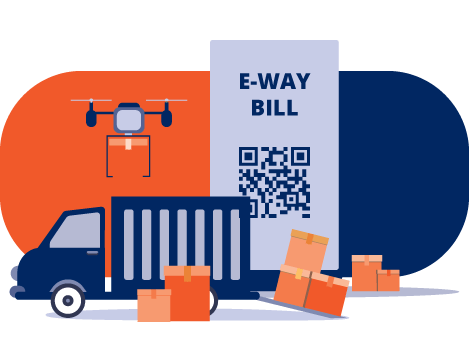
- An e-way bill, short form for electronic way bill, is a permit needed for inter-state and intra-state transportation of goods worth more than Rs. 50,000.
- It contains details of the goods, the consignor, the recipient and the transporter.
- It can be electronically generated through the Goods and Services Tax Network (GSTN).
- When an eway bill is generated, a unique E-way Bill Number (EBN) is allocated and is available to the supplier, recipient, and the transporter.
- Working:
- E-way bill must be raised before the goods are shipped and should include details of the goods, their consignor, recipient and transporter.
- Though check-posts have been abolished under GST, a consignment can be intercepted at any point for the verification of its E-way bill, for all inter-State and intra-State movement of goods.
- If a consignment is found without an E-way bill, a penalty of ₹10,000 or tax sought to be evaded, whichever is greater, can be levied.
- Coverage:
- The GST e-way bill became mandatory from April 1, 2018 for all inter-state transport of goods valued above Rs 50,000.
- Starting from April 15, 2018, it was made compulsory for the moving goods within a state in a phased manner.
- Validity: The e-way bill’s validity varies depending on the distance that the goods have to travel. Typically, the bill’s validity is one day for every 100 km of movement of goods.
- Goods excluded from e-way bill’s ambit: Perishable items (such as meat, milk and milk products and fruits and vegetables), gold and silver jewellery, cooking gas cylinders, raw silk, wool and handlooms.
Who should Generate an eWay Bill?
- Registered Person: E-Way bill must be generated when there is a movement of goods of more than Rs 50,000 in value to or from a registered person. A Registered person or the transporter may choose to generate and carry EWay bill even if the value of goods is less than Rs 50,000.
- Unregistered Persons: Unregistered persons are also required to generate e-Way Bill. However, where a supply is made by an unregistered person to a registered person, the receiver will have to ensure all the compliances are met as if they were the supplier.
- Transporter: Transporters carrying goods by road, air, rail, etc. also need to generate e-Way Bill if the supplier has not generated an e-Way Bill.
Q1) What is the GST Council?
The GST Council is a constitutional body responsible for making recommendations on issues related to the implementation of the Goods and Services Tax (GST) in India. The Union Finance Minister is the Chairperson of the GST Council. Decisions in the GST Council are taken by a majority of not less than three-fourth of weighted votes cast. Centre has one-third weightage of the total votes cast and all the states taken together have two-third of weightage of the total votes cast.
Source: ‘E-way Bill will bring big change in gold trade,’ says Finance Minister K N Balagopal


 Last updated on Oct, 2026
→ UPSC 2027 Notification will be released on 13 January 2027 at upsconline.nic.in.
→ Check Nobel Prize 2026 Winners List here.
→ Download PIB PRiSM Monthly Magazine 2026 here.
→ Check UPSC Monthly Current Affairs Magazine The Recitals here.
→ Check out the latest UPSC Syllabus here.
→ Download UPSC Model Answers for Mains 2026
→ UPSC Mains Question Paper 2026 is out now for Essay & GS Paper 1, 2, 3 & 4.
→ UPSC Calendar 2027 has been released.
→ Enroll in Vajiram & Ravi’s UPSC Mains Test Series 2027 for structured answer writing practice, expert evaluation, and exam-oriented feedback.
→ Join Vajiram & Ravi’s UPSC Mentorship Program 2027 for personalized guidance, strategy planning, and one-to-one support from experienced mentors.
→ Go through the UPSC Mains Previous Year Papers to enhance your preparation.
→ UPSC has released UPSC Toppers List 2025 with the Civil Services final result on its official website.
→ Also check Best UPSC Coaching in India