Legionnaires’ Disease Latest News
Legionnaires’ disease outbreak in New York City recently claimed its first life, with at least 67 people falling ill and dozens needing hospital care.
About Legionnaires’ Disease
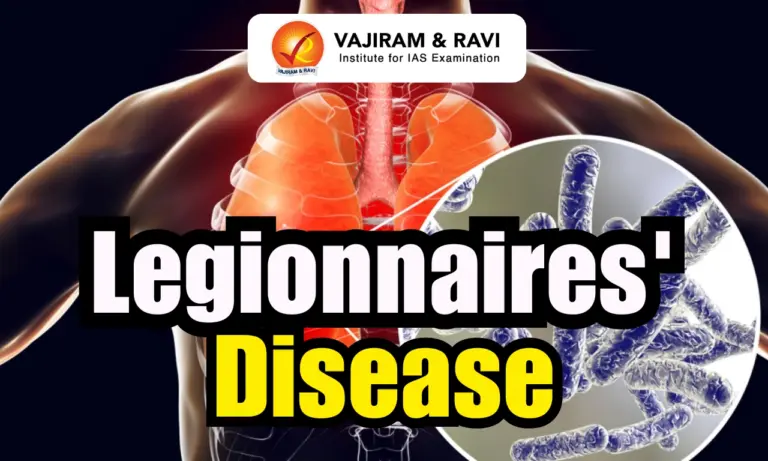
- It is a severe form of a lung infection (pneumonia) caused by a bacterium known as legionella.
- The name comes from a 1976 outbreak among people attending an American Legion convention in Philadelphia, where the disease was first identified.
- Legionella can also cause Pontiac fever. This is a milder, flu-like illness that doesn’t infect your lungs.


Legionnaires’ Disease Transmission
- Legionella is found naturally in freshwater, such as lakes and rivers. It can also be found in soil.
- But people usually only get sick from it when it grows and spreads in man-made water systems.
- These systems can include hot tubs, fountains, and the plumbing systems of large buildings, such as hotels or nursing homes.
- Most people catch Legionnaires’ disease by breathing in mist or small drops of water that contain the bacteria.
- You usually can’t get infected by drinking water that contains the bacteria unless you aspirate it (accidentally breathe the water into your lungs).
- It is not contagious, meaning it does not spread from person to person.
- Older adults, people with weakened immune systems, and people who smoke have a higher risk of getting Legionnaires’ disease.
Legionnaires’ Disease Symptoms
- It causes pneumonia-like symptoms that start two to 14 days after exposure to Legionella.
- Patients usually present with fever, cough, shortness of breath, tiredness, headache, muscle pain, and may have gastrointestinal symptoms such as abdominal pain and diarrhoea.
- In severe cases, neurological symptoms (e.g., confusion) and respiratory failure may occur, and some cases may result in death.
Legionnaires’ Disease Treatment
- Treating right away with antibiotics most often cures Legionnaires’ disease.
- But some people still have problems after treatment.
- Currently, there is no vaccine available for LD.
News: ETVB

 Last updated on Oct, 2026
→ UPSC 2027 Notification will be released on 13 January 2027 at upsconline.nic.in.
→ Check Nobel Prize 2026 Winners List here.
→ Download PIB PRiSM Monthly Magazine 2026 here.
→ Check UPSC Monthly Current Affairs Magazine The Recitals here.
→ Check out the latest UPSC Syllabus here.
→ Download UPSC Model Answers for Mains 2026
→ UPSC Mains Question Paper 2026 is out now for Essay & GS Paper 1, 2, 3 & 4.
→ UPSC Calendar 2027 has been released.
→ Enroll in Vajiram & Ravi’s UPSC Mains Test Series 2027 for structured answer writing practice, expert evaluation, and exam-oriented feedback.
→ Join Vajiram & Ravi’s UPSC Mentorship Program 2027 for personalized guidance, strategy planning, and one-to-one support from experienced mentors.
→ Go through the UPSC Mains Previous Year Papers to enhance your preparation.
→ UPSC has released UPSC Toppers List 2025 with the Civil Services final result on its official website.
→ Also check Best UPSC Coaching in India
Legionnaires' Disease FAQs
Q1. What is Legionnaires' disease?+
Q2. Where do people usually become infected with Legionella?+
Q3. How do most people contract Legionnaires' disease?+
Q4. Is Legionnaires' disease contagious?+
Q5. How is Legionnaires' disease treated?+
Tags: legionnaire’s disease prelims pointers upsc current affairs upsc prelims current affairs