About Environmental DNA
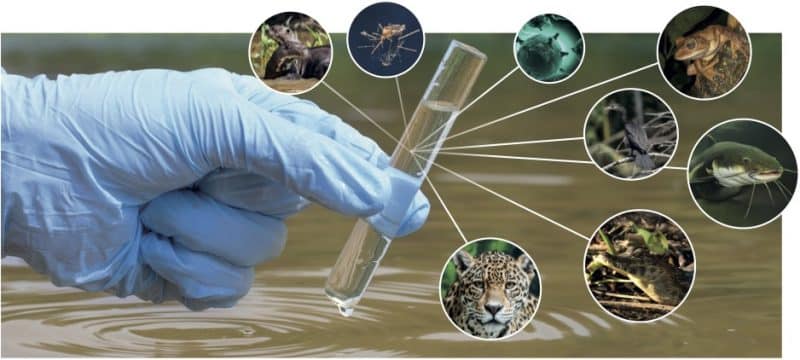
- eDNA is DNA shed by all organisms into their surroundings through natural processes during their lifetime or after death.
- Source: It originates from cellular material shed by organisms (via skin, excrement, etc.) into aquatic or terrestrial environments that can be sampled and monitored using new molecular methods.
Key points about new method
- The new non-invasive method can assess the total biodiversity of any ecosystem by sequencing the DNA fragments found in the environmental samples such as water, soil or air.
- This method can detect all kinds of organisms, including viruses, bacteria, archaea, and eukaryotes such as fungi, plants, insects, birds, fish and other animals.
- This method requires just a few litres of water sample without any direct capture or counting of species.
- The researchers filter out eDNA from environmental samples, read their sequences, and thus, identify the source of the eDNA.


Significance
- Such methodology is important for the early detection of invasive species as well as the detection of rare and cryptic species.
- eDNA can also reveal the presence of human remains
- The new method is cheaper, faster, and highly scalable to large freshwater and marine ecosystems which can help in monitoring and conserving the rich biodiversity of our country.
Q1) What is DNA?
The deoxyribonucleic acid is a molecule found in the cells of all living organisms. It serves as the genetic blueprint for the development, functioning, growth, and reproduction of living organisms. DNA carries the instructions necessary for the construction and regulation of the various components of an organism, from proteins to cells and entire organisms.
Source: Hyderabad-based researchers develop new eDNA sequencing method to assess biodiversity

 Last updated on Oct, 2026
→ UPSC 2027 Notification will be released on 13 January 2027 at upsconline.nic.in.
→ Check Nobel Prize 2026 Winners List here.
→ Download PIB PRiSM Monthly Magazine 2026 here.
→ Check UPSC Monthly Current Affairs Magazine The Recitals here.
→ Check out the latest UPSC Syllabus here.
→ Download UPSC Model Answers for Mains 2026
→ UPSC Mains Question Paper 2026 is out now for Essay & GS Paper 1, 2, 3 & 4.
→ UPSC Calendar 2027 has been released.
→ Enroll in Vajiram & Ravi’s UPSC Mains Test Series 2027 for structured answer writing practice, expert evaluation, and exam-oriented feedback.
→ Join Vajiram & Ravi’s UPSC Mentorship Program 2027 for personalized guidance, strategy planning, and one-to-one support from experienced mentors.
→ Go through the UPSC Mains Previous Year Papers to enhance your preparation.
→ UPSC has released UPSC Toppers List 2025 with the Civil Services final result on its official website.
→ Also check Best UPSC Coaching in India