Tungabhadra River Latest News
Police retrieved bodies of three Karnataka youngsters from Tungabhadra river near Mantralayam in Kurnool district recently.
About Tungabhadra River
- It is a significant peninsular river in southern India, flowing through the states of Karnataka and Andhra Pradesh.
- It is the principal tributary of the Krishna River.
- The Hindus consider this river sacred, and there is a mention of the river in the Ramayana, where it is referred to as Pampa.
- Course:
- It originates at Koodli, near Shimoga district in the state of Karnataka, where two rivers—the Tunga River and the Bhadra River—meet and give birth to the Tungabhadra.
- Both the Tunga & Bhadra Rivers originate on the eastern slopes of the Western Ghats.
- From this starting point, the Tungabhadra River travels a length of 531 km before joining the Krishna River at Sangamaleshwaram in Andhra Pradesh.
- The Krishna River finally ends in the Bay of Bengal.
- It runs for 382 km in Karnataka, forms the boundary between Karnataka and Andhra Pradesh for 58 km, and further runs for the next 91 km in Andhra Pradesh.
- It originates at Koodli, near Shimoga district in the state of Karnataka, where two rivers—the Tunga River and the Bhadra River—meet and give birth to the Tungabhadra.
- The total catchment area of the river is 69,552 sq.km. up to its confluence with Krishna.
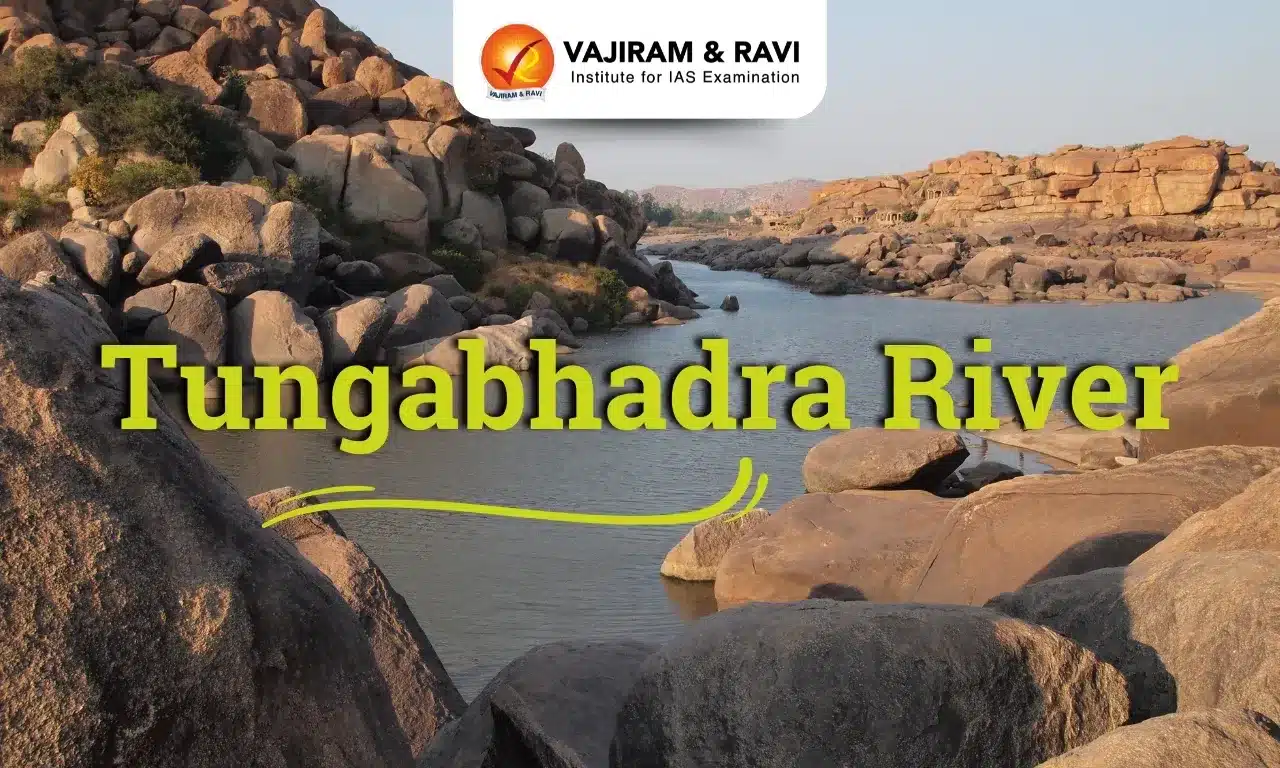
- The landscape around the Tungabhadra is dominated by massive piles of granite in hues of grey, ochre, and pink.
- The locked land that lies in the north of the Tungabhadra River between the Tungabhadra and the Krishna River is called the “Raichur Doab”.
- It is influenced chiefly by the southwest monsoon.
- Major Tributaries: Varada River and Hagari (Vedathy) River.
- The river has several dams and reservoirs built on it, including the Tunga Anicut Dam, the Bhadra Dam, the Hemavathy Dam, and the Tungabhadra Dam.
- The city of Hampi, which was the capital of the Vijayanagara Empire, is located on the banks of the river.
Source: TOI


 Last updated on Sep, 2026
→ UPSC 2027 Notification will be released on 13 January 2027 at upsconline.nic.in.
→ Asian Games 2026 are being held in Aichi-Nagoya, Japan, from 19 September to 4 October.
→ Check out the latest UPSC Syllabus here.
→ Download UPSC Model Answers for Mains 2026
→ UPSC Mains Question Paper 2026 is out now for Essay & GS Paper 1, 2, 3 & 4.
→ UPSC Calendar 2027 has been released.
→ Enroll in Vajiram & Ravi’s UPSC Mains Test Series 2027 for structured answer writing practice, expert evaluation, and exam-oriented feedback.
→ Join Vajiram & Ravi’s UPSC Mentorship Program 2027 for personalized guidance, strategy planning, and one-to-one support from experienced mentors.
→ Go through the UPSC Mains Previous Year Papers to enhance your preparation.
→ UPSC has released UPSC Toppers List 2025 with the Civil Services final result on its official website.
→ Also check Best UPSC Coaching in India
Tungabhadra River FAQs
Q1. The Tungabhadra River is the principal tributary of which major river?+
Q2. Which major historical site is located on the banks of the Tungabhadra River?+
Q3. How long is the Tungabhadra River before it merges with the Krishna River?+
Q4. The Tungabhadra River flows through which states?+
Tags: prelims pointers tungabhadra river upsc current affairs upsc prelims current affairs