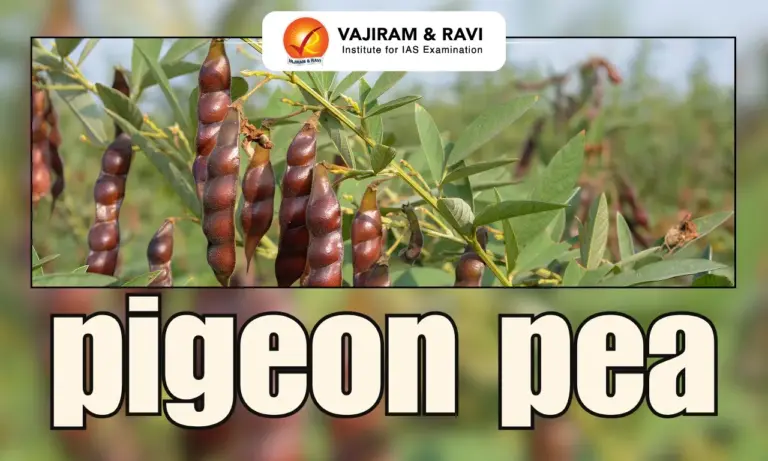
Pigeonpea Latest News
Recently, the Indian Council of Agricultural Research (ICAR) has developed India’s first fully annotated telomere-to-telomere (T2T) reference genome of pigeonpea (Cajanus cajan L. Millsp.) variety ‘Asha’.
About Pigeonpea
- It is popularly known as ‘Arhar’ or ‘Tur’.
- It is one of India’s most important pulse crops and a major source of dietary protein.
- It is a legume crop and protein-rich food which is primarily consumed as dal in India.
- It is predominantly a crop of tropical areas mainly cultivated in semi-arid regions of India.
- Required Climatic conditions
- Rain: It requires 600-650mm of annual rainfall along with moist conditions for the initial eight weeks and dry conditions during its flowering and pod development phase.
- Temperature: It can be grown with a temperature ranging from 26 to 30 degree Celsius in the rainy season and 17 to 22 degree Celsius in the post rainy (November to March) season.
- Soil: It can be grown on all types of soil, however, sandy loam or loam soil is most suitable for its cultivation.
- It is very sensitive to low radiation at pod development, therefore flowering during the monsoon and cloudy weather, leads to poor pod formation.
- It is commonly intercropped with a wide range of crops.
- Diseases: The important diseases of Pigeon pea are Wilt, Sterility mosaic disease, Phytophthora blight, Alternaria blight and Powdery mildew etc.
- Health benefits: It has low glycaemic index and is rich in thiamine, riboflavin, niacin, vitamin B-6, folate, vitamin A, calcium, zinc, iron and magnesium
- Major Pigeon pea producing states: Uttar Pradesh, Madhya Pradesh, West Bengal, Bihar and Jharkhand.
Source: PIB


 Last updated on Oct, 2026
→ UPSC 2027 Notification will be released on 13 January 2027 at upsconline.nic.in.
→ Asian Games 2026 are being held in Aichi-Nagoya, Japan, from 19 September to 4 October.
→ Check Nobel Prize 2026 Winners List here.
→ Download PIB PRiSM Monthly Magazine 2026 here.
→ Check UPSC Monthly Current Affairs Magazine The Recitals here.
→ Check out the latest UPSC Syllabus here.
→ Download UPSC Model Answers for Mains 2026
→ UPSC Mains Question Paper 2026 is out now for Essay & GS Paper 1, 2, 3 & 4.
→ UPSC Calendar 2027 has been released.
→ Enroll in Vajiram & Ravi’s UPSC Mains Test Series 2027 for structured answer writing practice, expert evaluation, and exam-oriented feedback.
→ Join Vajiram & Ravi’s UPSC Mentorship Program 2027 for personalized guidance, strategy planning, and one-to-one support from experienced mentors.
→ Go through the UPSC Mains Previous Year Papers to enhance your preparation.
→ UPSC has released UPSC Toppers List 2025 with the Civil Services final result on its official website.
→ Also check Best UPSC Coaching in India
Pigeonpea FAQs
Q1. Which country is the largest producer of Pigeonpea in the world?+
Q2. Pigeonpea commonly known as Tur belongs to which family?+
Tags: pigeonpea prelims pointers upsc current affairs upsc prelims current affairs