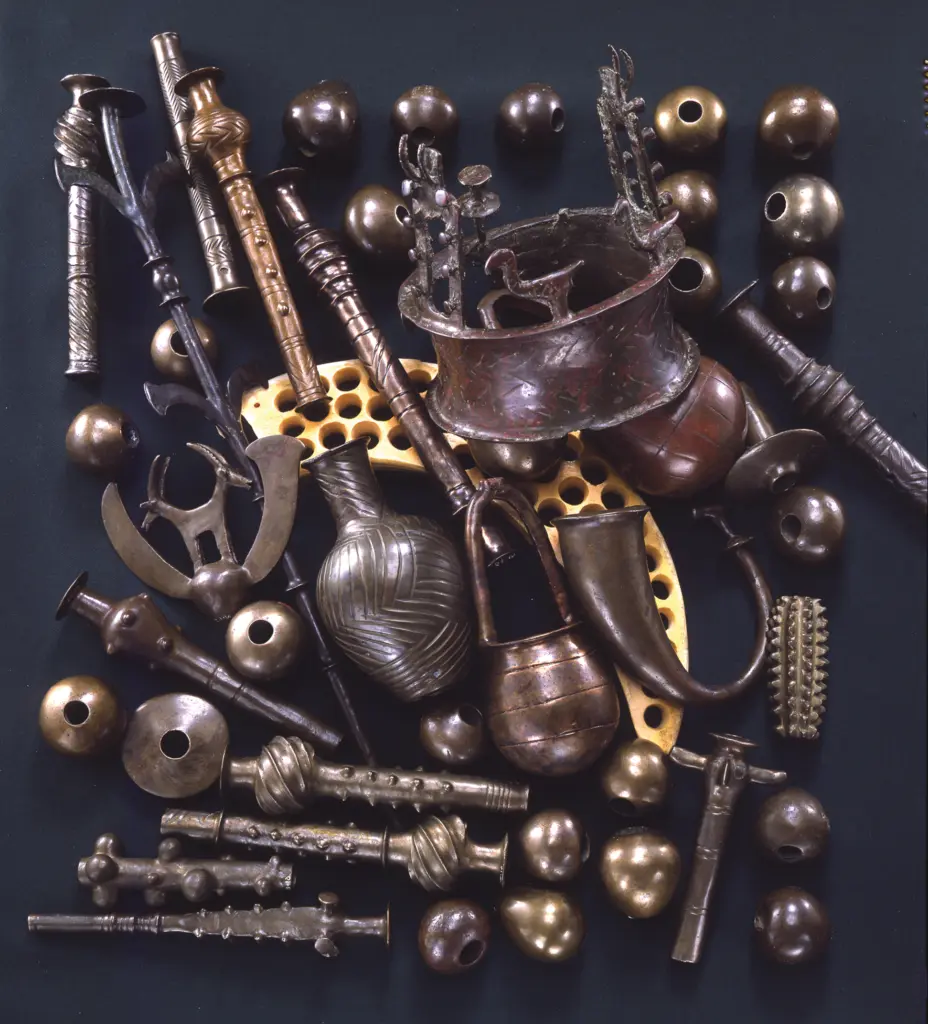
About Copper Age
- The Copper Age, or Chalcolithic time period, is a period that spans from about 5,000 to 2,000 years ago, depending on the region.
- It was a transitional phase from the Neolithic period (the New Stone Age) to the Bronze Age.
- Features:
- It is characterized by the emergence of metallurgy, especially the use of copper, along with stone tools.
- It coincides with the beginnings of craft specialization, the development of agriculture, long-distance trade, and increased sociopolitical complexity.
- Farmers typically raised domestic animals such as sheep-goats, cattle, and pigs, a diet supplemented by hunting and fishing.
- Crops grown by Chalcolithic farmers included barley, wheat, and pulses.
- A main identifying characteristic of the Chalcolithic period is polychrome painted pottery.
- Houses built by Chalcolithic farmers were constructed of stone or mudbrick.
- One characteristic pattern is a chain building, a row of rectangular houses connected to one another by shared party walls on the short ends.
- Another pattern, seen in larger settlements, is a set of rooms around a central courtyard, which may have facilitated the same sort of social arrangement.
- In archaeology, the first signs of massacres, battles, and warrior burials begin appearing with the rise of the Copper Age.
- By the end of the Copper Age, people discovered that by adding tin to copper, a stronger and more durable metal could be created: bronze. From that point on, the Bronze Age begins.
Q1) What is the Neolithic period?
The Neolithic Period, also called the New Stone Age, is the final stage of cultural evolution or technological development among prehistoric humans. The term Neolithic is most frequently used in connection with agriculture, which is the time when cereal cultivation and animal domestication were introduced. It is characterized by the beginning of a settled human lifestyle. The Neolithic stage of development was attained during the Holocene Epoch (the last 11,700 years of Earth’s history). The starting point of the Neolithic is generally thought to have occurred sometime around 10,000 BCE. The Neolithic followed the Paleolithic Period, or the age of chipped-stone tools, and preceded the Bronze Age, or the early period of metal tools.
Source: A 5,000-year-old cemetery discovered in Italy belongs to the Copper Age


 Last updated on Oct, 2026
→ UPSC 2027 Notification will be released on 13 January 2027 at upsconline.nic.in.
→ Check Nobel Prize 2026 Winners List here.
→ Download PIB PRiSM Monthly Magazine 2026 here.
→ Check UPSC Monthly Current Affairs Magazine The Recitals here.
→ Check out the latest UPSC Syllabus here.
→ Download UPSC Model Answers for Mains 2026
→ UPSC Mains Question Paper 2026 is out now for Essay & GS Paper 1, 2, 3 & 4.
→ UPSC Calendar 2027 has been released.
→ Enroll in Vajiram & Ravi’s UPSC Mains Test Series 2027 for structured answer writing practice, expert evaluation, and exam-oriented feedback.
→ Join Vajiram & Ravi’s UPSC Mentorship Program 2027 for personalized guidance, strategy planning, and one-to-one support from experienced mentors.
→ Go through the UPSC Mains Previous Year Papers to enhance your preparation.
→ UPSC has released UPSC Toppers List 2025 with the Civil Services final result on its official website.
→ Also check Best UPSC Coaching in India