About Butterfly Cicada
- It is a newly discovered species of cicada belonging to the genus Becquartina.
- It brings the total number of known species in the genus Becquartina to seven.
- It was discovered in Meghalaya.
- It marks the first-ever record of this genus in the country.
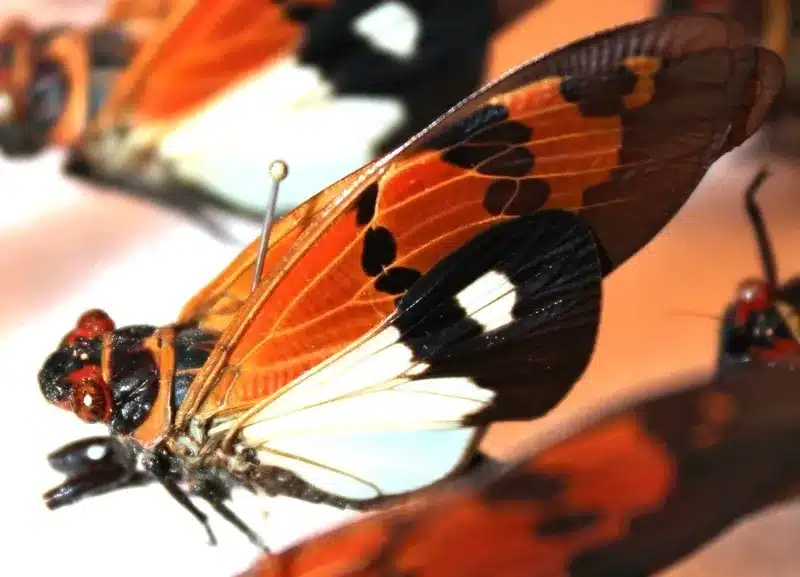
- The colorful wings of the cicada earned it the nickname “butterfly cicada”, with the species name “bicolour” reflecting its two distinct colour forms.
- Features:
- The species is localised in the Garo Hills and Ri-Bhoi districts, preferring thick forests and native vegetation.
- Active from April to June, the cicada’s calling patterns vary between Garo Hills and Ri-Bhoi districts. In Garo Hills, males call rigorously in the morning and evening, while in Ri-Bhoi, calls are heard during daylight hours.
- The basal one-third of the hind wing is rich saffron, and the apical two-thirds are matte black with prominent rich saffron squarish spots.
What are Cicadas?
- Cicada, (family Cicadidae) is any of a group of sound-producing insects.
- They have two pairs of membranous wings, prominent compound eyes, and three simple eyes (ocelli).
- Cicadas are medium to large in size, ranging from 2 to 5 cm (0.8 to 2 inches).
- Male cicadas produce loud noises by vibrating membranes (tymbals) near the base of the abdomen.
- Female cicadas usually lay their eggs in woody plant tissues that drop from the plant when, or shortly after, the eggs hatch.
- More than 3,000 species of cicadas are known. Most of them are tropical and occur in deserts, grasslands, and forests.
Q1) What is Garo Hills?
The eastern part of Meghalaya is known as the Garo Hills. The hilly tracts of Meghalaya are known as the Shillong Plateau and are divided into three parts, the Jaintia hills on the east, the Khasi hills in the centre and the Garo Hills on the western part of the state. The area is named after the local Garo people. The Garo hills cover an area of about 8000 square kilometres. The area offers beautiful sightseeing places, dense forests and different species of animals and birds.
Source: Meghalaya: Researchers discover stunning new cicada species


 Last updated on Oct, 2026
→ UPSC 2027 Notification will be released on 13 January 2027 at upsconline.nic.in.
→ Check Nobel Prize 2026 Winners List here.
→ Download PIB PRiSM Monthly Magazine 2026 here.
→ Check UPSC Monthly Current Affairs Magazine The Recitals here.
→ Check out the latest UPSC Syllabus here.
→ Download UPSC Model Answers for Mains 2026
→ UPSC Mains Question Paper 2026 is out now for Essay & GS Paper 1, 2, 3 & 4.
→ UPSC Calendar 2027 has been released.
→ Enroll in Vajiram & Ravi’s UPSC Mains Test Series 2027 for structured answer writing practice, expert evaluation, and exam-oriented feedback.
→ Join Vajiram & Ravi’s UPSC Mentorship Program 2027 for personalized guidance, strategy planning, and one-to-one support from experienced mentors.
→ Go through the UPSC Mains Previous Year Papers to enhance your preparation.
→ UPSC has released UPSC Toppers List 2025 with the Civil Services final result on its official website.
→ Also check Best UPSC Coaching in India