About Venus:
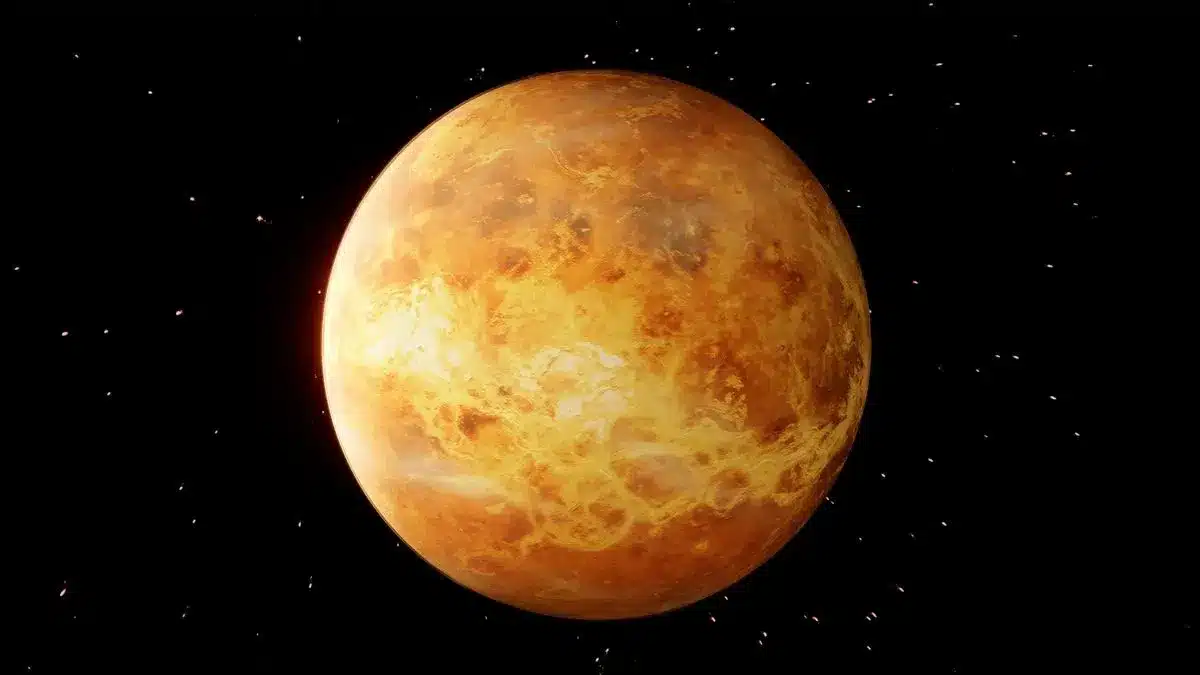
- It is the second planet from the Sun and the sixth largest planet.
- It is the hottest planet in the Solar System, even though Mercury is twice as close to the Sun and receives four times more solar energy.
- Venus’ atmosphere traps heat from the sun as an extreme version of the greenhouse effect that warms Earth.
- Temperatures on Venus reach 880 degrees Fahrenheit (471 degrees Celsius), which is more than hot enough to melt lead.
- Venus and Earth are often called twins because they are similar in size, mass, density, composition, and gravity.
- Venus is only a little bit smaller than Earth, with amass of about 80% of Earth’s.
- Composition:
- It is not a gas planet, but a rocky planet. The interior of Venus is made up of a central iron core and a rocky mantle, similar in composition to Earth.
- Its atmosphere is made up of mainly carbon dioxide (96%) and nitrogen (3.5%), with trace amounts of carbon monoxide, sulfur dioxide, water vapour, argon, and helium making up the other 0.5%.
- Venus is one of only two planets in our solar system that doesn’t have a moon (the other being Mercury).
- Venus is unusual because it spins the opposite directionof Earth and most other planets.
- It takes 243 Earth daystorotate on its axis, which is by far the slowest of any of the major planets.
- It takes 225 Earth days for Venus to go all the way around the Sun. That means that a day on Venus is a little longer than a year on Venus.
- Venus is highly visible from Earth due to its reflective clouds. In the sky, Venus appears as a brilliant white object that is one of the brightest natural things in the night sky.
Q1: What is the greenhouse effect?
The greenhouse effect is the process through which heat is trapped near Earth’s surface by substances known as greenhouse gases. This process makes Earth much warmer than it would be without an atmosphere. Greenhouse gases consist of carbon dioxide, methane, ozone, nitrous oxide, chlorofluorocarbons, and water vapor.
Source: Study finds why water vanished from Venus: Hydrogen chemistry at play


 Last updated on Oct, 2026
→ UPSC 2027 Notification will be released on 13 January 2027 at upsconline.nic.in.
→ Check Nobel Prize 2026 Winners List here.
→ Download PIB PRiSM Monthly Magazine 2026 here.
→ Check UPSC Monthly Current Affairs Magazine The Recitals here.
→ Check out the latest UPSC Syllabus here.
→ Download UPSC Model Answers for Mains 2026
→ UPSC Mains Question Paper 2026 is out now for Essay & GS Paper 1, 2, 3 & 4.
→ UPSC Calendar 2027 has been released.
→ Enroll in Vajiram & Ravi’s UPSC Mains Test Series 2027 for structured answer writing practice, expert evaluation, and exam-oriented feedback.
→ Join Vajiram & Ravi’s UPSC Mentorship Program 2027 for personalized guidance, strategy planning, and one-to-one support from experienced mentors.
→ Go through the UPSC Mains Previous Year Papers to enhance your preparation.
→ UPSC has released UPSC Toppers List 2025 with the Civil Services final result on its official website.
→ Also check Best UPSC Coaching in India