About CITES
- Convention on International Trade in Endangered Species of Wild Fauna and Flora (CITES) is an international agreement between 184 governments to ensure that international trade in wild animals and plants does not threaten the survival of the species.
- The convention entered into force in 1975. India has been a CITES Party since 1976.
- All import, export and re-export of species covered under CITES must be authorized through a permit system.
Appendix of CITES:
- Appendix I: Prohibits commercial trade of critically endangered species.
- Appendix II: Regulates trade to prevent over-exploitation.
- Appendix III: Protects species under national laws.
- Every two years, the Conference of the Parties (CoP), the supreme decision-making body of CITES, applies a set of biological and trade criteria to evaluate proposals from parties to decide if a species should be in Appendix I or II.
Ivory Trade:
- The ivory trade is the commercial trade in elephant ivory tusks and other ivory products.
- At least 20,000 African elephants are illegally killed for their tusks each year.
- The ivory trade threatens elephant survival, harms ecosystems, endangers local communities, and undermines security.
- The ivory trade has traditionally involved smuggling whole or partial elephant tusks from Africa to Asia, where they would be processed and carved into ivory products.
- The demand for ivory has been fueled primarily by a growing middle class in China, where ivory carving is a longstanding tradition.
Reasons Behind Advocating for Trade Ban Lift:
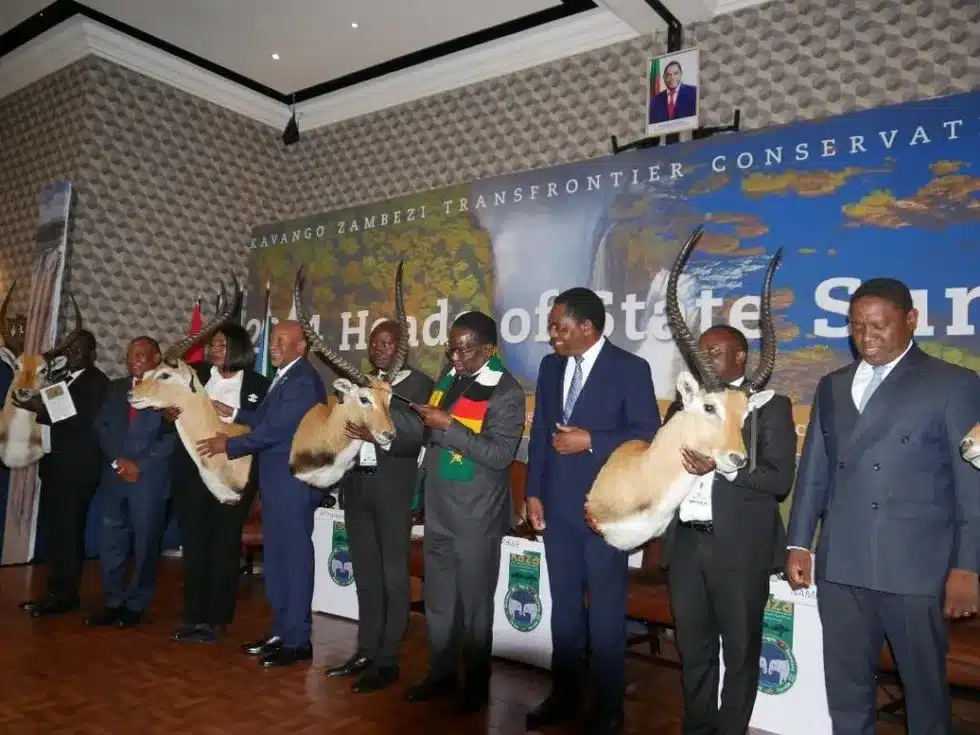
Southern African leaders seek to lift CITES ivory ban for economic gain, citing $1 billion value. KAZA states hold a $1 billion ivory stockpile, with Zimbabwe’s 166-ton stash worth $600 million.
Q1: What is Ivory?
Ivory, a variety of dentin of which the tusk of the elephant is composed and which is prized for its beauty, durability, and suitability for carving. The tusk is the upper incisor and continues to grow throughout the lifetime of male and female African elephants and of the male Indian elephant; the female Indian elephant has no tusks or small ones. The teeth of the hippopotamus, walrus, narwhal, sperm whale, and some types of wild boar and warthog are recognized as ivory but have little commercial value, because of their small size.
Source: KAZA Summit 2024: Leaders decide to fight ivory trade ban at CITES CoP20


 Last updated on Oct, 2026
→ UPSC 2027 Notification will be released on 13 January 2027 at upsconline.nic.in.
→ Asian Games 2026 are being held in Aichi-Nagoya, Japan, from 19 September to 4 October.
→ Check Nobel Prize 2026 Winners List here.
→ Download PIB PRiSM Monthly Magazine 2026 here.
→ Check UPSC Monthly Current Affairs Magazine The Recitals here.
→ Check out the latest UPSC Syllabus here.
→ Download UPSC Model Answers for Mains 2026
→ UPSC Mains Question Paper 2026 is out now for Essay & GS Paper 1, 2, 3 & 4.
→ UPSC Calendar 2027 has been released.
→ Enroll in Vajiram & Ravi’s UPSC Mains Test Series 2027 for structured answer writing practice, expert evaluation, and exam-oriented feedback.
→ Join Vajiram & Ravi’s UPSC Mentorship Program 2027 for personalized guidance, strategy planning, and one-to-one support from experienced mentors.
→ Go through the UPSC Mains Previous Year Papers to enhance your preparation.
→ UPSC has released UPSC Toppers List 2025 with the Civil Services final result on its official website.
→ Also check Best UPSC Coaching in India