About Sunkoshi River:
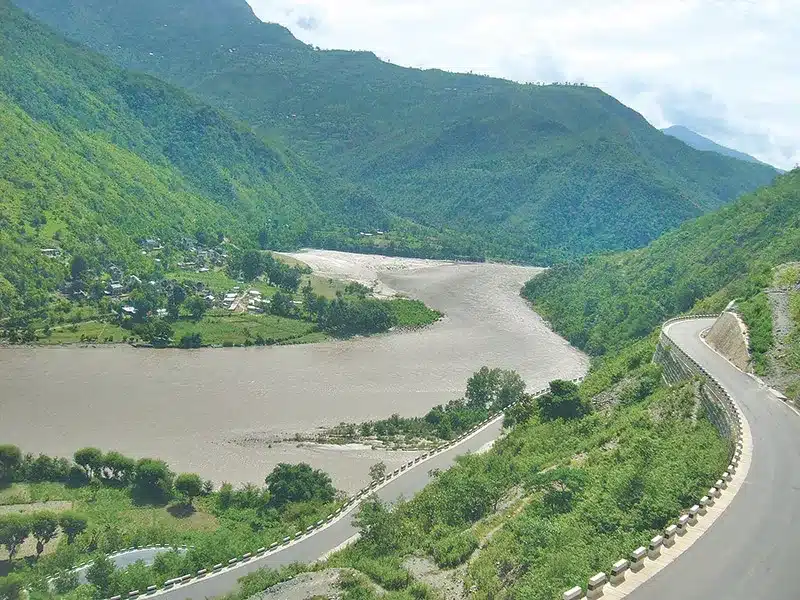
- Sunkoshi, also known as the ‘river of gold, is a river in Nepal that is part of the Koshi or Saptkoshi River system formed by the seven (sapta) rivers joining in east-central Nepal.
- Course: River Sunkoshi’s water source is located in the Zhangzangbo Glacier in Tibet, which merges with River Saptkoshi, ultimately joining the Gangain the Katihar district of Bihar in India, before finally draining into the ocean at the Bay of Bengal in Bangladesh.
- It is one of the longest and most popular rivers for rafting in Nepal, and is known for its challenging rapids.
- It forms the watershed for most of eastern Nepal.
Key Facts about Koshi River:
- It is a transboundary river which flows through China, Nepal, and India.
- It is a prominent tributary of the Ganges.
- Course: Originating from the Tibetan Plateau, it crosses the Himalayas and flows through the Mahabharat range and Siwalik hills, reaching the plains of eastern Nepal and finally meeting the Ganges in Bihar, India.
- The Kosi drains an area of 74,500 sq.km, of which only 11,070 sq.km lie within Indian Territory. The Koshi River system drains about 45% of Nepal.
- The Kosi River valley is bounded by steep margins that disconnect it from the Yarlung Zangbo River to the north, the Mahananda River to the east, the Gandaki to the west, and the Ganga to the south.
- It is well known for its tendency to change course, generally in a westward direction. During the last 200 years, the river has shifted westwards for a distance of about 112 km and has laid waste large tracks of agricultural land
- Kosi is known as the “sorrow of Bihar”, as it has caused widespread human suffering in the past due to flooding and very frequent changes in course, when it flows from Nepal to Bihar.
- Tributaries: It has seven major tributaries: Sun Koshi, Tama Koshi or Tamba Koshi, Dudh Koshi, Indravati, Likhu, Arun, and Tamore or Tamar.
Q1: Which are the main tributaries of Ganges River?
The Yamuna, the Ghaghara, the Gandak and the Kosi are the major tributaries of the river Ganga.
Source: River Sunkoshi Cleanup In Nepal Removes 24,575 Kg Of Plastic In 36 Hours


 Last updated on Oct, 2026
→ UPSC 2027 Notification will be released on 13 January 2027 at upsconline.nic.in.
→ Asian Games 2026 are being held in Aichi-Nagoya, Japan, from 19 September to 4 October.
→ Check Nobel Prize 2026 Winners List here.
→ Download PIB PRiSM Monthly Magazine 2026 here.
→ Check UPSC Monthly Current Affairs Magazine The Recitals here.
→ Check out the latest UPSC Syllabus here.
→ Download UPSC Model Answers for Mains 2026
→ UPSC Mains Question Paper 2026 is out now for Essay & GS Paper 1, 2, 3 & 4.
→ UPSC Calendar 2027 has been released.
→ Enroll in Vajiram & Ravi’s UPSC Mains Test Series 2027 for structured answer writing practice, expert evaluation, and exam-oriented feedback.
→ Join Vajiram & Ravi’s UPSC Mentorship Program 2027 for personalized guidance, strategy planning, and one-to-one support from experienced mentors.
→ Go through the UPSC Mains Previous Year Papers to enhance your preparation.
→ UPSC has released UPSC Toppers List 2025 with the Civil Services final result on its official website.
→ Also check Best UPSC Coaching in India