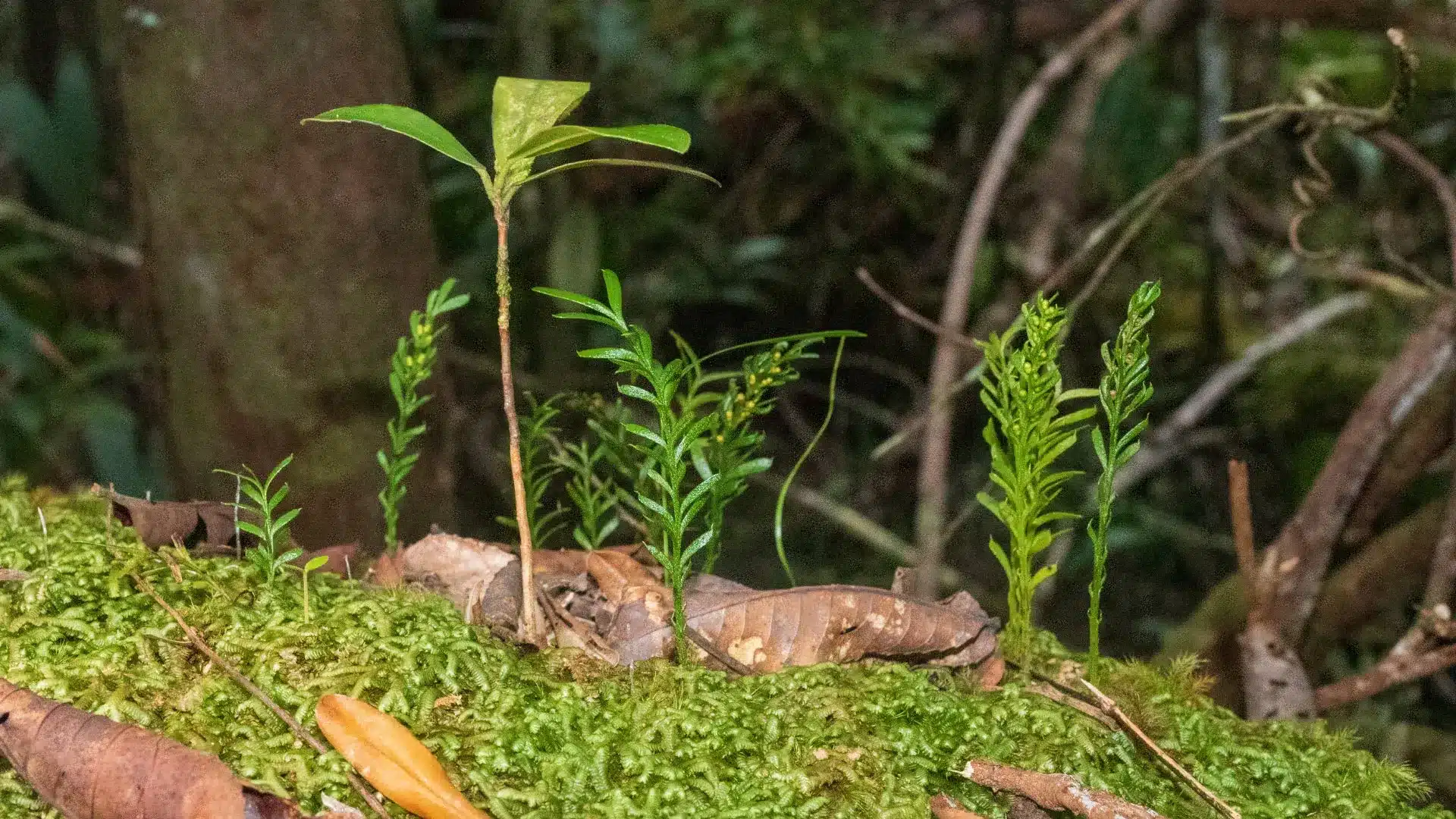
About Tmesipteris oblanceolate:
- It is a rare species of fern which grows primarily on the ground or atop fallen tree trunks on the island nation of New Caledonia (an overseas French territory situated in the Southwest Pacific), and on neighboring islands such as Vanuatu.
- It is a small plant, typically 10-15 centimeters (4-6 inches) in height.
- It has a record-breaking genome size of 160.45 billion base pairs (Gbp), the units that make up a strand of DNA, 11 billion more than the previous record holder, the Japanese flowering plant Paris japonica, and 50 times more than the human genome.
- If stretched out like from a ball of yarn, the length of the DNA in each cell of this fern would extend nearly 350 feet (106 meters). The human genome would extend a mere 6-1/2 feet (2 meters).
- Tmesipteris is a small genus of ferns whose ancestors evolved about 350 million years ago — well before dinosaurs set foot on Earth.
- It is distinguished by its mainly epiphytic habit (it grows mainly on the trunks and branches of trees) and restricted distribution in Oceania and several Pacific Islands.
What are Ferns?
- Ferns are plants that do not have flowers.
- Similar to flowering plants, ferns have roots, stems, and leaves.
- However, unlike flowering plants, ferns do not have flowers or seeds; instead, they usually reproduce sexually by tiny spores or sometimes can reproduce vegetatively.
Q1: What is Genome?
A genome is the complete set of genetic information in an organism. It provides all of the information the organism requires to function. In living organisms, the genome is stored in long molecules of DNA called chromosomes. Small sections of DNA, called genes, code for the RNA and protein molecules required by the organism. In eukaryotes, each cell’s genome is contained within a membrane-bound structure called the nucleus. Prokaryotes, which contain no inner membranes, store their genome in a region of the cytoplasm called the nucleoid. The full range of RNA molecules expressed by a genome is known as its transcriptome, and the full assortment of proteins produced by the genome is called its proteome.
Source: Humble fern from New Caledonia boasts world’s largest genome


 Last updated on Oct, 2026
→ UPSC 2027 Notification will be released on 13 January 2027 at upsconline.nic.in.
→ Asian Games 2026 are being held in Aichi-Nagoya, Japan, from 19 September to 4 October.
→ Check Nobel Prize 2026 Winners List here.
→ Download PIB PRiSM Monthly Magazine 2026 here.
→ Check UPSC Monthly Current Affairs Magazine The Recitals here.
→ Check out the latest UPSC Syllabus here.
→ Download UPSC Model Answers for Mains 2026
→ UPSC Mains Question Paper 2026 is out now for Essay & GS Paper 1, 2, 3 & 4.
→ UPSC Calendar 2027 has been released.
→ Enroll in Vajiram & Ravi’s UPSC Mains Test Series 2027 for structured answer writing practice, expert evaluation, and exam-oriented feedback.
→ Join Vajiram & Ravi’s UPSC Mentorship Program 2027 for personalized guidance, strategy planning, and one-to-one support from experienced mentors.
→ Go through the UPSC Mains Previous Year Papers to enhance your preparation.
→ UPSC has released UPSC Toppers List 2025 with the Civil Services final result on its official website.
→ Also check Best UPSC Coaching in India