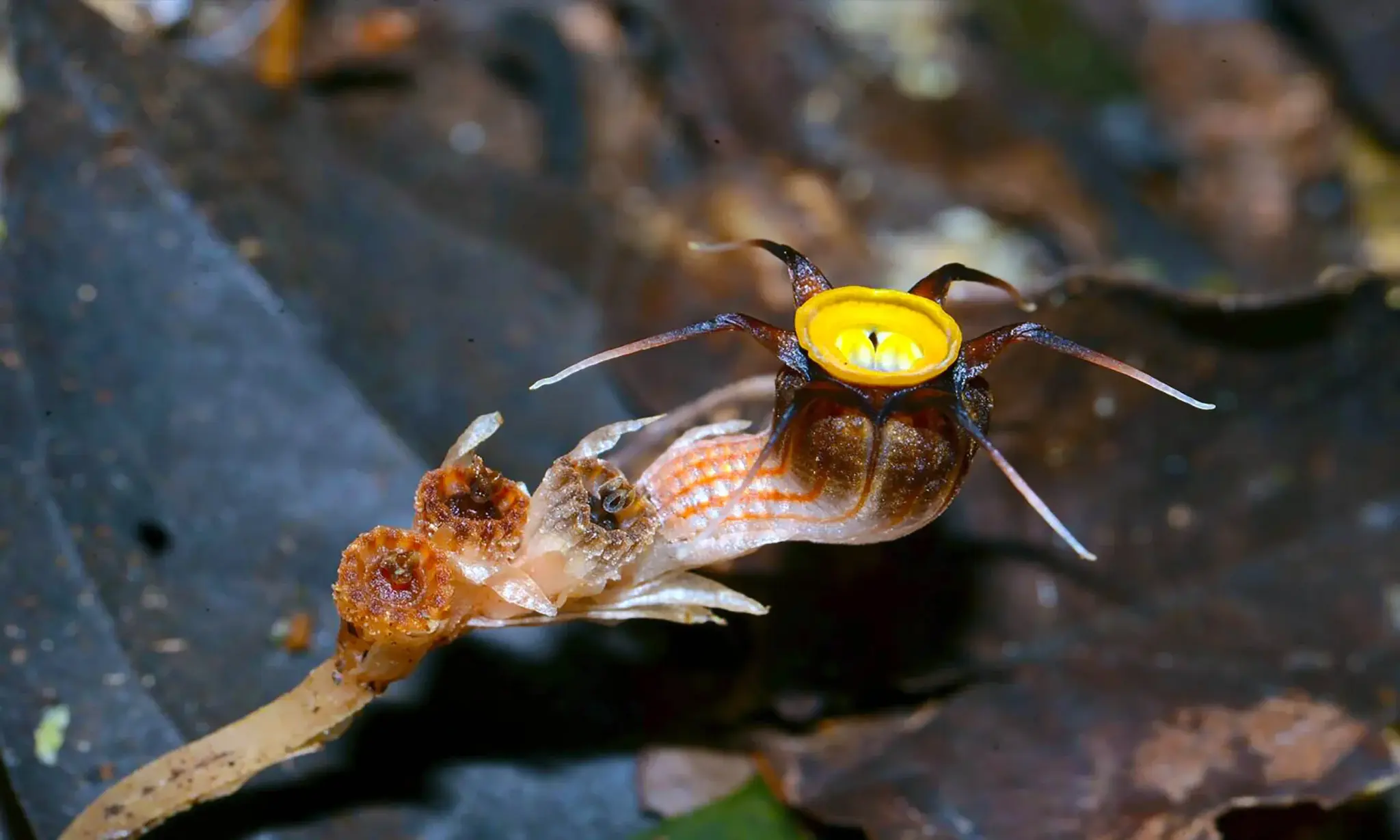
About Thismia malayana:
- It is a new species of plant discovered in the tropical rainforests of Peninsular Malaysia.
- It belongs to a group of plants known as mycoheterotrophs.
- Unlike most plants, mycoheterotrophs do not perform photosynthesis.
- Instead, they act as parasites, stealing carbon resources from the fungi on their roots.
- This adaptation takes advantage of the mycorrhizal symbiosis, which is usually a mutually beneficial relationship between colonizing fungi and a plant’s root system.
- What happens in mycorrhizal symbiosis?
- The fungi help the tree absorb water and nutrients from the soil, while the tree provides the fungi with sugars produced through photosynthesis.
- This symbiotic partnership is vital for the health and growth of both organisms.
- But Thismia malayana, instead of contributing to the exchange, acts as a parasite,siphoning off carbon resources from the fungi without offering anything in return.
- By stealing nutrients from fungi, this newly discovered species thrives in the low-light conditionsof dense forestunderstories, where its highly specialised flowers are pollinated by fungus gnats and other small insects.
- The unusual plant is around 2 cm long and is typically found hidden in leaf litter and growing near tree roots or old rotten logs.
Despite its small size, Thismia malayana is very sensitive to environmental changes and has been classified as Vulnerable according to the IUCN Red List.
Q1: What are Fungi?
Fungi, along with Animalia (animals), Plantae (plants), Protista, Archaea/Archaebacteria, and Bacteria or Eubacteria form the six ‘kingdoms’ of biology. They are eukaryotic organisms; i.e., their cells contain membrane-bound organelles and clearly defined nuclei. Fungi usually reproduce both sexually and asexually. They help in breaking down dead organic material, they continue the cycle of nutrients through ecosystems. Fungi, as food, play a role in human nutrition in the form of mushrooms. They also act as agents of fermentation in the production of bread, cheeses, alcoholic beverages, and numerous other food preparations.
Source: Remarkable new plant species steals nutrients from underground fungi


 Last updated on Oct, 2026
→ UPSC 2027 Notification will be released on 13 January 2027 at upsconline.nic.in.
→ Asian Games 2026 are being held in Aichi-Nagoya, Japan, from 19 September to 4 October.
→ Check Nobel Prize 2026 Winners List here.
→ Download PIB PRiSM Monthly Magazine 2026 here.
→ Check UPSC Monthly Current Affairs Magazine The Recitals here.
→ Check out the latest UPSC Syllabus here.
→ Download UPSC Model Answers for Mains 2026
→ UPSC Mains Question Paper 2026 is out now for Essay & GS Paper 1, 2, 3 & 4.
→ UPSC Calendar 2027 has been released.
→ Enroll in Vajiram & Ravi’s UPSC Mains Test Series 2027 for structured answer writing practice, expert evaluation, and exam-oriented feedback.
→ Join Vajiram & Ravi’s UPSC Mentorship Program 2027 for personalized guidance, strategy planning, and one-to-one support from experienced mentors.
→ Go through the UPSC Mains Previous Year Papers to enhance your preparation.
→ UPSC has released UPSC Toppers List 2025 with the Civil Services final result on its official website.
→ Also check Best UPSC Coaching in India