Russell’s Viper Latest News
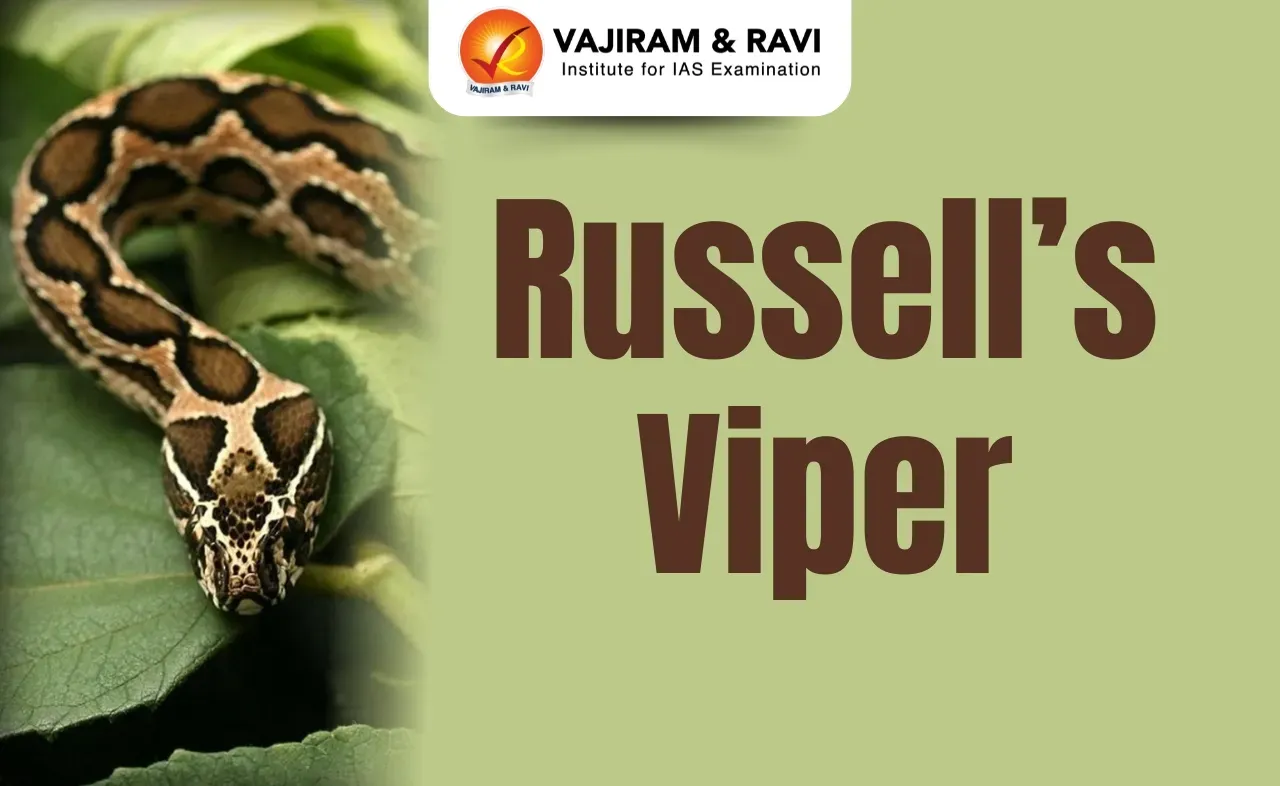
Studies carried out in mice have demonstrated that two approved drugs — varespladib and marimastat — were effective in countering systemic and lethal effects of Russell’s viper (Daboia russelii) venom either individually or in combination.
About Russell’s Viper
- Russell’s vipe is a highly venomous terrestrial snake of the family Viperidae found in Asia.
- It is one of the big four snakes (deadliest snakes) in India, the others being the Common krait (Bungarus caeruleus), the Indian Cobra (Naja naja) and the Saw-scaled viper (Echis carinatus).
- Russell’s vipers are responsible for over half of India’s snakebite cases.
- Habitat: They tend to avoid dense forests. They are mostly found in open, grassy, or bushy areas, but may also be found in second-growth forests (scrub jungles), on forested plantations, and on farmland.
- Distribution: It is found in India, Sri Lanka, Bangladesh, Nepal, Myanmar, Thailand, Pakistan, Cambodia, Tibet, China (Guangxi, Guangdong), Taiwan, and Indonesia.


Features of Russell’s Viper
- The snake can grow up to 1.5 meters and is identified by its distinctive reddish-brown spots outlined in black and white.
- It has a wide, triangular head with small, overlapping scales, large nostrils, and small eyes with vertical pupils.
- It is mainly nocturnal, becoming active as the sun fades.
- These snakes are quite sedentary, often staying in one place for several days unless disturbed.
- Conservations Status: IUCN Red List: Least Concern
Highlights of the Study
- Phospholipase A2 (PLA2), and Snake Venom Metalloproteinase (SVMPs) are two main components of Russell’s viper snake venom.
- These toxins interfere with components of the blood clotting cascade to induce anticoagulant and haemorrhagic effects in humans. While the varespladib drug inhibits PLA2, the marimastat drug inhibits SVMP.
- The PLA2 inhibitor varespladib was found to neutralise even the high PLA2 activity of the venom found in Tamil Nadu and Punjab. The varespladib drug effectively inhibited the modest PLA2 activity of the venom from other Indian regions.
Source: TH

 Last updated on Oct, 2026
→ UPSC 2027 Notification will be released on 13 January 2027 at upsconline.nic.in.
→ Asian Games 2026 are being held in Aichi-Nagoya, Japan, from 19 September to 4 October.
→ Check Nobel Prize 2026 Winners List here.
→ Download PIB PRiSM Monthly Magazine 2026 here.
→ Check UPSC Monthly Current Affairs Magazine The Recitals here.
→ Check out the latest UPSC Syllabus here.
→ Download UPSC Model Answers for Mains 2026
→ UPSC Mains Question Paper 2026 is out now for Essay & GS Paper 1, 2, 3 & 4.
→ UPSC Calendar 2027 has been released.
→ Enroll in Vajiram & Ravi’s UPSC Mains Test Series 2027 for structured answer writing practice, expert evaluation, and exam-oriented feedback.
→ Join Vajiram & Ravi’s UPSC Mentorship Program 2027 for personalized guidance, strategy planning, and one-to-one support from experienced mentors.
→ Go through the UPSC Mains Previous Year Papers to enhance your preparation.
→ UPSC has released UPSC Toppers List 2025 with the Civil Services final result on its official website.
→ Also check Best UPSC Coaching in India
Russell’s Viper FAQs
Q1. What is the role of the phospholipase?+
Q2. Which drug is made from snake venom?+
Q3. What is anti-venom used for?+
Tags: prelims pointers russell’s viper upsc current affairs upsc prelims current affairs