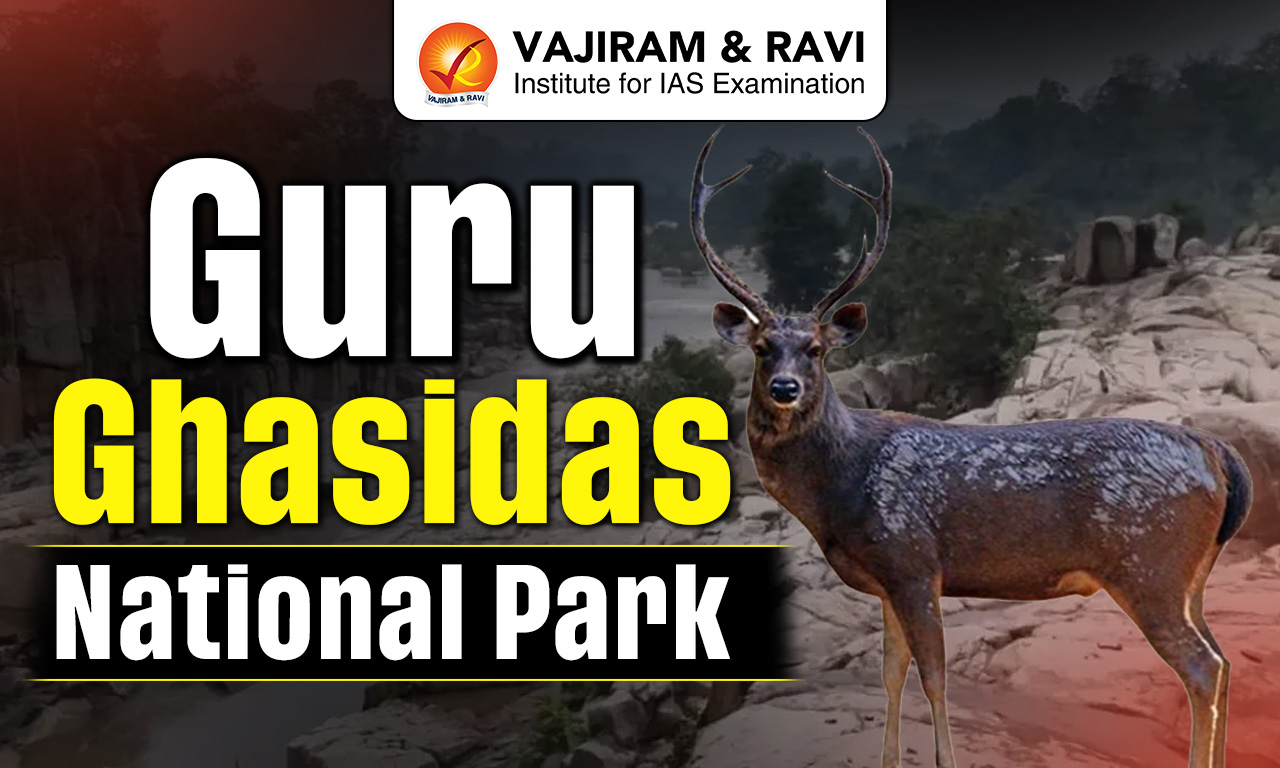
Guru Ghasidas National Park is one of the important protected areas in India, located in the state of Chhattisgarh. It is known for its rich biodiversity, dense forests, and wildlife. The park is part of a larger forest landscape and plays a key role in conserving endangered species. It is also significant from an ecological point of view as it supports a variety of flora and fauna.
Guru Ghasidas National Park Geography
- Guru Ghasidas National Park is located in northern Chhattisgarh, covering districts like Koriya, Manendragarh-Chirmiri-Bharatpur, Surajpur, and Balrampur. It shares borders with Madhya Pradesh and Jharkhand and is part of the larger Guru Ghasidas -Tamor Pingla Tiger Reserve.
- The park has a varied landscape of hills, plateaus, valleys, and dense tropical moist deciduous forests, with trees like sal, teak, and bamboo. Its altitude ranges from about 327 to 736 meters, supporting rich biodiversity.
- Several rivers and streams such as the Banas River, Bijaur Nala, Gopad, and Mahan provide water and sustain wildlife. The park also acts as an important wildlife corridor connecting Bandhavgarh Tiger Reserve and Palamau Tiger Reserve, making it ecologically significant.
Guru Ghasidas National Park History
- The history of Guru Ghasidas National Park is closely linked with the earlier Sanjay National Park and the Sanjay-Dubri Tiger Reserve. This reserve was originally created in 1983 to protect tigers and their natural habitat. At that time, the entire area was part of Madhya Pradesh.
- In the year 2000, when Chhattisgarh was formed as a separate state, a large portion of this forest area came under its control. The Chhattisgarh government later renamed this part as Guru Ghasidas National Park, in honour of Guru Ghasidas, a respected social reformer of the region.
- In 2011, Jairam Ramesh, who was then the Minister of State for Environment and Forests, suggested developing this area into a tiger reserve to strengthen wildlife conservation. Since around 2010, the park has had a small population of tigers, which it shares with nearby forest areas of Madhya Pradesh.


Guru Ghasidas National Park Flora
Guru Ghasidas National Park is mainly covered with sub-tropical and tropical deciduous forests. The most common tree found here is sal (also called sakhua), which forms a large part of the forest cover. Along with sal, other important trees include teak, saja, salai, mahua, shisham, gurjan, achar, tendu, and bamboo. These forests provide food and shelter to wildlife and help maintain the ecological balance of the region.
Guru Ghasidas National Park Fauna
- The park has a rich variety of wildlife and supports a healthy ecosystem. It is home to animals like tigers, leopards, nilgai, jackals, antelopes, wild boars, bison (gaur), hyenas, and porcupines. These species show the diversity of mammals found in the park.
- The park also has many bird species such as parakeets, bulbuls, rufous treepie, red-headed vulture, and racket-tailed drongo, making it important for bird conservation as well.
- In addition, several reptiles like cobras, monitor lizards, and pythons are found here. Overall, the presence of different types of animals, birds, and reptiles highlights the rich biodiversity of the park and its importance for conservation.
Guru Ghasidas National Park Significance
- Guru Ghasidas National Park is important because it plays a key role in conserving biodiversity in central India. It provides a natural habitat for many species of animals, birds, and plants, including endangered species like tigers. This makes it an important part of India’s protected area network.
- Another major significance of the park is its role as a wildlife corridor. It connects important forest areas like Bandhavgarh Tiger Reserve and Palamau Tiger Reserve, allowing animals to move freely. This helps in maintaining genetic diversity and ecological balance.
- The park is also important from an ecological point of view as it helps in climate regulation, soil conservation, and maintaining water resources. Its forests support rainfall patterns and reduce environmental degradation.

 Last updated on Oct, 2026
→ UPSC 2027 Notification will be released on 13 January 2027 at upsconline.nic.in.
→ Check Nobel Prize 2026 Winners List here.
→ Download PIB PRiSM Monthly Magazine 2026 here.
→ Check UPSC Monthly Current Affairs Magazine The Recitals here.
→ Check out the latest UPSC Syllabus here.
→ Download UPSC Model Answers for Mains 2026
→ UPSC Mains Question Paper 2026 is out now for Essay & GS Paper 1, 2, 3 & 4.
→ UPSC Calendar 2027 has been released.
→ Enroll in Vajiram & Ravi’s UPSC Mains Test Series 2027 for structured answer writing practice, expert evaluation, and exam-oriented feedback.
→ Join Vajiram & Ravi’s UPSC Mentorship Program 2027 for personalized guidance, strategy planning, and one-to-one support from experienced mentors.
→ Go through the UPSC Mains Previous Year Papers to enhance your preparation.
→ UPSC has released UPSC Toppers List 2025 with the Civil Services final result on its official website.
→ Also check Best UPSC Coaching in India
Guru Ghasidas National Park FAQs
Q1. What is Guru Ghasidas National Park?+
Q2. Where is Guru Ghasidas National Park located?+
Q3. What is the geographical importance of the park?+
Q4. What is the history of Guru Ghasidas National Park?+
Q5. What type of vegetation is found in the park?+
Tags: environment environment notes