About Northern Bald Ibis:
- Scientific Name: Geronticus eremita
- Conservation status: Endangered (formerly Critically Endangered)
- Historical range: Once native to Central Europe until the 17th century, also found in North Africa and the Arabian Peninsula.
- Extinction in Europe: The species became extinct in Central Europe by the 17th century due to excessive hunting.
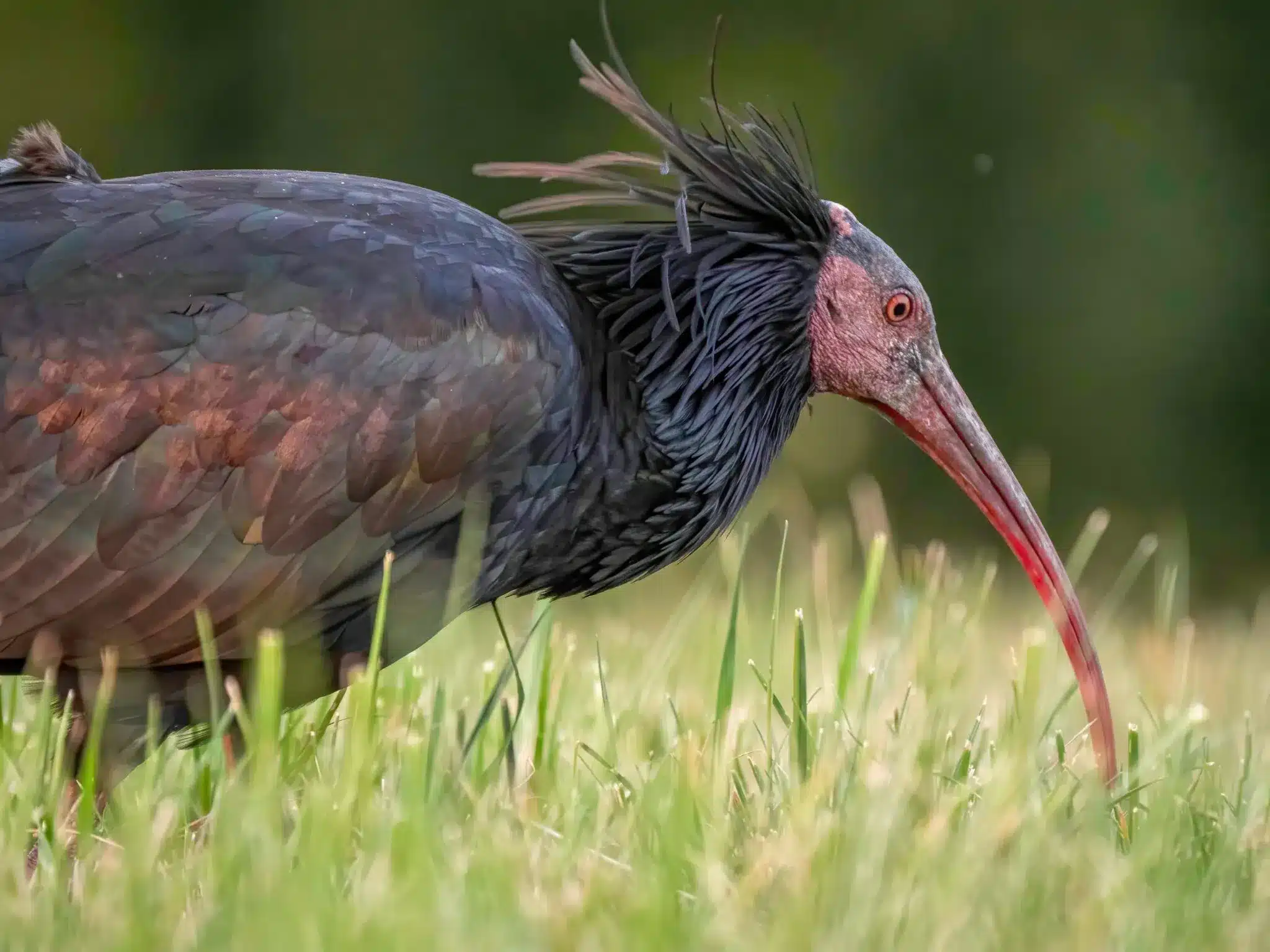
- Distinctive features: The Northern Bald Ibis is known for its black plumage with an iridescent green sheen, a bald red head adorned with black markings, and a long, downward-curved beak.
- Their red beak and legs stand out against their dark feathers. There is no sexual dimorphism in this species.
- Diet: They primarily feed on insect larvae, earthworms, and other invertebrates, using their long, slender beak to probe the ground, guided by their sense of touch.
- Habitat: These ibises prefer open areas with short grass, such as meadows, pastures, or even sports fields like golf courses. Despite their bald head resembling that of a vulture, they are not scavengers.
- Social behaviour: Northern Bald Ibises are social birds, historically forming large colonies with thousands of individuals.
- They engage in a ritual greeting involving crest-spreading and bowing, which often triggers a similar response throughout the colony.
- Monogamy: Typically, seasonally monogamous, breeding partnerships often change yearly, though some pairs may stay together for multiple years.
- Breeding habits: They choose steep rock faces with protective nooks for nesting, laying up to four greenish eggs. Incubation begins with the first egg, leading to staggered hatching times.
Nestling development: Young birds fledge within 42-50 days, initially following their parents before joining juvenile groups. They learn migration routes by following experienced birds during the fall migration.
Q1. What is IUCN?
The International Union for Conservation of Nature is a global organization composed of governments, NGOs, scientists, and experts dedicated to conserving nature and promoting sustainability. Its primary role involves assessing the conservation status of species, providing data and analysis on the state of biodiversity worldwide, and offering guidance and frameworks for conservation efforts.


 Last updated on Oct, 2026
→ UPSC 2027 Notification will be released on 13 January 2027 at upsconline.nic.in.
→ Asian Games 2026 are being held in Aichi-Nagoya, Japan, from 19 September to 4 October.
→ Check Nobel Prize 2026 Winners List here.
→ Download PIB PRiSM Monthly Magazine 2026 here.
→ Check UPSC Monthly Current Affairs Magazine The Recitals here.
→ Check out the latest UPSC Syllabus here.
→ Download UPSC Model Answers for Mains 2026
→ UPSC Mains Question Paper 2026 is out now for Essay & GS Paper 1, 2, 3 & 4.
→ UPSC Calendar 2027 has been released.
→ Enroll in Vajiram & Ravi’s UPSC Mains Test Series 2027 for structured answer writing practice, expert evaluation, and exam-oriented feedback.
→ Join Vajiram & Ravi’s UPSC Mentorship Program 2027 for personalized guidance, strategy planning, and one-to-one support from experienced mentors.
→ Go through the UPSC Mains Previous Year Papers to enhance your preparation.
→ UPSC has released UPSC Toppers List 2025 with the Civil Services final result on its official website.
→ Also check Best UPSC Coaching in India