About PARAM Rudra Supercomputer:
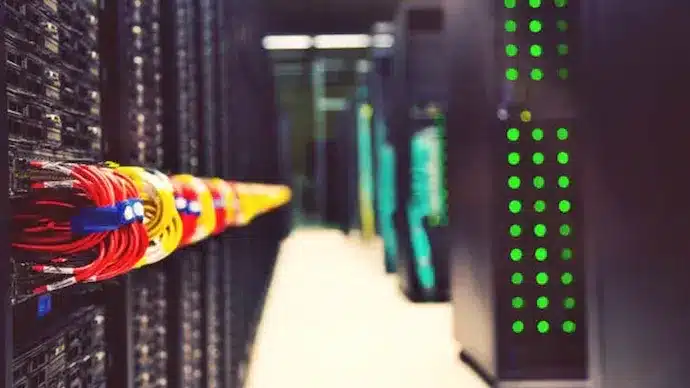
- It is designed to tackle complex computational challenges across various scientific and engineering domains.
- Three Param Rudra supercomputers have been developed at Rs 130 crores, indigenously under the National Supercomputing Mission.
- They have been deployed at three key locations: Delhi, Pune and Kolkata.
- In Pune, the Giant Metre Radio Telescope (GMRT) will leverage the supercomputer to explore Fast Radio Bursts (FRBs) and other astronomical phenomena.
- In Delhi, Inter University Accelerator Centre (IUAC) will enhance research in fields like material science and atomic physics.
- In Kolkata, S N Bose Centre will use supercomputing technology to drive advanced research in areas such as physics, cosmology, and earth sciences.
What is a High-Performance Computing (HPC) system?
- It is tailored for weather and climate research.
- It is located at two key sites, the Indian Institute of Tropical Meteorology (IITM) in Pune and the National Center for Medium Range Weather Forecast (NCMRWF) in Noida, this HPC system has extraordinary computing power.
- The new HPC systems are named ‘Arka’ and ‘Arunika,’ reflecting their connection to the Sun.
- Significance: These high-resolution models will significantly enhance the accuracy and lead time of predictions related to tropical cyclones, heavy precipitation, thunderstorms, hailstorms, heat waves, droughts, and other critical weather phenomena.
Key facts about the National Supercomputing Mission
- It was launched in 2015 to provide the country with supercomputing infrastructure to meet the increasing computational demands of academia, researchers, MSMEs, and startups.
- It aims to create a network of advanced computing systems across India.
- It is a collaboration between the Ministry of Electronics and Information Technology (MeitY) and the Department of Science and Technology (DST).
- It is implemented by the Centre for Development of Advanced Computing (C-DAC), Pune and the Indian Institute of Science (IISc), Bengaluru.
Q1: What is the Giant Metrewave Radio Telescope (GMRT)?
It is a low-frequency radio telescope that helps investigate various radio astrophysical problems ranging from nearby solar systems to the edge of the observable universe .It is located at Khodad, 80 km north of Pune, Maharashtra. It is a project of the Department of Atomic Energy (DAE), operating under the Tata Institute of Fundamental Research (TIFR).


 Last updated on Oct, 2026
→ UPSC 2027 Notification will be released on 13 January 2027 at upsconline.nic.in.
→ Asian Games 2026 are being held in Aichi-Nagoya, Japan, from 19 September to 4 October.
→ Check Nobel Prize 2026 Winners List here.
→ Download PIB PRiSM Monthly Magazine 2026 here.
→ Check UPSC Monthly Current Affairs Magazine The Recitals here.
→ Check out the latest UPSC Syllabus here.
→ Download UPSC Model Answers for Mains 2026
→ UPSC Mains Question Paper 2026 is out now for Essay & GS Paper 1, 2, 3 & 4.
→ UPSC Calendar 2027 has been released.
→ Enroll in Vajiram & Ravi’s UPSC Mains Test Series 2027 for structured answer writing practice, expert evaluation, and exam-oriented feedback.
→ Join Vajiram & Ravi’s UPSC Mentorship Program 2027 for personalized guidance, strategy planning, and one-to-one support from experienced mentors.
→ Go through the UPSC Mains Previous Year Papers to enhance your preparation.
→ UPSC has released UPSC Toppers List 2025 with the Civil Services final result on its official website.
→ Also check Best UPSC Coaching in India