Solar Coronal Holes Latest News
Recently, a new study has accurately estimated the physical parameters of thermal and magnetic field structures of solar coronal holes.
About Solar Coronal Holes
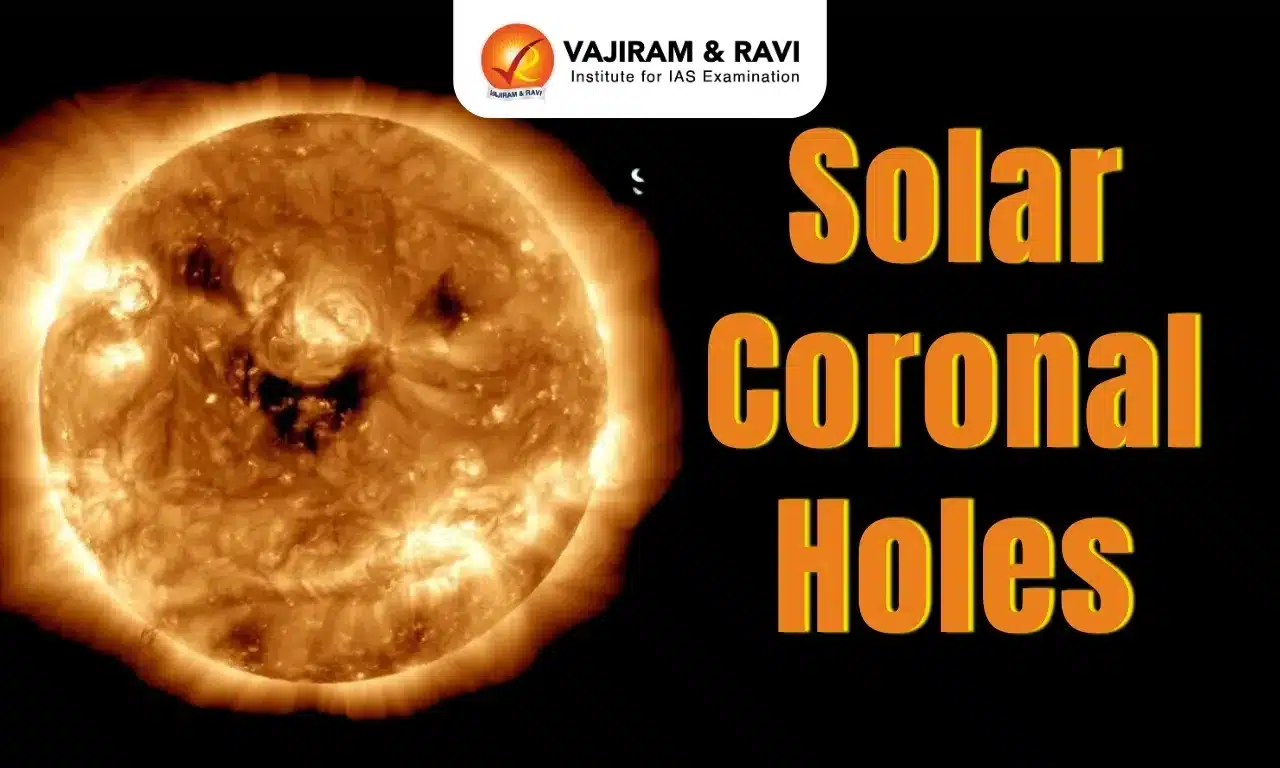
- Coronal holes are dark regions in X-ray and extreme ultraviolet images of the Sun.
- These were discovered in the 1970s by X-ray satellites.


Features of Solar Coronal Holes
- They appear dark because they are cooler, less dense regions than the surrounding plasma and are regions of open, unipolar magnetic fields.
- They have open magnetic field lines and are hence important for understanding the interplanetary medium and space weather.
- Coronal holes can last between a few weeks to months. The holes are not a unique phenomenon, appearing throughout the sun’s approximately 11-year solar cycle.
- They can last much longer during solar minimum – a period of time when activity on the Sun is substantially diminished, according to NASA.
Significance of Solar Coronal Holes
- The occurrences of coronal holes are associated with disturbances in the Earth’s ionosphere, the layer of the atmosphere that reflects and modifies the radio waves, leading to further communication issues.
- They have significant influence on space weather that affects satellites, as well as the Indian summer monsoon rainfall.
Solar Coronal Holes FAQs
Q1. What is a solar coronal hole?
Ans. A coronal hole is a large region in the corona which is less dense and is cooler than its surroundings.
Q2. What is ejected from the Sun’s coronal hole?
Ans. Coronal mass ejections (CMEs) are huge bubbles of coronal plasma threaded by intense magnetic field lines that are ejected from the Sun over the course of several hours.
Q3. Why do sunspots appear dark?
Ans. Sunspots are areas that appear dark on the surface of the Sun. They appear dark because they are cooler than other parts of the Sun’s surface.
Source: PIB

 Last updated on Sep, 2026
→ UPSC 2027 Notification will be released on 13 January 2027 at upsconline.nic.in.
→ Asian Games 2026 are being held in Aichi-Nagoya, Japan, from 19 September to 4 October.
→ Check out the latest UPSC Syllabus here.
→ Download UPSC Model Answers for Mains 2026
→ UPSC Mains Question Paper 2026 is out now for Essay & GS Paper 1, 2, 3 & 4.
→ UPSC Calendar 2027 has been released.
→ Enroll in Vajiram & Ravi’s UPSC Mains Test Series 2027 for structured answer writing practice, expert evaluation, and exam-oriented feedback.
→ Join Vajiram & Ravi’s UPSC Mentorship Program 2027 for personalized guidance, strategy planning, and one-to-one support from experienced mentors.
→ Go through the UPSC Mains Previous Year Papers to enhance your preparation.
→ UPSC has released UPSC Toppers List 2025 with the Civil Services final result on its official website.
→ Also check Best UPSC Coaching in India