What’s in today’s article?
- Why in news?
- What is an Earthquake?
- News Summary: Earthquake in Morocco
- Where did the quake hit?
- Why the Morocco quake occurred?
- What is oblique-reverse faulting?
Why in news?
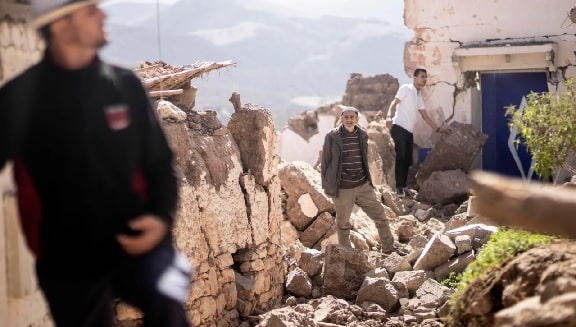
- A rare, powerful earthquake struck Morocco on September 8 night, killing hundreds of people and damaging buildings, including in the historic city of Marrakech.
- Marrakech is a UNESCO World Heritage Site.
- So far, more than 2000 people have died, mostly in Marrakech and five provinces near the quake’s epicentre.
What is an Earthquake?

- An earthquake is an intense shaking of the ground caused by movement under the earth’s surface.
- The location below the earth’s surface where the earthquake starts is called the
- The location directly above the hypocentre on the surface of the earth is called the epicentre.
- It happens when two blocks (tectonic plates) of the earth suddenly slip past one another releasing stored-up ‘elastic strain’ energy in the form of seismic waves.
- These spread through the earth and cause the shaking of the ground.
- They are measured on scales called the –
- Moment Magnitude Scale (Mw), based on the total moment (a product of the distance a fault moved and the force required to move it) release of the earthquake.
- The Richter scale (magnitude scale) – energy released – 0-10.
- The intensity scale/Mercalli scale – visible damage – 1-12.
- Earthquakes continue to remain the most common natural hazard that cannot be predicted as no early warning systems can be developed.


News Summary: Earthquake in Morocco
- The epicentre of the earthquake was located in the High Atlas Mountain range, about 72 kilometers from Marrakech.
- The quake had a magnitude of 6.8, meaning it is classed as “strong.” It also struck at a relatively shallow depth, making it more destructive.
- As per the US Geological Survey (USGS),the focus was 18.5 km below the Earth’s surface, though Morocco’s own seismic agency pegged the depth at 11 km.
- Either way, it was a fairly shallow quake.
- Such quakes are generally more dangerous as they carry more energy to the surface, when compared to quakes that occur deeper underneath the surface.
- While deeper quakes do indeed spread farther as seismic waves move radially upwards to the surface, they lose energy while travelling greater distances.
- Earthquakes of this size in the region are uncommon, according to the US Geological Survey, but not unexpected.
- Nine quakes with a magnitude of 5 or higher have hit the area since 1900, but none of them have had a magnitude higher than 6.

Why the Morocco quake occurred?
- Background
- While seismicity rates are indeed lower in the region, making earthquakes rarer, they are not completely unheard of.
- According to the USGS, large destructive earthquakes have been recorded and reported from Morocco in the western Mediterranean.
- Such quakes occur due to the northward convergence of the African plate with respect to the Eurasian plate along a complex plate boundary.
- Reasons behind Morocco quake
- With respect to Morocco’s quake, the USGS attributed it to oblique-reverse faulting at shallow depth within the Moroccan High Atlas Mountain range.

What is oblique-reverse faulting?
- Fault
- A fault is a fracture or zone of fractures between two blocks of rock.
- Faults allow the blocks to move relative to each other, causing earthquakes if the movement occurs rapidly.
- During a quake, the rock on one side of the fault suddenly slips with respect to the other.
- Different types of faults
- Scientists use the angle of the fault with respect to the surface (known as the dip) and the direction of the slip along the fault to classify faults.
- Faults which move along the direction of the dip plane are dip-slip faults, whereas faults which move horizontally are known as strike-slip faults.
- Oblique-slip faults show characteristics of both dip-slip and strike-slip faults.
- The term reverse refers to a situation that the upper block, above the fault plane, moves up and over the lower block.
- Oblique-reverse faulting
- It is also known as oblique-thrust faulting.
- It is a type of geological faulting in which rocks on one side of the fault plane move vertically and horizontally in response to compressional forces.
- This type of faulting is common in areas of compression — when one tectonic plate is converging into another.

Q1) What is Atlas Mountain Range?
The Atlas Mountains are a prominent mountain range in North Africa, stretching across Morocco, Algeria, and Tunisia.
Q2) What is a tectonic plate?
A tectonic plate is a massive, rigid slab of rock that makes up a significant portion of the Earth’s outer shell, known as the lithosphere. These plates are the fundamental building blocks of the Earth’s crust and uppermost mantle, and they cover the entire surface of our planet. Tectonic plates vary in size but can be as large as entire continents or smaller, covering portions of continents or ocean basins.
Source: Why the earthquake in Morocco has caused so much damage | CNN | Indian Express

 Last updated on Oct, 2026
→ UPSC 2027 Notification will be released on 13 January 2027 at upsconline.nic.in.
→ Check Nobel Prize 2026 Winners List here.
→ Download PIB PRiSM Monthly Magazine 2026 here.
→ Check UPSC Monthly Current Affairs Magazine The Recitals here.
→ Check out the latest UPSC Syllabus here.
→ Download UPSC Model Answers for Mains 2026
→ UPSC Mains Question Paper 2026 is out now for Essay & GS Paper 1, 2, 3 & 4.
→ UPSC Calendar 2027 has been released.
→ Enroll in Vajiram & Ravi’s UPSC Mains Test Series 2027 for structured answer writing practice, expert evaluation, and exam-oriented feedback.
→ Join Vajiram & Ravi’s UPSC Mentorship Program 2027 for personalized guidance, strategy planning, and one-to-one support from experienced mentors.
→ Go through the UPSC Mains Previous Year Papers to enhance your preparation.
→ UPSC has released UPSC Toppers List 2025 with the Civil Services final result on its official website.
→ Also check Best UPSC Coaching in India