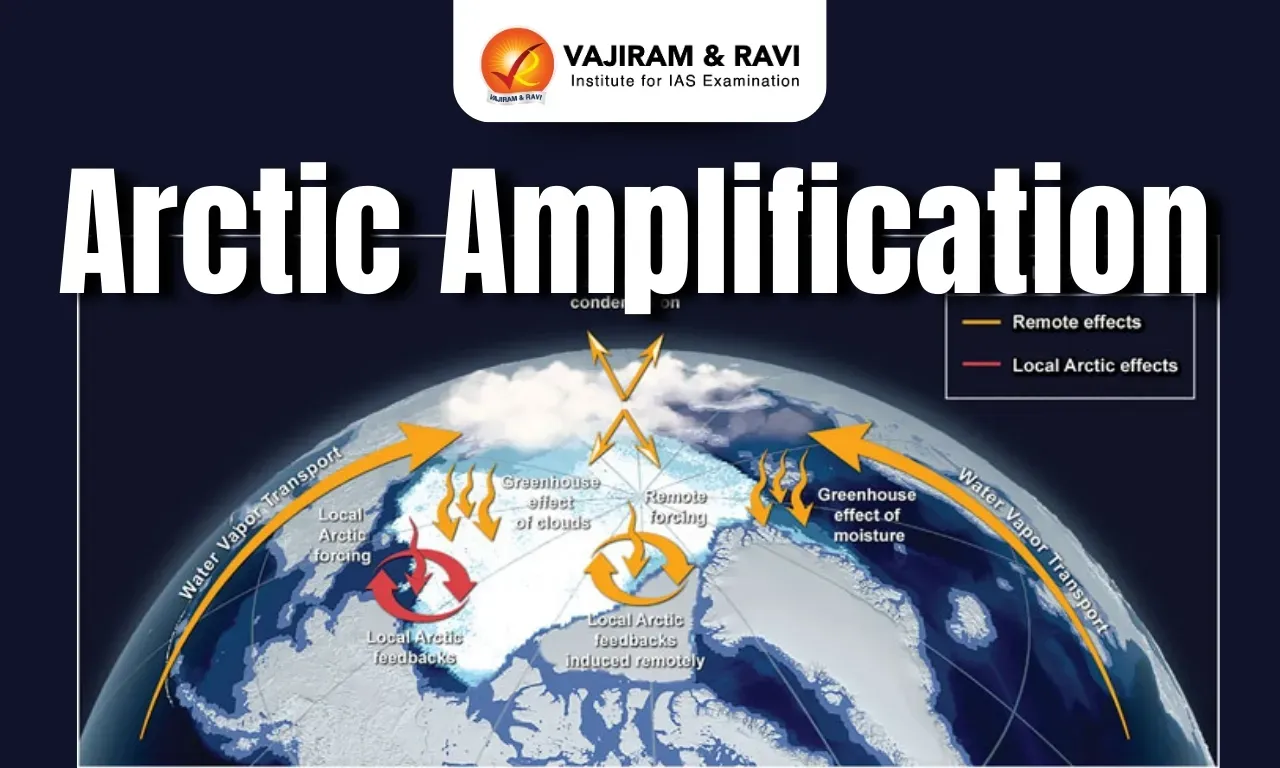
Arctic Amplification Latest News
According to the 2024 European State of the Climate Report, Europe has warmed nearly twice as much as the global average, with far-reaching climatic and ecological consequences.
What is Arctic Amplification?
- Arctic amplification is a phenomenon where temperature changes in the polar regions, especially the Arctic, are more intense than the global average temperature change.
- It is a form of polar amplification, which occurs when changes in Earth’s atmosphere lead to a greater rise in temperatures near the poles than in other parts of the world.
- This effect is measured against the average temperature rise of the planet and is particularly pronounced in the northern polar regions, hence the term Arctic amplification.
- The phenomenon is primarily driven by changes in the net radiation balance of the atmosphere, especially due to the increase in greenhouse gases like CO₂ and methane, which trap more heat in the Arctic region.
- The major contributing factors to Arctic amplification are: Ice-Albedo Feedback, Lapse Rate Feedback, Water Vapour Feedback & Ocean Heat Transport.


Key Highlights from the 2024 European State of the Climate Report
- The Arctic region is warming three to four times faster than the global average, a phenomenon called Arctic Amplification.
- This is due to the melting of Arctic ice, reducing the albedo effect, where ice (which reflects sunlight) is replaced by darker surfaces (land or water) that absorb more solar radiation, enhancing warming.
- Warming Trends in Europe vs. Global Averages:
- The global average temperature has risen by approximately 1.3°C above pre-industrial levels (1850–1900 baseline).
- In 2024, the planet crossed the critical 1.5°C threshold for the first time.
- Europe’s average temperature has increased by about 2.4°C, making it one of the fastest-warming regions on Earth.
- This accelerated warming has led to extreme weather events, including intense heat waves, heavy rainfall, and flooding.
- Regional Climatic Contrasts Within Europe:
- The Eastern part of Europe experienced warmer and sunnier conditions.
- Western Europe witnessed cloudier and wetter weather.
- Southeastern European countries (e.g., Bulgaria, Romania, Serbia, Croatia) saw their longest heatwave on record in 2024.
- The number of ‘cold stress days’ was the lowest ever, and below-freezing temperature days dropped significantly.
Source: IE

 Last updated on Oct, 2026
→ UPSC 2027 Notification will be released on 13 January 2027 at upsconline.nic.in.
→ Check Nobel Prize 2026 Winners List here.
→ Download PIB PRiSM Monthly Magazine 2026 here.
→ Check UPSC Monthly Current Affairs Magazine The Recitals here.
→ Check out the latest UPSC Syllabus here.
→ Download UPSC Model Answers for Mains 2026
→ UPSC Mains Question Paper 2026 is out now for Essay & GS Paper 1, 2, 3 & 4.
→ UPSC Calendar 2027 has been released.
→ Enroll in Vajiram & Ravi’s UPSC Mains Test Series 2027 for structured answer writing practice, expert evaluation, and exam-oriented feedback.
→ Join Vajiram & Ravi’s UPSC Mentorship Program 2027 for personalized guidance, strategy planning, and one-to-one support from experienced mentors.
→ Go through the UPSC Mains Previous Year Papers to enhance your preparation.
→ UPSC has released UPSC Toppers List 2025 with the Civil Services final result on its official website.
→ Also check Best UPSC Coaching in India
Arctic Amplification FAQs
Q1. What is Arctic Amplification?+
Q2. What causes Arctic Amplification?+
Q3. How does Arctic Amplification affect global climate?+
Tags: arctic amplification prelims pointers upsc current affairs upsc prelims current affairs