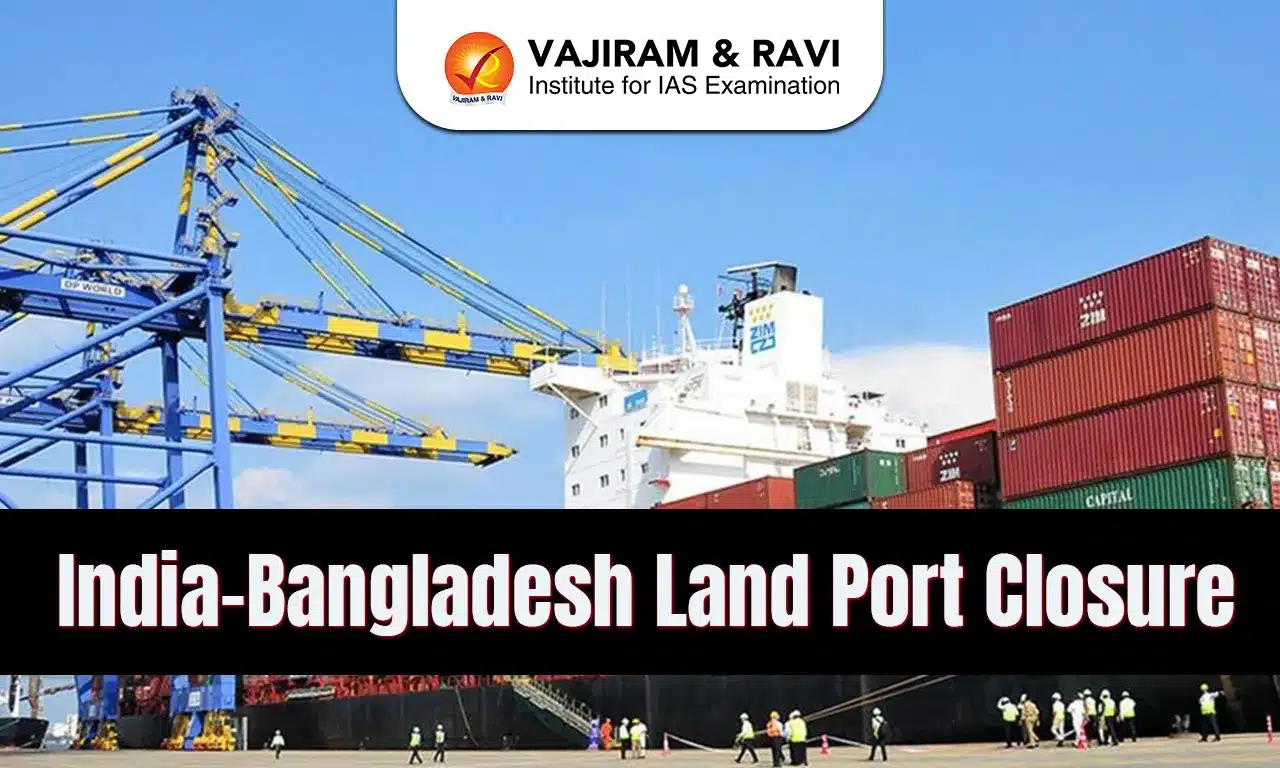
India-Bangladesh Land Port Closure Latest News
- Recently, India’s Directorate General of Foreign Trade ordered the closure of all land ports with Bangladesh for the export of apparel and certain goods via northeastern ports.
- The move is seen as a consequence of deteriorating India-Bangladesh relations following the fall of the Hasina government in August, with both countries yet to rebuild a functional diplomatic rapport.
Key Highlights of the May Trade Order on Bangladesh
- Import Restrictions via Land Ports
- India has halted the import of readymade garments from Bangladesh through all land ports.
- Imports are now only permitted via Nhava Sheva and Kolkata seaports.
- Export Bans to Bangladesh through the Northeast
- Exports of specific goods have been banned through the land ports of Assam, Meghalaya, Mizoram, and Tripura.
- These include fruits, fruit-flavoured drinks, processed food items (like baked goods, chips, and confectionery), cotton and cotton yarn waste, finished plastic and PVC goods (excluding pigments, dyes, plasticisers, and granules), and wooden furniture.
- Additional Land Routes Affected
- The same export restrictions apply at the Changrabandha and Fulbari land customs stations in West Bengal.
- Exemptions from the Ban
- Imports of fish, LPG, edible oil, and crushed stone from Bangladesh remain unaffected by the order.


Reasons Behind India’s Trade Restrictions on Bangladesh
- Call for Reciprocity in Trade
- India cited the need to ensure reciprocal trade relations after Bangladesh took unilateral steps affecting Indian exports.
- Bangladesh’s Restrictions Triggered Response
- On April 13, Bangladesh’s National Board of Revenue banned the import of cotton yarn from India via land ports.
- It also halted Indian rice exports through the Hili land port in West Bengal.
- Rising Friction at Border Crossings
- Indian officials reported that Bangladeshi authorities had been conducting aggressive inspections of Indian trucks for several months, leading to delays and trade disruptions.
- Scale of Border Trade Affected
- India and Bangladesh share 24 operational land ports, with several more under development, making these restrictions significant in scope and impact.
India’s Justification for the Trade Restrictions
- Immediate Implementation with Scope for Review
- The restrictions, effective from May 17, are subject to regular review.
- Even seaport trade with Bangladesh will face increased scrutiny and periodic assessments.
- Allegations of Trade Imbalance and Market Manipulation
- Indian officials accused Bangladesh of “cherry-picking” trade issues and attempting to treat the northeast region of India as a “captive market” for its goods, without offering fair access or transit for Indian products.
- Strategic Importance of the Northeast Region
- Citing Prime Minister Modi’s remarks, officials emphasized that the northeast is central to India’s BIMSTEC vision and economic strategy.
- The move is aimed at encouraging domestic manufacturing and entrepreneurship in the region, in line with the Atmanirbhar Bharat initiative.
Impact on Bangladesh’s Trade with Nepal and Bhutan
- India’s Assurances on Third-Country Trade
- India has stated that its order will not affect Bangladesh’s trade with Nepal and Bhutan.
- Despite India’s claims, the overland trade restrictions are expected to cause logistical hurdles, leading to delays and disruptions in shipments from Bangladesh to Nepal.
- Ripple Effect on Investment Climate
- The sudden order has created uncertainty, prompting investment planners to adopt a cautious approach towards entering or expanding operations in Bangladesh.
Wider Geopolitical Undercurrents Behind India’s Land Port Closure
- A Diplomatic Message to Bangladesh
- Indian officials have described the land port restrictions as a calculated signal to Bangladesh, particularly in response to remarks made by interim government chief Mohammed Yunus during his visit to China in March.
- Concerns Over Northeast Region References
- Prof. Yunus referred to India’s northeast as “landlocked” and promoted Bangladesh as a strategic route for Chinese access to the region, positioning Bangladesh as a “guardian of the ocean.”
- India found these remarks unacceptable.
- Apprehensions About Bangladesh-Pakistan Ties
- Indian officials also cited growing warmth between Bangladesh’s interim government and Pakistan—an actor India holds responsible for cross-border terrorism—as part of the backdrop to the decision.
- Economic and Symbolic Impact
- While the ban on readymade garments affects only a $700 million slice of Bangladesh’s $50 billion exports, India believes it is significant enough to convey its geopolitical concerns to both Bangladesh and the global community.
India-Bangladesh Land Port Closure FAQs
Q1. Why did India shut land ports with Bangladesh?
Ans. India cited lack of trade reciprocity and geopolitical concerns with Bangladesh’s interim government as key reasons.
Q2. What goods were banned in the May 2025 order?
Ans. Apparel, food items, plastic goods, cotton waste, and furniture were restricted via northeastern land ports.
Q3. Will this affect Bangladesh’s trade with Nepal?
Ans. Yes, logistical disruptions from land closures are likely to hamper smooth trade with Nepal.
Q4. How did Bangladesh react to the ban?
Ans. Informally disappointed, Bangladesh criticized lack of communication and expressed concern over garment export losses.
Q5. Is this part of a larger political issue?
Ans. Yes, it responds to controversial remarks by Bangladesh’s interim leader and warming ties with China and Pakistan.
Source: TH

 Last updated on Oct, 2026
→ UPSC 2027 Notification will be released on 13 January 2027 at upsconline.nic.in.
→ Asian Games 2026 are being held in Aichi-Nagoya, Japan, from 19 September to 4 October.
→ Check Nobel Prize 2026 Winners List here.
→ Download PIB PRiSM Monthly Magazine 2026 here.
→ Check UPSC Monthly Current Affairs Magazine The Recitals here.
→ Check out the latest UPSC Syllabus here.
→ Download UPSC Model Answers for Mains 2026
→ UPSC Mains Question Paper 2026 is out now for Essay & GS Paper 1, 2, 3 & 4.
→ UPSC Calendar 2027 has been released.
→ Enroll in Vajiram & Ravi’s UPSC Mains Test Series 2027 for structured answer writing practice, expert evaluation, and exam-oriented feedback.
→ Join Vajiram & Ravi’s UPSC Mentorship Program 2027 for personalized guidance, strategy planning, and one-to-one support from experienced mentors.
→ Go through the UPSC Mains Previous Year Papers to enhance your preparation.
→ UPSC has released UPSC Toppers List 2025 with the Civil Services final result on its official website.
→ Also check Best UPSC Coaching in India
Tags: india-bangladesh land port closure mains articles upsc current affairs upsc mains current affairs