7 Wonders of the World: The world is home to countless architectural and cultural masterpieces that showcase human creativity, engineering excellence, and artistic brilliance. Among these remarkable landmarks, seven monuments have been recognized as the New Seven Wonders of the World for their historical significance, unique design, and enduring legacy. These iconic structures attract millions of visitors every year and stand as symbols of human achievement across different civilizations. The Great Wall of China, Petra, the Colosseum, Chichen Itza, Machu Picchu, the Taj Mahal, and Christ the Redeemer are celebrated worldwide for their extraordinary beauty, craftsmanship, and cultural importance.
7 Wonders of the World
In 2000, the Swiss Foundation started a campaign to select the 7 Wonders of the World from the existing collection of 200 monuments. Out of the 200 monuments and landmarks under consideration, seven were chosen to be recognized as the New 7 Wonders of the World. These include the Giza Pyramid, the Great Wall of China, Petra, the Colosseum, Chichen Itza, Machu Picchu, the Taj Mahal, and Christ the Redeemer. Although the Great Pyramid of Giza is an iconic monument, it was not included in the official list of the Seven Wonders of the World, being recognized more as a historic landmark. Below, we provide a table showcasing the New Seven Wonders of the World.
| 7 Wonders of the World | |||
|
So. |
Name |
Location |
Year |
|
1 |
The Great Wall of China |
China |
700 BC |
|
2 |
The Petra |
ma’an, Jordan |
312 BC |
|
3 |
The Colosseum |
Rome, Italy |
AD 80 |
|
4 |
The Chichen Itza |
Yucatan, Mexico |
AD 600 |
|
5 |
The Machu Picchu |
Cusco Region, Peru |
AD 1450 |
|
6 |
The Taj Mahal |
Agra, India |
AD 1643 |
|
7 |
Christ the Redeemer |
Rio de Janeiro |
AD 1931 |
List of 7 Wonders of the World
Below we have shared some facts related to each of the 7 Wonders of the World, for a better understanding and to stay updated with the unknown facts.
The Great Wall of China
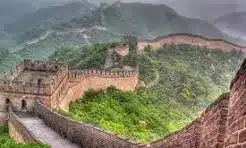
The Great Wall of China stands as one of the most massive construction projects in history. It is often referred to as a “wall” due to its dual structure, consisting of parallel walls spanning vast distances. This extensive network of fortifications was designed to safeguard the Chinese empires and their borders. Throughout history, various sections of the wall were built, starting as early as the 7th century BC, but the most iconic parts were constructed during the Ming dynasty (1368–1644). The entire system, including its branches, stretches over 21,196 kilometres. In 1987, it earned a UNESCO World Heritage status, drawing tourists from across the globe.
Petra, Jordan
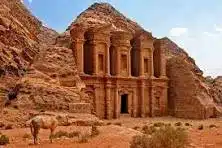
Located in a secluded valley in between sandstone mountains, Petra is a historical and archaeological wonder in southern Jordan. Originally known as Raqmu, Petra became the capital of the Nabataean Kingdom, an Arab tribe that made remarkable advancements in trade, architecture, and water management. The city flourished as a trade hub, particularly for spices. The rock-cut structures, which change hues under different sunlight, earned it the nickname “Rose City.” Petra’s complex water system and stunning architecture continue to captivate tourists.
The Colosseum, Italy
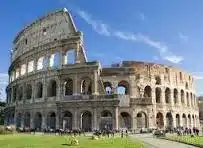
Located in Rome, the Colosseum (also called the Flavian Amphitheater) is an architectural marvel from the first century AD. Commissioned by Emperor Vespasian in AD 72 and completed by his son Titus in AD 80, this oval-shaped arena was designed for large-scale public spectacles. Made primarily from concrete and sand, the Colosseum features a series of intricate vaults and remains the largest amphitheater ever built. Today, it stands as an enduring symbol of Imperial Rome, attracting millions of visitors annually.
Chichen Itza, Mexico
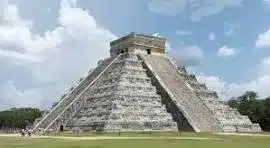
Chichen Itza, located in Mexico’s Yucatan Peninsula, was once a thriving city of the Maya civilization. At its peak in the 9th and 10th centuries CE, the city served as a center for trade and culture. The city’s most famous structure, the El Castillo pyramid, is a testament to the Mayans’ astronomical knowledge, with 365 steps representing the days of the year. Chichen Itza, a UNESCO World Heritage site since 1988, attracts tourists from around the world to explore its ancient temples and ball courts.
Machu Picchu, Peru
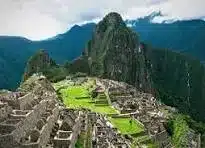
Machu Picchu is a 15th-century Inca citadel built 7,970 feet above sea level in the Andes Mountains of Peru. Believed to have been built for the Inca emperor Pachacuti, the site was abandoned by the 16th century but remained hidden from the outside world until American explorer Hiram Bingham rediscovered it in 1911. Known for its sophisticated dry-stone construction, agricultural terraces, and sacred temples, Machu Picchu remains one of the most well-preserved pre-Columbian sites in the world. It became a UNESCO World Heritage site in 1983 and continues to draw explorers and history enthusiasts.
The Taj Mahal, India
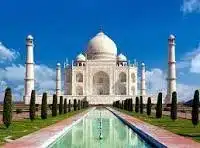
The Taj Mahal, located in Agra, India, is an architectural masterpiece and symbol of eternal love. Built by Mughal Emperor Shah Jahan in memory of his wife Mumtaz Mahal, the Taj Mahal is renowned for its stunning white marble dome and intricate design. The Taj Mahal took 22 years to complete and employed 20,000 workers, also features a vast garden and reflecting pool. It houses the tombs of both Mumtaz and Shah Jahan. Designated a UNESCO World Heritage site in 1983, the Taj Mahal remains one of the most popular tourist destinations in the world, attracting millions each year.
Christ the Redeemer, Brazil
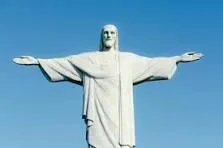
Christ the Redeemer, a monument statue of Jesus Christ, stands at the top of Mount Corcovado in Rio de Janeiro, Brazil. This Art Deco statue, designed by Brazilian engineer Heitor da Silva Costa and sculpted by French artist Paul Landowski, was completed in 1931. The 30-meter (98-foot) tall statue, with outstretched arms measuring 28 meters (92 feet), is made of reinforced concrete and covered in mosaic tiles. It overlooks the city of Rio and is the largest Art Deco sculpture in the world. In 2007, Christ the Redeemer was named one of the New 7 Wonders of the World.


Original 7 Wonders of the World
Of the Original 7 Wonders of the World, only the Great Pyramid of Giza remains intact today. The others were lost to history, destroyed over time by natural disasters such as earthquakes and fires. Among them, the famed Hanging Gardens of Babylon are believed to have been built near the Euphrates River, in present-day Iraq, by King Nebuchadnezzar II around 600 B.C. Ancient Greek poets described the gardens as a marvel, reportedly rising to a height of 75 feet atop a large, square, brick structure. The complete list of the Original 7 Wonders of the World includes:
- Great Pyramid of Giza – Egypt
- Hanging Gardens of Babylon – Ancient Mesopotamia (modern-day Iraq)
- Statue of Zeus at Olympia – Greece
- Temple of Artemis at Ephesus – Turkey
- Mausoleum at Halicarnassus – Turkey
- Colossus of Rhodes – Greece
- Lighthouse of Alexandria – Egypt
7 Wonders of the World Selection Process
The concept of the 7 Wonders of the World dates back to the 5th century BCE, when Greek historian Herodotus first made a list of the most remarkable man-made structures he encountered during his travels. These wonders reflected the inspiring achievements of ancient civilizations in architecture and engineering.
In contrast, a modern list, known as the New 7 Wonders of the World was finalized in 2007 through a global public voting campaign initiated by the New7Wonders Foundation. Millions of people from around the world participated, selecting monuments they believed best represented human creativity and heritage.
While there were no rigid criteria for selection, the chosen wonders typically stood out for their historical significance, architectural brilliance, cultural impact, and visual amazement.
About UNESCO World Heritage Sites
UNESCO World Heritage Sites are places of outstanding cultural, historical, scientific, or natural importance that are recognized and protected for their universal value to humanity.
- Designated by the United Nations Educational, Scientific and Cultural Organization (UNESCO).
- Include sites with exceptional cultural, natural, or mixed heritage value.
- Aim to preserve important landmarks and ecosystems for future generations.
- Selected based on specific criteria related to historical, cultural, scientific, or environmental significance.
- Receive international recognition and support for conservation efforts.
- Help promote sustainable tourism and cultural awareness.
- Encourage countries to protect and manage their heritage assets effectively.
- Include monuments, archaeological sites, forests, mountains, deserts, and national parks.
- The World Heritage Convention was adopted in 1972 to safeguard global heritage.
- India is home to several UNESCO World Heritage Sites, including the Taj Mahal, Qutub Minar, and Kaziranga National Park.
- World Heritage Sites represent the shared heritage of humanity and contribute to global cultural and environmental conservation.

 Last updated on August, 2026
→ UPSC Mains Question Paper 2026 is out now for Essay & GS Paper 1, 2, 3 & 4.
→ UPSC Mains GS Paper 1 2026 is out now.
→ UPSC Mains GS Paper 2 2026 is out now.
→ UPSC Mains GS Paper 3 2026 is out now.
→ UPSC Mains GS Paper 4 2026 is out now.
→ UPSC Mains Indian Language Paper & English Compulsory Paper are out now.
→ Check out the latest UPSC Syllabus 2026 here.
→ UPSC Mains Admit Card 2026 is now out.
→ Enroll in Vajiram & Ravi’s UPSC Mains Test Series 2027 for structured answer writing practice, expert evaluation, and exam-oriented feedback.
→ Join Vajiram & Ravi’s UPSC Mentorship Program 2027 for personalized guidance, strategy planning, and one-to-one support from experienced mentors.
→ Go through the UPSC Mains Previous Year Papers to enhance your preparation.
→ Download UPSC Mains Essay Paper 2025, UPSC Mains GS Paper-I 2025, UPSC Mains GS Paper-II 2025, UPSC Mains GS Paper-III 2025, UPSC Mains GS Paper-IV 2025, UPSC Mains English (Compulsory) Paper 2025, UPSC Mains Hindi (Qualifying) Paper 2025 here.
→ UPSC has released UPSC Toppers List 2025 with the Civil Services final result on its official website.
→ UPSC Calendar 2027 has been released.
→ Also check Best UPSC Coaching in India
7 Wonders of the World FAQs
Q1. Which are the official 7 Wonders of the World?+
Q2. What is the Speciality of 7 wonders of the world?+
Q3. When was Taj Mahal constructed?+
Q4. Where is The Great Wall of China situated?+
Q5. Is the Giza pyramid counted among 7 wonders of the world?+
Tags: 7 wonders of the world