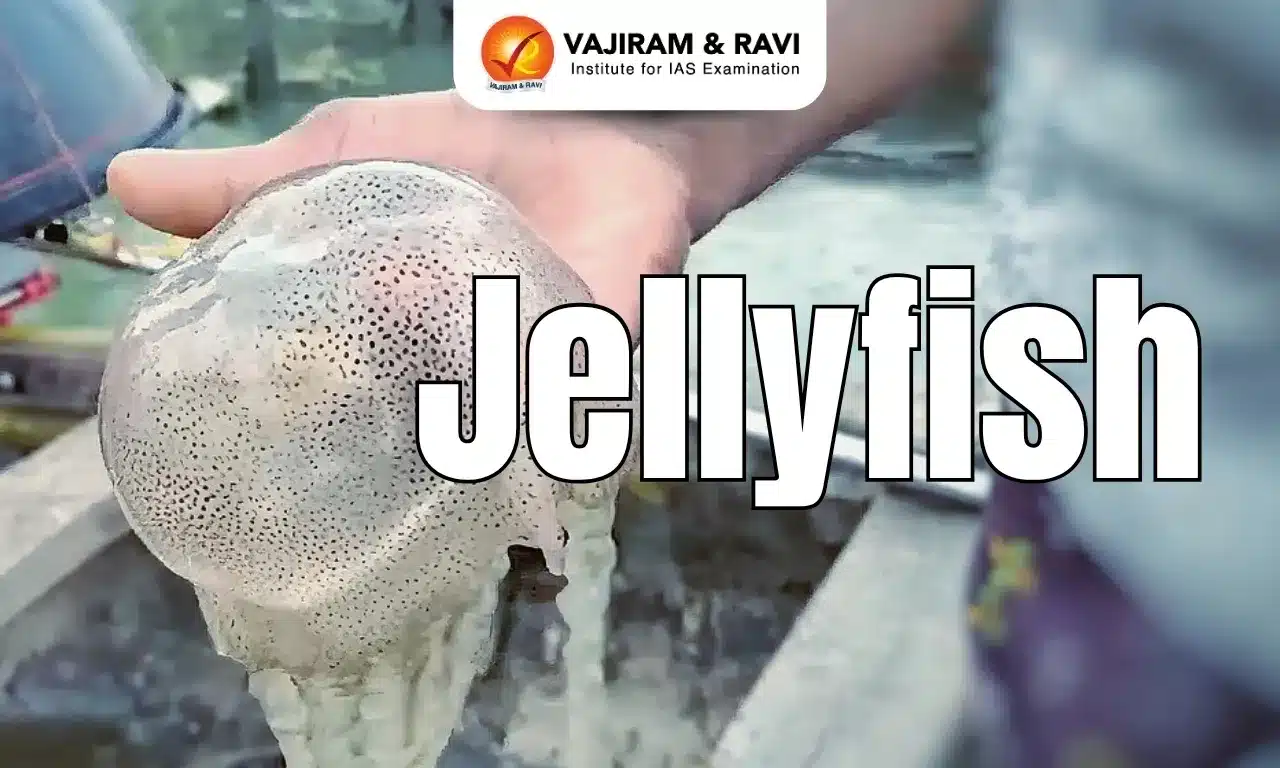
Jellyfish Latest News
Recently, one of the largest nuclear power plants in France was forced to temporarily shut down due to a slimy and spineless adversary: jellyfish.
About Jellyfish
- It is a resilient gelatinous zooplankton of the phylum Cnidaria.
- It is a highly adaptable marine organism with simple anatomy, stinging tentacles and efficient jet propulsion.


Characteristics of Jellyfish
- It is a simple invertebrate, members of the phylum Cnidaria, which includes creatures such as sea anemones, sea whips, and corals.
- The body parts of a jellyfish radiate from a central axis. This “radial symmetry” allows jellyfish to detect and respond to food or danger from any direction.
- They are pretty simple, lack brains, blood, or even hearts.
- Anatomy: They are composed of three layers: an outer layer, called the epidermis; a middle layer made of a thick, elastic, jelly-like substance called mesoglea; and an inner layer, called the gastrodermis.
- Jellyfish have the ability to sting with their tentacles.
- Ecological Impact: These blooms disrupt marine ecosystems by reducing biodiversity, outcompeting native species and collapsing fish and invertebrate populations.
Reasons for Jellyfish’s Bloom
- Global warming has led to higher ocean temperatures, which, in turn, has resulted in the surge of plankton — the primary food source of jellyfish. With an abundance of food available, jellyfish have been able to increase their population substantially.
- Overfishing: Recently various kinds of species, such as tuna and sea turtles, that prey on jellyfish have been removed from the ecosystem. These species also feed on plankton, and with their reduced population, jellyfish have more plankton to consume and thrive unchecked.
- Plastic Pollution: Unlike other marine creatures, jellyfish can tolerate low oxygen levels in water, which is a consequence of pollution. This has also contributed to the increase in their population in recent years.
Source: IE

 Last updated on Oct, 2026
→ UPSC 2027 Notification will be released on 13 January 2027 at upsconline.nic.in.
→ Check Nobel Prize 2026 Winners List here.
→ Download PIB PRiSM Monthly Magazine 2026 here.
→ Check UPSC Monthly Current Affairs Magazine The Recitals here.
→ Check out the latest UPSC Syllabus here.
→ Download UPSC Model Answers for Mains 2026
→ UPSC Mains Question Paper 2026 is out now for Essay & GS Paper 1, 2, 3 & 4.
→ UPSC Calendar 2027 has been released.
→ Enroll in Vajiram & Ravi’s UPSC Mains Test Series 2027 for structured answer writing practice, expert evaluation, and exam-oriented feedback.
→ Join Vajiram & Ravi’s UPSC Mentorship Program 2027 for personalized guidance, strategy planning, and one-to-one support from experienced mentors.
→ Go through the UPSC Mains Previous Year Papers to enhance your preparation.
→ UPSC has released UPSC Toppers List 2025 with the Civil Services final result on its official website.
→ Also check Best UPSC Coaching in India
Jellyfish FAQs
Q1. Do jellyfish have eyes?+
Q2. Is jellyfish harmful for humans?+
Q3. What is the biological name of jellyfish?+
Tags: jellyfish prelims pointers upsc current affairs upsc prelims current affairs