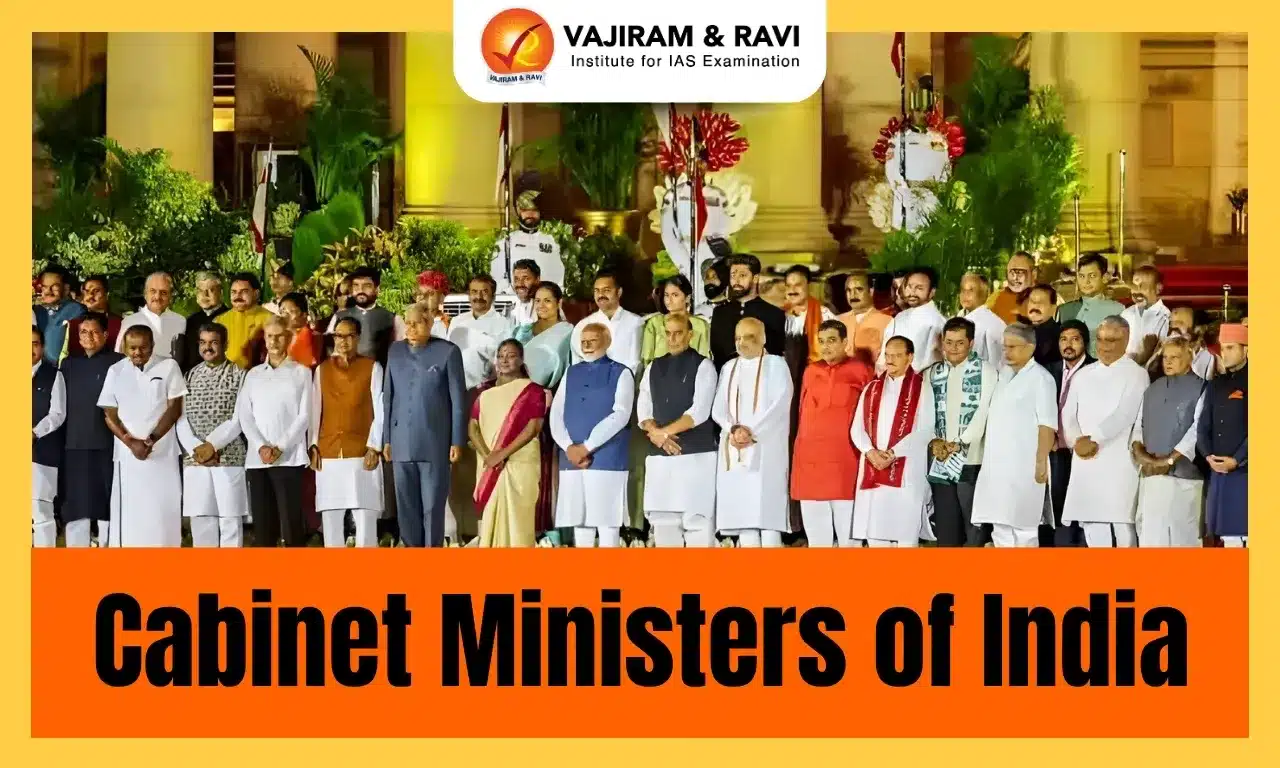
The Cabinet Ministers of India 2026 form the core of the Union Government, headed by Prime Minister Narendra Modi, who began his third term on 9 June 2024. The cabinet includes around 30 Cabinet Ministers, along with Ministers of State (Independent Charge) and Ministers of State. Each minister oversees important portfolios such as Defence, Home Affairs, Finance, External Affairs, and Education. Together, they work to implement government policies, ensure national development, and represent India’s diverse regions and interests.
Cabinet Ministers of India
The Cabinet Ministers of India have an important role in managing the governance of India. They are responsible for taking all the decisions in the executive branch. To understand the functioning of Cabinet Ministers of India, it is important to understand their structure, role and responsibilities, tenure and appointment process.
Cabinet Ministers of India 2026
Here is a list of Cabinet Ministers of India 2026 along with ministers and their portfolios: Here is the detailed List of Cabinet Ministers of India 2026.
Prime Minister
| Sl. No. | Ministers | Portfolios |
|
1 |
Narendra Modi, Prime Minister |
Ministry of Personnel, Public Grievances and Pensions; Department of Atomic Energy; Department of Space |
Cabinet Ministers
| Sl. No. | Cabinet Ministers | Portfolios |
|
1 |
Rajnath Singh |
Minister of Defence |
|
2 |
Amit Shah |
Minister of Home Affairs; Minister of Cooperation |
|
3 |
Nitin Gadkari |
Minister for Road Transport & Highways |
|
4 |
JP Nadda |
Minister of Health; and Minister of Chemicals and Fertilizers |
|
5 |
Shivraj Singh Chouhan |
Minister of Agriculture and Farmers Welfare; Minister of Rural Development |
|
6 |
Nirmala Sitharaman |
Minister of Finance; Minister of Corporate Affairs |
|
7 |
S Jaishankar |
Ministry of External Affairs |
|
8 |
Manohar Lal Khattar |
Housing and Urban Affairs, Power |
|
9 |
HD Kumaraswamy |
Minister of Heavy Industries; Minister of Steel |
|
10 |
Piyush Goyal |
Minister of Commerce and Industry |
|
11 |
Pralhad Joshi |
Education Ministry |
|
12 |
Jitan Ram Manjhi |
Ministry of Micro, Small and Medium Enterprises |
|
13 |
Lalan Singh |
Minister of Panchayati Raj; Minister of Fisheries, Animal Husbandry and Dairying |
|
14 |
Sarbananda Sonowal |
Minister of Ports, Shipping and Waterways |
|
15 |
Virendra Kumar |
Minister of Social Justice and Empowerment |
|
16 |
Ram Mohan Naidu |
Aviation Ministry |
|
17 |
Pralhad Joshi |
Minister of Consumer Affairs |
|
18 |
Jual Oram |
Minister of Tribal Affairs |
|
19 |
Giriraj Singh |
Minister of Textiles |
|
20 |
Ashiwnin Vaishnaw |
Minister of Railways, Minister of Information and Broadcasting |
|
21 |
Jyotiraditya Scindia |
Minister of Development of North Eastern Region and Telecom |
|
22 |
Bhupendra Yadav |
Minister of Environment, Forest and Climate Change |
|
23 |
Gajendra Singh Shekhawat |
Minister of Culture; Minister of Tourism |
|
24 |
Annapurna Devi |
Minister of Women and Child Development |
|
25 |
Kiran Rijiju |
Minister of Parliamentary Affairs; Minister of Minority Affairs |
|
26 |
Hardeep Singh Puri |
Minister of Petroleum and Natural Gas |
|
27 |
Mansukh Mandaviya |
Minister of Labour and Employment; Minister of Youth Affairs and Sports |
|
28 |
G Kishan Reddy |
Minister of Coal, Mines |
|
29 |
Chirag Paswan |
Minister of Food Processing Industries |
|
30 |
CR Patil |
Minister of Jal Shakti |


Cabinet Ministers of India Structure
The Cabinet Ministers of India are responsible to collectively take decisions of the Government of India. The body is composed of various ministers each having different roles and responsibilities.
- Prime Minister: The Prime Minister is the head of the government of India and the leader of the executive branch. He is responsible for ensuring smooth functioning of the government and manages the setting of Agenda for the Cabinet.
- Cabinet Ministers: Cabinet Ministers consist of the senior ministers who head the important ministers like Defence, Finance, Home Affairs and External Affairs. These ministers participate in all the important policy discussions and decisions that are responsible for the functioning of the government.
- Ministers of State: These are junior-level ministers who may either be assigned independent charge of a ministry or be attached to Cabinet Ministers to assist them in managing their portfolios. They are often responsible for handling specific functions or departments within a larger ministry.
- Deputy Ministers: Now relatively uncommon, Deputy Ministers were traditionally appointed to support Cabinet Ministers and Ministers of State in carrying out administrative responsibilities and coordinating routine functions.
Cabinet Ministers in India Roles and Responsibilities
The Cabinet Ministers of India are responsible for shaping and executing the government policy. Their roles and responsibilities cover areas like legislation, administration, delivery of public service all coming together and forming the backbone of India’s executive governance. Their Roles and Responsibilities include:
- Policy Formulation: Cabinet Ministers of India draft the national policies and legislative proposals. They help shape the overall strategic direction of the government.
- Administrative Leadership: Every Cabinet Minister is responsible for managing the functioning of a ministry. This includes handling budgets, implementing schemes, and ensuring the ministry’s effective operation.
- Legislative Participation: Cabinet Ministers are expected to actively participate in the legislative process in the form of introduction of bills, engaging in debates and raising questions in the parliament.
- Collective Responsibility: All Cabinet Ministers are collectively accountable to the Parliament. Even if a minister disagrees in internal discussions, they must publicly support Cabinet decisions as part of the principle of collective responsibility.
Cabinet Ministers Tenure and Appointment
The following is the appointment and tenure of Cabinet Ministers
- Selection Process: The Cabinet Ministers are selected by the Prime Minister based on their competence, experience and political considerations.
- Formal Appointment: The President of India formally appoints the Cabinet Minister in accordance with Article 75 of the Constitution on the advice of the Prime Minister.
- Tenure: The Cabinet Ministers are appointed for a tenure of 5 years, same as that of the Prime Minister.
- Resignation and Removal Ministers can resign or be removed at the discretion of the Prime Minister. The President acts on the Prime Minister’s advice in such matters.

 Last updated on Sep, 2026
→ UPSC Mains Question Paper 2026 is out now for Essay & GS Paper 1, 2, 3 & 4.
→ UPSC Mains GS Paper 1 2026 is out now.
→ UPSC Mains GS Paper 2 2026 is out now.
→ UPSC Mains GS Paper 3 2026 is out now.
→ UPSC Mains GS Paper 4 2026 is out now.
→ UPSC Mains Indian Language Paper & English Compulsory Paper are out now.
→ Check out the latest UPSC Syllabus 2026 here.
→ UPSC Mains Admit Card 2026 is now out.
→ Enroll in Vajiram & Ravi’s UPSC Mains Test Series 2027 for structured answer writing practice, expert evaluation, and exam-oriented feedback.
→ Join Vajiram & Ravi’s UPSC Mentorship Program 2027 for personalized guidance, strategy planning, and one-to-one support from experienced mentors.
→ Go through the UPSC Mains Previous Year Papers to enhance your preparation.
→ Download UPSC Mains Essay Paper 2025, UPSC Mains GS Paper-I 2025, UPSC Mains GS Paper-II 2025, UPSC Mains GS Paper-III 2025, UPSC Mains GS Paper-IV 2025, UPSC Mains English (Compulsory) Paper 2025, UPSC Mains Hindi (Qualifying) Paper 2025 here.
→ UPSC has released UPSC Toppers List 2025 with the Civil Services final result on its official website.
→ UPSC Calendar 2027 has been released.
→ Also check Best UPSC Coaching in India
Cabinet Ministers of India FAQs
Q1. Who are the 29 cabinet ministers of India?+
Q2. Who are called cabinet ministers in India?+
Q3. Is the PM a cabinet minister?+
Q4. How is a cabinet minister appointed?+
Q5. What constitutional article presents Cabinet Minister in India?+
Tags: cabinet ministers of india