Need for Urban Climate Resilience Latest News
- India’s urban landscape is rapidly expanding, posing significant challenges in adapting to climate change.
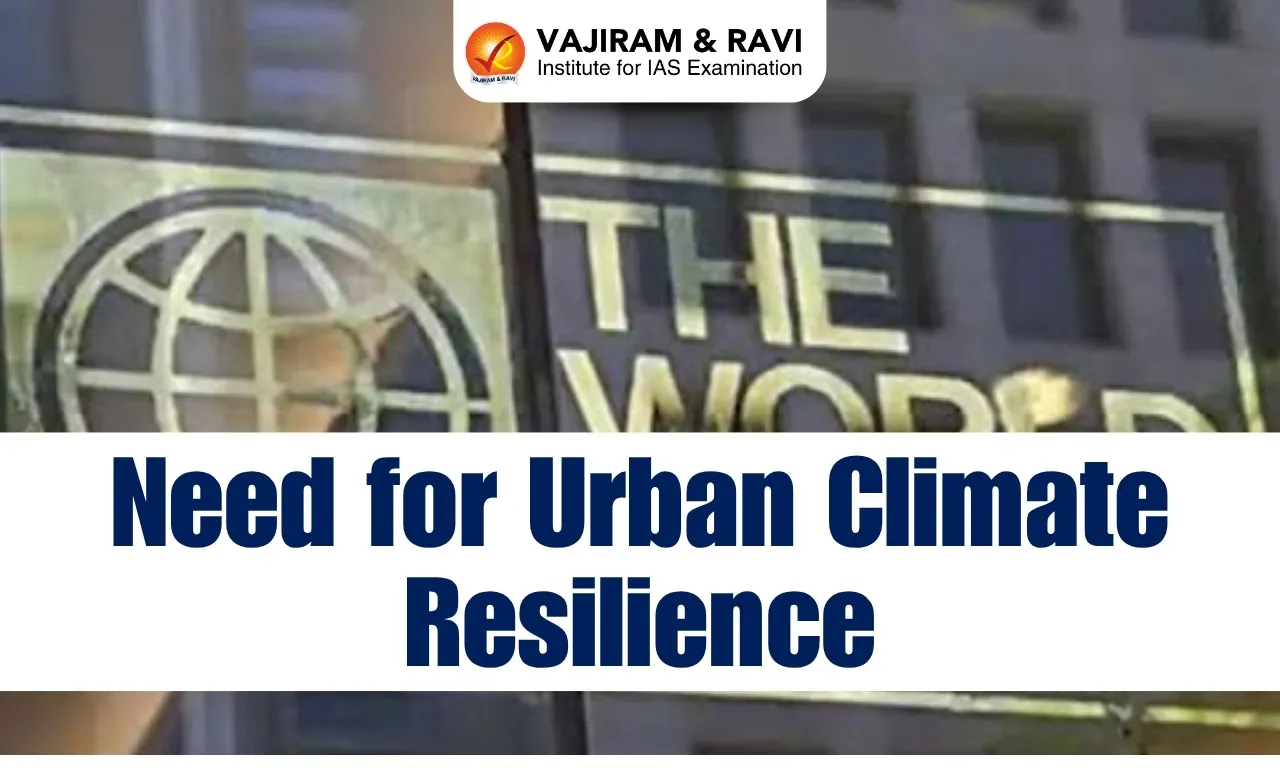
- A World Bank report (“Towards Resilient and Prosperous Cities in India”), in collaboration with the Union Ministry of Housing and Urban Affairs (MoHUA), highlights the urgent need for urban climate resilience.
- It advocates for greater autonomy for Urban Local Bodies (ULBs) and suggests a $2.4 trillion investment requirement by 2050.
Key Highlights from the Report
- Need for urban autonomy in climate governance:
- World Bank India Country Director Auguste Tano Kouame emphasized that cities with decision-making autonomy perform better in climate resilience.
- Advocated for the implementation of the 74th Constitutional Amendment Act, 1992, based on local conditions.
- Decentralization leads to better resource mobilization, asset monetization, revenue generation, and accountability.
- Urban climate risks and economic costs:
- Urban India will experience two major shocks –
- Pluvial flooding (urban flooding due to poor drainage and excessive concretization).
- Extreme heat stress, worsened by the urban heat island effect.
- Estimated annual flood-related losses are $5 billion by 2030 and $30 billion by 2070.
- Heat-related fatalities could double to over 3 lakh per year by 2050.
- Urban India will experience two major shocks –


Financial and Population Projections
- Investment needs:
- $2.4 trillion required by 2050 for building resilient infrastructure and services.
- At least $150 billion needed to build flood resilience in 60% of high-risk cities over the next 15 years.
- Urban growth trajectory:
- Urban population to nearly double to 951 million by 2050.
- By 2030, cities will generate 70% of new employment in India.
Best Practices Cited in India
- Ahmedabad has developed a Heat Action Plan model which aims to strengthen early warning systems, improve healthcare readiness, increase green cover and shift work schedules for outdoor laborers.
- Kolkata has adopted a city-level flood forecasting and warning system.
- Indore has invested in a modern solid waste management system, improving cleanliness and supporting green jobs.
- Chennai has adopted a climate action plan based on thorough risk assessment and targeting both adaptation and low-carbon growth.
Recommendations of the Report
- For national and state governments:
- Create a financing roadmap.
- Set standards and frameworks to boost municipal capacity.
- Engage the private sector in climate-resilient infrastructure.
- For cities and ULBs:
- Evaluate climate risks at the local level.
- Mobilise capital (including private investments) for adaptation and mitigation.
- Adopt strategies such as –
- Cool roofs, early warning systems, urban greening, and shifted working hours to mitigate heat stress.
- Urban planning that reduces impervious surfaces and improves stormwater management.
Conclusion
The World Bank–MoHUA report highlights that empowering cities through greater autonomy, targeted investments, and institutional reforms is crucial for making India’s urban future climate-resilient, economically productive, and socially inclusive.

 Last updated on Oct, 2026
→ UPSC 2027 Notification will be released on 13 January 2027 at upsconline.nic.in.
→ Check Nobel Prize 2026 Winners List here.
→ Download PIB PRiSM Monthly Magazine 2026 here.
→ Check UPSC Monthly Current Affairs Magazine The Recitals here.
→ Check out the latest UPSC Syllabus here.
→ Download UPSC Model Answers for Mains 2026
→ UPSC Mains Question Paper 2026 is out now for Essay & GS Paper 1, 2, 3 & 4.
→ UPSC Calendar 2027 has been released.
→ Enroll in Vajiram & Ravi’s UPSC Mains Test Series 2027 for structured answer writing practice, expert evaluation, and exam-oriented feedback.
→ Join Vajiram & Ravi’s UPSC Mentorship Program 2027 for personalized guidance, strategy planning, and one-to-one support from experienced mentors.
→ Go through the UPSC Mains Previous Year Papers to enhance your preparation.
→ UPSC has released UPSC Toppers List 2025 with the Civil Services final result on its official website.
→ Also check Best UPSC Coaching in India
Need for Urban Climate Resilience
Q1. How does the 74th Amendment help in climate-resilient urban governance?+
Q2. Why are Indian cities more vulnerable to floods and heat?+
Q3. What are the economic risks of not investing in urban climate adaptation?+
Q4. How does decentralisation support climate resilience in cities?+
Q5. What measures can reduce heat-related deaths in cities?+
Tags: mains articles need for urban climate resilience upsc current affairs upsc mains current affairs