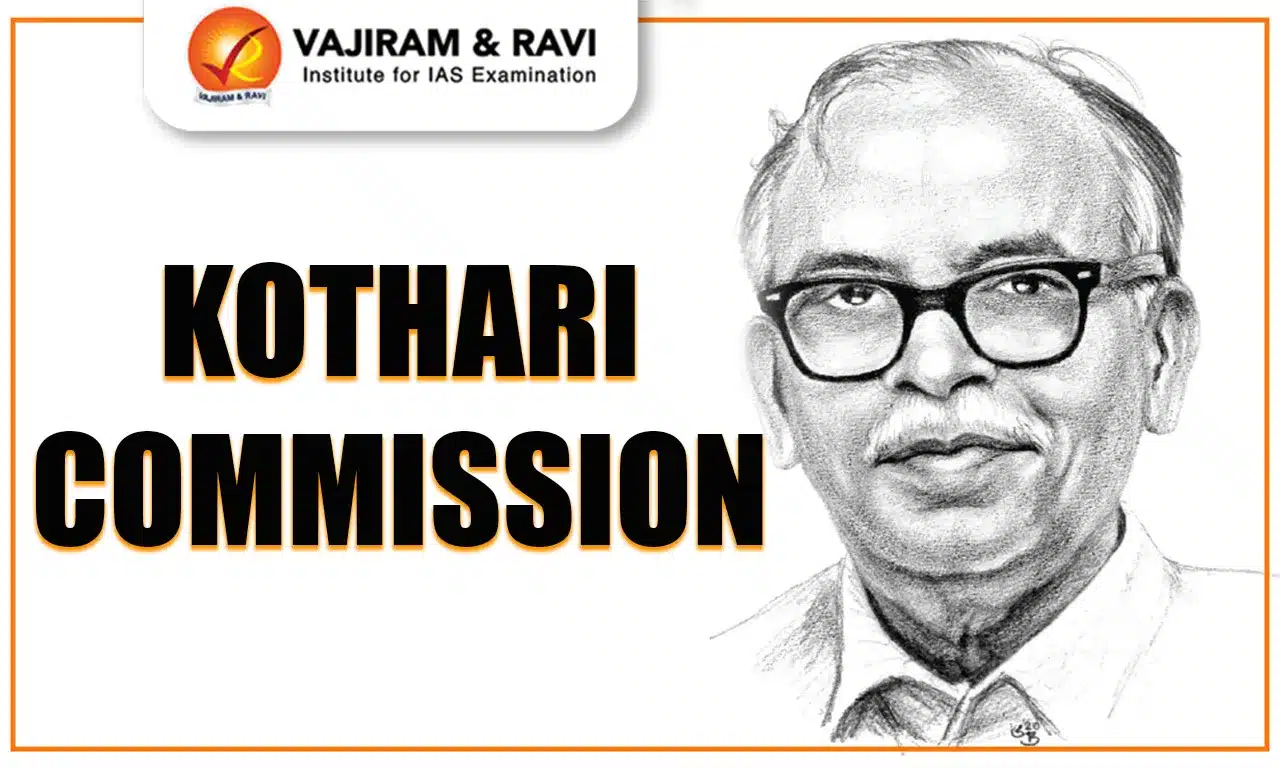
Kothari Commission was formed under the chairmanship of Dr. Daulat Singh Kothari with 17 other members and is also known as National Education Commission, 1964. It was a temporary committee established by the government of India to streamline the education system of India. The main objective of the Kothari Commission was to create an educational framework and provide recommendations and create policies for the development of the education system in India.
Kothari Commission
Kothari Commission sustained from 1964 till 1966 under the chairmanship of Dr. DS Kothari aimed to lay down the framework for a national education policy from primary school to the highest level. The scope excluded medical and legal education but covered every other aspect of the education system of India.
The Kothari Commission worked for two years and submitted the report on 29th June 1966. It formed 12 Task Forces to focus on key areas like School Education, Technical and Higher Education, and Agricultural Education. Alongside, 7 Working Groups were created to study specific issues in greater detail.
Kothari Commission Formation
The Kothari Commission was formed with the core agenda of crafting a roadmap for the educational development and policy formation to contribute to growth and progress of the country. Other than this commission was formed to address the below mentioned needs:
- To conduct a thorough review of Education System of India and identify gaps at every level from primary to higher education.
- To tackle inequalities in access and quality, especially in rural and underprivileged regions.
- To push for broad reforms in areas like curriculum design, infrastructure, teacher training, and overall learning quality.
- To make education more relevant to the evolving social and economic needs of a developing India.
- To introduce a unified and consistent national education framework across the country.


Kothari Commission Report
Kothari Commission Report was submitted on 29th June 1996 with title “Education and National Development” based on how education is the most important and essential resource that every citizen has the right and must equip with for the development of the country. The report was divided into four sub parts including:
- Part I: Focused on the General issues.
- Part II: Studied the Stages of Education.
- Part III: Provided Recommendations and programmes.
- Part IV: Deals with additional papers.
Also further based on four main themes including:
- Increase of Productivity
- Promoting National and social integration
- Modernization and Education
- Developing moral, social, and spiritual values
Kothari Commission Recommendations
- Kothari Commission proposed a unified school system to offer equal learning opportunities to all children, regardless of their background.
- Recommended free education for all children up to the age of 14.
- The commission emphasized creativity, critical thinking, and the holistic development of learners through a well-rounded curriculum.
- Suggested that students should learn three Language:
- Mother tongue or regional language
- Official language of the state
- English
- Standardized the academic progression into 10+2+3 Education Structure:
- 10 years of school (Class 1-10)
- 2 years of higher secondary (Class 11-12)
- 3 years of undergraduate education (Bachelor’s degree)
- Teacher-Student Ratio must be an optimal ratio to ensure better attention and instruction.
- Expanding access to girl’s education, including setting up schools and hostels for female students.
- Recommended revamping teacher education to improve teaching quality and morale.
- Focus on Core Subjects by integrating science, mathematics, social studies, and national service throughout the education journey.
- Proposed increasing the number of universities and investing in research and innovation.
- Emphasized developing vocational and technical institutions to serve the needs of a modern economy.
Kothari Commission Impact
As a result of the recommendations by the Kothari Commission, National Policy on Education was formed. Other recommendations includes:
- Education System followed the pattern of 10+2+3
- Education became the fundamental right which provided education to children who are between the age of 6 to 14 years.
- The equalization of the education system was adopted to all sections of the society.
- The revision in the pay scale and status was seen in the aspect of teachers.
- There was a setup of two different boards i.e. the central board and the state board was done. The Board of Higher Secondary Education was formed in 1986.
Kothari Commission Limitations
There were also some Kothari Commission Limitations which are discussed below:
- The Commission’s recommendations were leaned toward a centralized model and didn’t fully reflect India’s vast linguistic, cultural, and regional differences.
- Many recommendations required heavy funding, better infrastructure, and inter-governmental coordination, which were not always feasible leading to delays and uneven execution.
- While it offered structural suggestions for universities, the Commission fell short of providing a sustainable roadmap for funding higher education.
- It did not propose a strong framework for revisiting and updating policies over time.
- The emphasis was more on structure and access than measurable learning outcomes or quality metrics.
| Also Read | |
| Parliamentary Committee | Join Parliamentary Committee |
| Ethics Committee | Drafting Committee |

 Last updated on Sep, 2026
→ UPSC Mains Question Paper 2026 is out now for Essay & GS Paper 1, 2, 3 & 4.
→ UPSC Mains GS Paper 1 2026 is out now.
→ UPSC Mains GS Paper 2 2026 is out now.
→ UPSC Mains GS Paper 3 2026 is out now.
→ UPSC Mains GS Paper 4 2026 is out now.
→ UPSC Mains Indian Language Paper & English Compulsory Paper are out now.
→ Check out the latest UPSC Syllabus 2026 here.
→ UPSC Mains Admit Card 2026 is now out.
→ Enroll in Vajiram & Ravi’s UPSC Mains Test Series 2027 for structured answer writing practice, expert evaluation, and exam-oriented feedback.
→ Join Vajiram & Ravi’s UPSC Mentorship Program 2027 for personalized guidance, strategy planning, and one-to-one support from experienced mentors.
→ Go through the UPSC Mains Previous Year Papers to enhance your preparation.
→ Download UPSC Mains Essay Paper 2025, UPSC Mains GS Paper-I 2025, UPSC Mains GS Paper-II 2025, UPSC Mains GS Paper-III 2025, UPSC Mains GS Paper-IV 2025, UPSC Mains English (Compulsory) Paper 2025, UPSC Mains Hindi (Qualifying) Paper 2025 here.
→ UPSC has released UPSC Toppers List 2025 with the Civil Services final result on its official website.
→ UPSC Calendar 2027 has been released.
→ Also check Best UPSC Coaching in India
Kothari Commission FAQs
Q1. What is the Kothari Commission?+
Q2. When was the Kothari Commission formed?+
Q3. Who headed the Kothari Commission?+
Q4. Why was the Kothari Commission formed?+
Q5. How many members were in the Kothari Commission?+
Tags: committee kothari commission