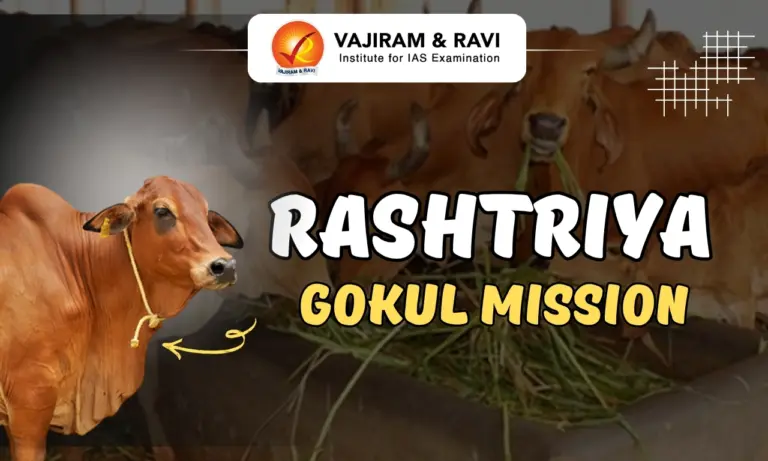
The Rashtriya Gokul Mission is a Central Sector Scheme launched in December 2014 by the Department of Animal Husbandry and Dairying (DAHD) under the Ministry of Fisheries, Animal Husbandry and Dairying to conserve indigenous bovine breeds and improve their genetic quality and productivity.
About Rashtriya Gokul Mission
The Rashtriya Gokul Mission aims to strengthen India’s indigenous bovine resources through scientific breeding, advanced reproductive technologies and modern livestock management.
- Launched in December 2014 as a Central Sector Scheme.
- Implemented by the Department of Animal Husbandry and Dairying (DAHD).
- Focuses on the conservation and genetic improvement of indigenous cattle and buffalo breeds.
- Promotes scientific breeding to enhance milk production and productivity.
- Encourages the use of advanced reproductive technologies and genomic selection.
- Supports sustainable dairy farming and improves the livelihood of dairy farmers.
Rashtriya Gokul Mission Objectives
The Rashtriya Gokul Mission seeks to improve indigenous bovine development and strengthen India’s dairy sector by achieving the following objectives:
- Conserve and develop indigenous cattle and buffalo breeds.
- Improve the genetic quality of the indigenous bovine population.
- Enhance milk production and productivity through scientific breeding.
- Increase the availability of high genetic merit breeding animals.
- Promote modern reproductive technologies for faster genetic improvement.
- Strengthen sustainable livestock development and farmer incomes.
- Reduce dependence on imported bovine germplasm.


Rashtriya Gokul Mission Components
The Rashtriya Gokul Mission is implemented through scientific breeding programmes, modern technologies and digital livestock initiatives.
- Genetic Improvement: Promotes pedigree selection, progeny testing, genomic selection and breed multiplication to improve indigenous bovine breeds.
- Modern Reproductive Technologies: Supports Artificial Insemination (AI), Sex-Sorted Semen, In Vitro Fertilisation (IVF) and Embryo Transfer Technology (ETT) for rapid genetic improvement.
- Digital Livestock Architecture: Implements e-GOPALA, Bharat Pashudhan and INDUS Indigenous Genomic Chip (INDUS Chip to strengthen livestock identification, breeding and digital advisory services.
- Bharat Pashudhan: A digital database under the National Digital Livestock Mission (NDLM) that provides unique identification and traceability of livestock through animal tagging.
- e-GOPALA App: A farmer-oriented digital platform providing information on livestock health, breeding services, disease management and availability of quality germplasm.
- INDUS Indigenous Genomic Chip: It is developed for genomic selection of superior indigenous cattle breeds by identifying animals with desirable genetic traits at an early age.
- Farmer Capacity Building: Provides training, technical assistance and scientific livestock management support to farmers and breeding professionals.
- High Genetic Merit Animal Development: Supports the production, rearing and dissemination of genetically superior indigenous bovine animals.
Rashtriya Gokul Mission Achievements
The Rashtriya Gokul Mission has significantly contributed to improving India’s dairy sector and indigenous bovine development.
- Milk production increased from 146.3 million tonnes (2014-15) to 247.87 million tonnes (2024-25, provisional).
- Per capita milk availability increased from 319 grams/day in 2014-15 to 485 grams/day in 2024-25.
- Overall milk productivity increased by about 26.34% during the last decade.
- Scientific breeding and genomic technologies have accelerated the genetic improvement of indigenous bovine breeds.
- The mission supports the livelihoods of nearly 8.5 crore dairy farmers.
- India continues to remain the largest milk producer in the world.
Rashtriya Gokul Mission Recent Reforms
The Union Cabinet approved major reforms to strengthen the implementation of the mission.
- Enhanced the total scheme outlay from ₹2,400 crore to ₹3,400 crore.
- Approved the establishment of 30 Heifer Rearing Centres for producing High Genetic Merit (HGM) animals.
- Introduced 3% interest subvention on loans for purchasing High Genetic Merit IVF heifers.
- Expanded IVF laboratories, embryo production facilities and genomic breeding programmes.
- Increased the adoption of digital livestock management and advanced breeding technologies.
Rashtriya Gokul Mission Significance
The Rashtriya Gokul Mission plays a vital role in strengthening India’s livestock sector and rural economy.
- Conserves India’s indigenous bovine genetic resources.
- Improves milk productivity through scientific breeding and biotechnology.
- Enhances the income and livelihood of dairy farmers.
- Promotes sustainable and climate-resilient livestock development.
- Strengthens nutritional security by increasing milk availability.
- Supports India’s leadership as the world’s largest milk-producing country.
- Contributes to inclusive rural development through a stronger dairy economy.

 Last updated on Sep, 2026
→ UPSC 2027 Notification will be released on 13 January 2027 at upsconline.nic.in.
→ Check out the latest UPSC Syllabus here.
→ Download UPSC Model Answers for Mains 2026
→ UPSC Mains Question Paper 2026 is out now for Essay & GS Paper 1, 2, 3 & 4.
→ UPSC Calendar 2027 has been released.
→ Enroll in Vajiram & Ravi’s UPSC Mains Test Series 2027 for structured answer writing practice, expert evaluation, and exam-oriented feedback.
→ Join Vajiram & Ravi’s UPSC Mentorship Program 2027 for personalized guidance, strategy planning, and one-to-one support from experienced mentors.
→ Go through the UPSC Mains Previous Year Papers to enhance your preparation.
→ UPSC has released UPSC Toppers List 2025 with the Civil Services final result on its official website.
→ Also check Best UPSC Coaching in India
Rashtriya Gokul Mission FAQs
Q1. When was the Rashtriya Gokul Mission launched?+
Q2. Which ministry implements the Rashtriya Gokul Mission?+
Q3. What are the primary objectives of the Rashtriya Gokul Mission?+
Q4. Under which category of government schemes is the Rashtriya Gokul Mission implemented?+
Q5. What were the major reforms approved under the Rashtriya Gokul Mission in March 2025?+
Tags: Rashtriya Gokul Mission