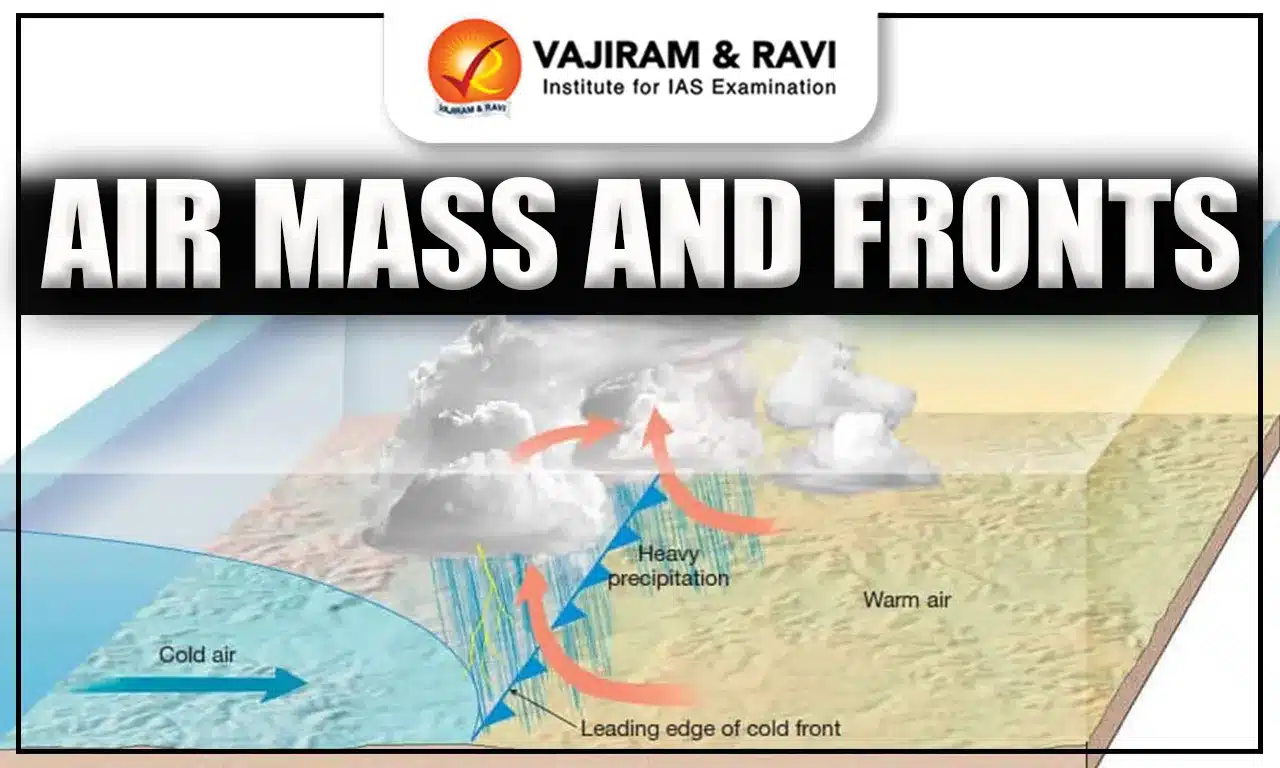
Air Masses are known as huge bodies of air that have uniform temperature, humidity and pressure, forming around different regions like the polar, tropical, maritime and continental zones. These air bodies travel over different regions and interact with each other and hence affects the weather system. When contracting air masses converge, they form boundaries called fronts. In this article, we are going to cover air masses and fronts, their types, formations and importance.
Fronts
Fronts are of different types depending on the nature and movement of air masses involved. A cold front is formed when colder air replaces warmer air and results in intense rainfall and storms. Whereas, a warm front is formed when warm air advances over cold air and creates widespread but light precipitation. A stationary front occurs when neither air masses advances and causes long-lasting cloudy or rainy conditions. An occluded front is formed when a cold front overtakes a warm front and generates complex and unsettled weather. The interaction between air masses and fronts plays an important role in shaping both regional and global climatic patterns and makes them central to the study of meteorology.
Types of Air Mass and Fronts
Air Masses and Fronts can be divided into the following types:
Types of Air Masses
Air masses are classified by temperature and moisture from their source regions:
- Tropical (T): Warm air masses formed in low latitudes.
- Polar (P): Cold air masses developed in mid- to high-latitude regions.
- Arctic (A): Extremely cold air masses originating from polar zones.
- Continental (c): Dry air masses generated over land.
- Maritime (m): Moist air masses formed over oceans.
Common combinations include:
- cT (Continental Tropical): Hot and dry, formed over deserts.
- mT (Maritime Tropical): Warm and humid, originating from tropical seas.
- cP (Continental Polar): Cold and dry, from high-latitude landmasses.
- mP (Maritime Polar): Cold and moist, from colder oceans.
Types of Fronts
Fronts mark the boundaries between two different air masses:
- Cold Front: Cold air undercuts warm air, bringing storms and cooler conditions.
- Warm Front: Warm air moves above cold air, causing steady rain and rising temperatures.
- Stationary Front: Neither air mass advances, resulting in prolonged rain or clouds.
- Occluded Front: A cold front overtakes a warm front, creating mixed weather events.


Air Mass and Fronts Classifications
Air Mass and fronts can be classified into the following:
Classification of Air Masses
Air masses are divided on the basis of their source regions and nature of surface. These classification are:
By Source Region
- Polar (P): Cold air masses originating from high-latitude regions.
- Tropical (T): Warm air masses formed in low-latitude regions.
By Surface Type
- Continental (c): Dry air masses that develop over landmasses.
- Maritime (m): Moist air masses that form over oceans or seas.
Combined Classifications
- cP (Continental Polar): Cold and dry; originates over polar land areas.
- mP (Maritime Polar): Cold and moist; develops over polar oceans.
- cT (Continental Tropical): Hot and dry; forms over desert regions.
- mT (Maritime Tropical): Warm and humid; arises over tropical oceans.
Classification of Fronts
Fronts are the areas in between two contrasting air masses that interact with each other but do not mix. Fronts can be sub-divided into the following types:
- Cold Front: Formed when a cold air mass advances and displaces warm air, often causing thunderstorms or heavy showers.
- Warm Front: Occurs when warm air overtakes cold air, resulting in prolonged rainfall and a rise in temperature.
- Stationary Front: Arises when neither air mass dominates, leading to cloudy skies and persistent drizzle or rain.
- Occluded Front: Develops when a cold front overtakes a warm front, creating complex weather with mixed precipitation.
Air Masses and Fronts Formation
Air masses and fronts are formed on the following basis:
Formation of Air Masses
Air masses are formed when large volumes of air form over a uniform surface area for a prolonged period, acquiring the temperature, humidity and pressure characteristics of that area.
- Tropical air masses: Warm, formed over hot regions.
- Polar air masses: Cold, originating in high latitudes.
- Maritime air masses: Moist, formed over oceans.
- Continental air masses: Dry, developed over land.
Formation of Fronts
Fronts emerge when air masses with contrasting properties meet.
- Cold Front: Cold air pushes warm air upwards.
- Warm Front: Warm air slides over cold air.
- Stationary Front: Neither air mass advances, remaining static.
- Occluded Front: Cold front overtakes a warm front, lifting warm air completely.
Air Masses and Fronts Importance
Air masses and fronts are important from the aspect of weather and climate and influence both short-term and long term atmospheric conditions in the following manner:
- They determine local temperature and humidity with fronts causing rainfall, storms and snow.
- Source regions like the tropical, polar, maritime and continental zones shape long-term climatic features.
- Cold fronts bring heavy but short lived rainfall and warm fronts cause steady and long term showers.
- Interactions at fronts form thunderstorms, cyclones or tornadoes.
- Having the right knowledge helps forecast weather, protect crops and sustain ecological balance.
- In essence, air masses and fronts are the building blocks of atmospheric processes, crucial for weather forecasting, disaster preparedness, and climate studies.

 Last updated on Sep, 2026
→ UPSC 2027 Notification will be released on 13 January 2027 at upsconline.nic.in.
→ Asian Games 2026 are being held in Aichi-Nagoya, Japan, from 19 September to 4 October.
→ Check out the latest UPSC Syllabus here.
→ Download UPSC Model Answers for Mains 2026
→ UPSC Mains Question Paper 2026 is out now for Essay & GS Paper 1, 2, 3 & 4.
→ UPSC Calendar 2027 has been released.
→ Enroll in Vajiram & Ravi’s UPSC Mains Test Series 2027 for structured answer writing practice, expert evaluation, and exam-oriented feedback.
→ Join Vajiram & Ravi’s UPSC Mentorship Program 2027 for personalized guidance, strategy planning, and one-to-one support from experienced mentors.
→ Go through the UPSC Mains Previous Year Papers to enhance your preparation.
→ UPSC has released UPSC Toppers List 2025 with the Civil Services final result on its official website.
→ Also check Best UPSC Coaching in India
Air Mass and Fronts FAQs
Q1. What are air masses and fronts?+
Q2. What is the relationship between air masses and weather fronts?+
Q3. What are the 4 types of fronts?+
Q4. What are the 4 types of air masses?+
Q5. What is a cold front?+
Tags: air mass and fronts