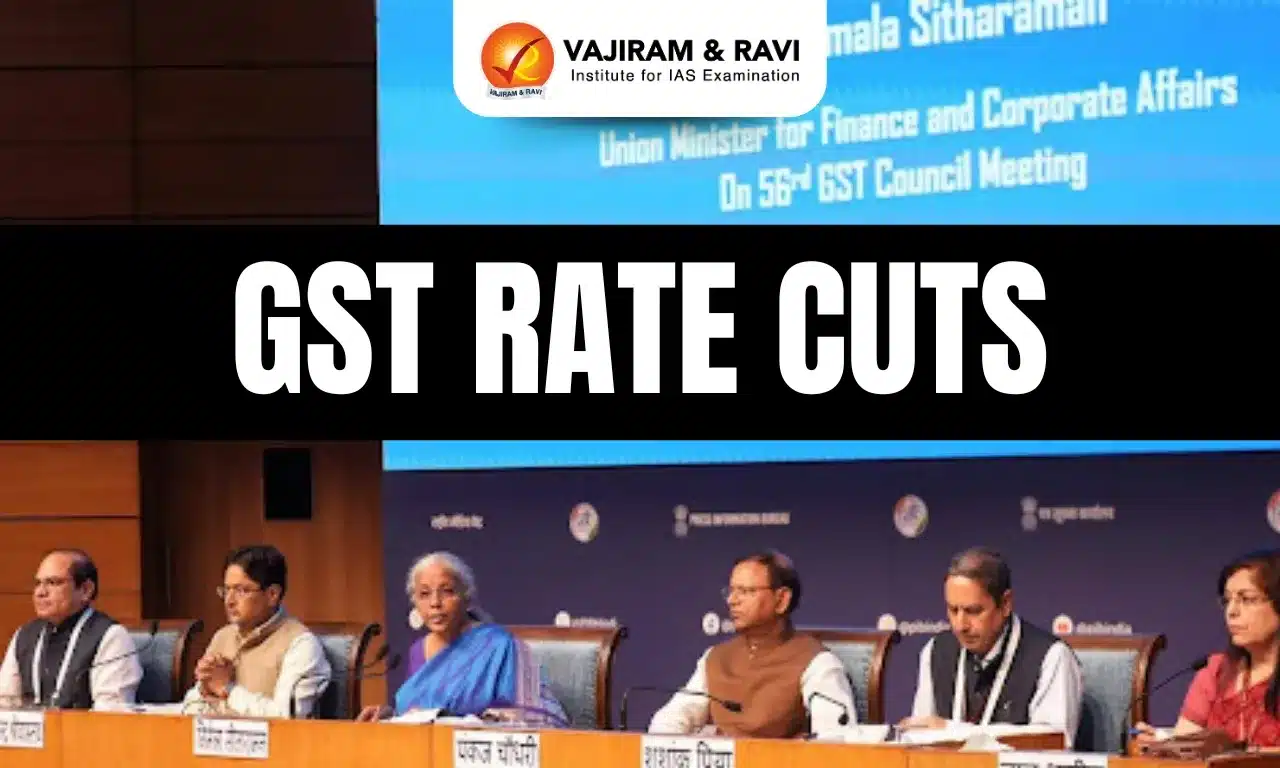
GST Rate Cuts Latest News
- The GST Council has implemented major GST rate cuts in 2025, reducing slabs and taxes on over 90% of items to boost consumption and simplify India’s indirect tax system.
Introduction
- The Government of India has undertaken one of the most significant overhauls of the Goods and Services Tax (GST) regime since its introduction in 2017.
- In September 2025, the GST Council announced major rate rationalisation, reducing the number of slabs and cutting taxes on a wide range of items.
- This reform, projected as a “next-generation” step, is expected to spur demand, ease compliance, and stimulate growth at a time when India faces external shocks such as steep U.S. tariffs on Indian exports.
- However, it also raises questions on revenue sustainability and uneven sectoral impacts.


GST Rationalisation: A Long-Pending Reform
- The idea of simplifying GST has been under discussion for years. Initially, GST featured multiple rates: 0%, 5%, 12%, 18%, and 28%, along with compensation cess.
- Critics argued that this complicated structure undermined the “one nation, one tax” principle.
- In 2021, a Group of Ministers (GoM) was formed to suggest rationalisation, but progress was slow until the Union government revived the proposal in 2025.
- The reforms introduced now reduce the slabs to 0%, 5%, 18%, and 40%, with the compensation cess retained only temporarily for tobacco products.
- Over 91% of items that underwent rate changes witnessed cuts, signalling a clear pro-consumer approach.
Key Changes Announced
- Wider Tax Reductions: Of 453 items reviewed, 413 saw rate cuts, particularly shifting goods from the 12% to the 5% slab.
- Luxury Items: While 17 goods moved from 28% to 40%, the effective tax incidence on items like luxury cars fell, since the cess was subsumed.
- Healthcare and Renewable Energy: Rates on medical products and renewable energy components dropped from 12% to 5%, benefiting patients and clean energy expansion.
- Construction Materials: Cement moved from 28% to 18%, providing relief to the real estate sector.
- Automobiles: Cars and non-luxury two-wheelers moved from 28% to 18%, boosting the auto sector.
Need for the Reforms
- Two factors added urgency to these changes:
- End of Compensation Cess: With cess repayment to States nearing completion, the government sought a new rate structure to prevent “sin goods” like tobacco from becoming artificially cheap.
- U.S. Tariffs Impact: With 50% tariffs imposed by the U.S. on Indian imports, India anticipated stress on exports and private investment. By rationalising GST, the government aimed to boost domestic consumption to offset external shocks.
Beneficiary Sectors
- Healthcare: Cheaper medical devices and equipment promise direct consumer benefits.
- Renewable Energy: Lower tax on solar, wind, and related equipment supports India’s 2030 clean energy targets.
- Real Estate and Construction: Lower GST on cement and slabs reduces costs, likely stimulating housing demand.
- Consumer Goods and Appliances: Reduced costs could accelerate sales during the festive season.
- Automobile Sector: Car manufacturers expect a stronger demand revival.
Concerns and Criticisms
- Despite widespread approval, some sectors expressed concerns:
- Textiles: Although raw material rates fell, garments priced above Rs. 2,500 attract 18% GST, burdening premium segments.
- Insurance: While life and health insurance gained exemptions, the removal of input tax credits could raise insurer costs.
- Aviation: Airlines opposed higher GST on non-economy seats, citing cost escalation.
- MSMEs: Labour-intensive sectors fear rising costs due to increased GST on labour charges from 12% to 18%.
- Oil Industry: The inverted duty structure in edible oils remains unresolved.
Revenue Implications
- The Centre estimated a revenue shortfall of Rs. 48,000 crore in 2023-24 due to GST cuts, though State Bank of India research suggested a much lower impact of around Rs. 3,700 crore.
- Opposition-ruled States demanded a new cess on items in the 40% slab to compensate for losses, but this was rejected by the Council. The ultimate impact will depend on how higher consumption offsets rate cuts.
Future Outlook
- The reforms position India towards a simpler GST architecture, potentially improving compliance and reducing litigation.
- While short-term fiscal challenges exist, long-term gains could emerge through stronger demand, private investment, and the formalisation of the economy.
- The GST rationalisation also complements India’s broader economic reforms agenda and may help cushion the economy against global uncertainties.
Source: TH

 Last updated on Oct, 2026
→ UPSC 2027 Notification will be released on 13 January 2027 at upsconline.nic.in.
→ Asian Games 2026 are being held in Aichi-Nagoya, Japan, from 19 September to 4 October.
→ Check Nobel Prize 2026 Winners List here.
→ Download PIB PRiSM Monthly Magazine 2026 here.
→ Check UPSC Monthly Current Affairs Magazine The Recitals here.
→ Check out the latest UPSC Syllabus here.
→ Download UPSC Model Answers for Mains 2026
→ UPSC Mains Question Paper 2026 is out now for Essay & GS Paper 1, 2, 3 & 4.
→ UPSC Calendar 2027 has been released.
→ Enroll in Vajiram & Ravi’s UPSC Mains Test Series 2027 for structured answer writing practice, expert evaluation, and exam-oriented feedback.
→ Join Vajiram & Ravi’s UPSC Mentorship Program 2027 for personalized guidance, strategy planning, and one-to-one support from experienced mentors.
→ Go through the UPSC Mains Previous Year Papers to enhance your preparation.
→ UPSC has released UPSC Toppers List 2025 with the Civil Services final result on its official website.
→ Also check Best UPSC Coaching in India
GST Rate Cuts FAQs
Q1. What are the new GST slabs after rationalisation?+
Q2. Which sectors benefit the most from GST cuts?+
Q3. Why were the GST rate cuts implemented now?+
Q4. What is the estimated revenue loss from GST cuts?+
Q5. Which sectors have expressed concerns about the GST changes?+
Tags: GST rate cuts mains articles upsc current affairs upsc mains current affairs