Manki-Munda System Latest News
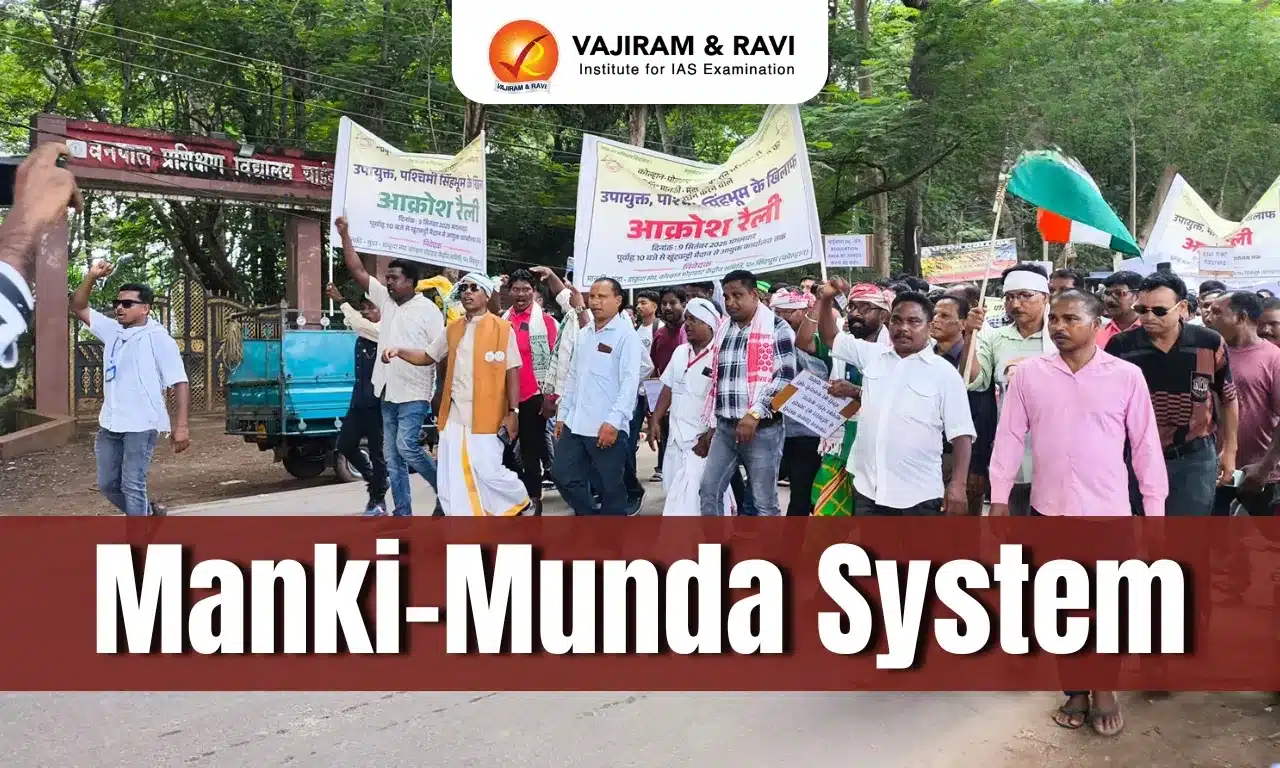
- Recently, adivasis of the Ho tribe in Jharkhand’s West Singhbhum protested against the Deputy Commissioner, alleging interference in their traditional Manki-Munda self-governance system after the removal of village heads (Mundas).
- While the district administration clarified that Mankis and Mundas remain integral to the revenue framework and blamed rumors on social media for the unrest, tribal concerns over losing autonomy persist.
- The episode threatens the century-old equilibrium between indigenous governance structures and the state administration in Jharkhand’s Kolhan region.
Traditional Manki-Munda Governance
- For centuries, the Ho tribe of Jharkhand’s Kolhan region followed a decentralised governance system rooted in social and political responsibilities.
- Each village was led by a Munda, the hereditary village head who resolved local disputes.
- Groups of 8–15 villages, known as a pidh, were overseen by a Manki, who handled cases unresolved at the village level.
- Importantly, the Manki-Munda system dealt only with internal governance, having no role in revenue or land matters, nor any concept of taxes or external sovereign authority.
- This changed with the arrival of the East India Company, which introduced taxation.


British Intervention and Co-option of the Manki-Munda System
- Following victories at Plassey (1757) and Buxar (1764), the East India Company gained diwani rights in 1765, enabling tax collection across Bengal, Bihar, Odisha, and Jharkhand.
- The Permanent Settlement Act of 1793 empowered zamindars with land deeds and fixed revenue demands, often beyond their capacity.
- To meet targets, zamindars seized Ho lands in Kolhan, sparking adivasi uprisings like the Ho revolt (1821–22) and the Kol revolt (1831).
- After repeated military failures, the British adopted a strategic compromise — formally recognising and co-opting the Manki-Munda system into their administration.
Wilkinson’s Rules and Their Lasting Impact
- In 1837, the British appointed Captain Thomas Wilkinson as Political Agent in the Kolhan Government Estate (KGE) to manage the Ho-dominated region.
- Recognising the strength of local governance, Wilkinson drafted 31 “Wilkinson’s Rules” in 1833, formally codifying the Manki-Munda system for the first time.
- While appearing to preserve tribal autonomy and restrict outsiders (dikkus), the rules effectively co-opted community leaders as agents of British authority, integrating Kolhan into colonial administration.
- This shift triggered major changes: the influx of outsiders surged from 1,579 in 1867 to 15,755 by 1897, aided by the railways, creating demographic shifts.
- Equally transformative was the introduction of private property — Mundas and Mankis became raiyats (tenants), receiving land deeds (pattas).
- This altered collective traditions of landholding, fostering individual ownership and reshaping Ho society.
Continuation of Wilkinson’s Rules
- Although the Kolhan Government Estate was dissolved after Independence in 1947, Wilkinson’s Rules remain in force, with Kolhan exempted from India’s general civil procedure laws.
- Courts upheld their validity for decades, until the Patna High Court in Mora Ho vs State of Bihar (2000) ruled they were old customs, not formal law — yet allowed them to continue in the absence of alternatives.
- Despite calls to update the system, neither Bihar nor Jharkhand took action.
- A 2021 Jharkhand initiative, Nyay Manch, was proposed but never enacted, leaving Wilkinson’s Rules still operational today.
The Current Conflict in Kolhan
- The recent unrest in West Singhbhum stems from complaints by Scheduled Castes and OBCs in Ho-dominated villages.
- Issues included Mundas restricting the Gope community from pursuing non-traditional livelihoods and prolonged absences of village heads, which hindered access to official documents.
- In response, the district administration issued a nine-point directive reminding Mundas of their duties under Wilkinson’s 1837 Hukuknama, aimed at ensuring transparency in the Manki-Munda system.
- However, villagers misinterpreted this as interference, sparking rumours of action against Mankis and Mundas.
- The administration has clarified that it does not intend to override customary laws.
Larger Issues with the Manki-Munda System
- In West Singhbhum, 1,850 Manki-Munda posts exist, with 200 vacant, of which 50 were recently filled via Gram Sabhas.
- However, concerns remain. Some roles have reportedly been given to non-tribal raiyats, bypassing the village system, sparking discontent.
- Within the Ho community, especially among youth, there are growing demands for reforms — including ending the hereditary nature of Munda roles and allowing non-tribal raiyats participation.
- Hereditary succession often leaves leadership in the hands of individuals lacking formal education, creating challenges in managing today’s document-driven administration.
- As a result, villagers frequently escalate unresolved issues to the district administration.
- Many leaders note that while the Deputy Commissioner’s role is limited, it is crucial in clarifying provisions of Wilkinson’s Hukuknama and intervening in disputes or succession issues.
- Many argue the system should be preserved but modernised to align with democratic needs.

 Last updated on Sep, 2026
→ UPSC 2027 Notification will be released on 13 January 2027 at upsconline.nic.in.
→ Asian Games 2026 are being held in Aichi-Nagoya, Japan, from 19 September to 4 October.
→ Check out the latest UPSC Syllabus here.
→ Download UPSC Model Answers for Mains 2026
→ UPSC Mains Question Paper 2026 is out now for Essay & GS Paper 1, 2, 3 & 4.
→ UPSC Calendar 2027 has been released.
→ Enroll in Vajiram & Ravi’s UPSC Mains Test Series 2027 for structured answer writing practice, expert evaluation, and exam-oriented feedback.
→ Join Vajiram & Ravi’s UPSC Mentorship Program 2027 for personalized guidance, strategy planning, and one-to-one support from experienced mentors.
→ Go through the UPSC Mains Previous Year Papers to enhance your preparation.
→ UPSC has released UPSC Toppers List 2025 with the Civil Services final result on its official website.
→ Also check Best UPSC Coaching in India
Manki-Munda System FAQs
Q1. What is the Manki-Munda system in Kolhan?+
Q2. How did the British impact the Manki-Munda system?+
Q3. What were Wilkinson’s Rules?+
Q4. Why is the Manki-Munda system facing conflict today?+
Q5. What reforms are being discussed for the Manki-Munda system?+
Tags: mains articles Manki-Munda system upsc current affairs upsc mains current affairs