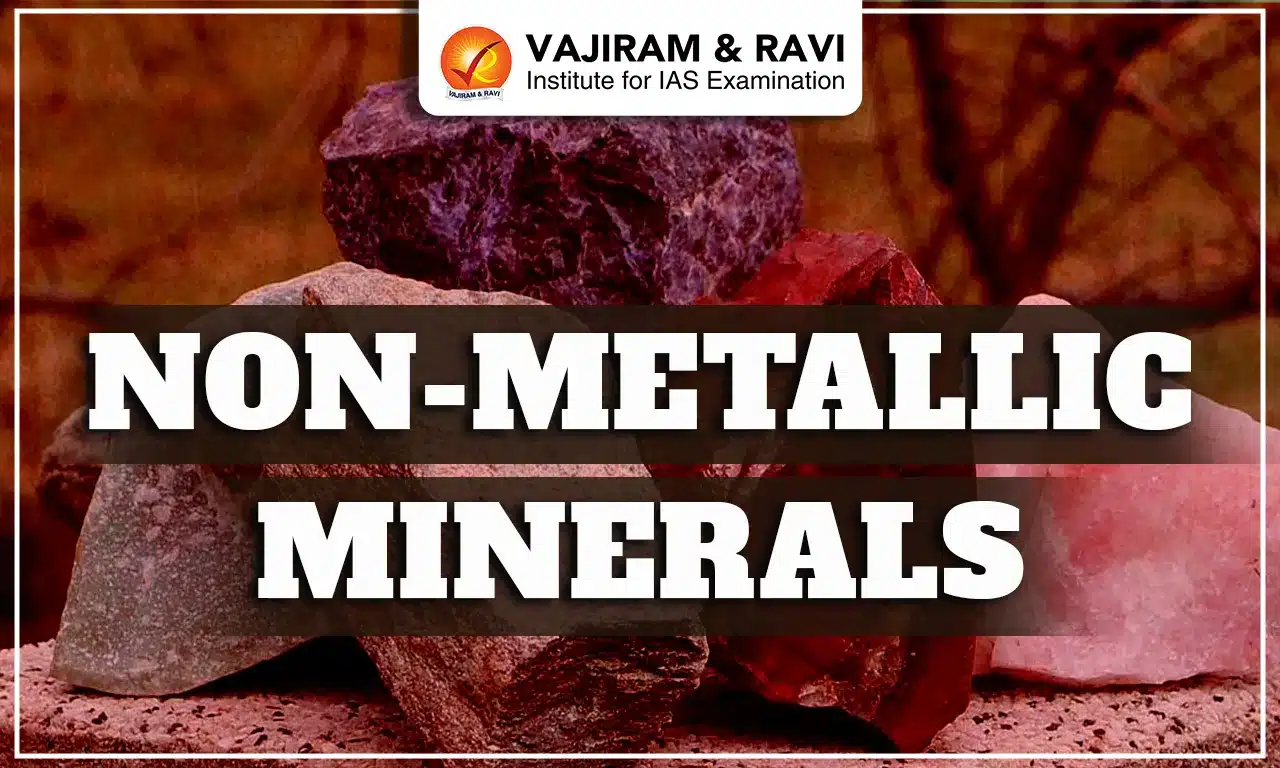
Non-metallic minerals are those minerals that do not contain metals in them and are generally not used as sources of metals. Instead, they are valued for their physical and chemical properties, making them useful in various industries. These minerals include mica, diamonds, limestones, dolomite, gypsum. In this article, we are going to cover non-metallic minerals and their types.
Non-Metallic Minerals
India is endowed with a rich variety of non-metallic minerals, which form an important backbone for several industries ranging from electronics, construction, and fertilizers to ornaments and ceramics. While mica has long been a hallmark of India’s global mineral reputation, other minerals such as limestone, gypsum, and diamonds also play significant roles in industrial and economic growth. Additionally, heavy mineral sands and titanium deposits along India’s coastline add to its mineral wealth, making the country self-reliant in several critical sectors.
Non-Metallic Minerals Types
The non-metallic minerals are of the following types:
Mica
- Properties & Importance: Mica has unique insulating properties, excellent dielectric strength, and resistance to high voltage. This makes mica a highly valuable mineral in the electrical and electronics industry. It is widely used in capacitors, transformers, and insulation materials.
- Distribution in India: Major mica-bearing ores are found in Andhra Pradesh, Bihar, Jharkhand, Maharashtra, and Rajasthan. Among these, Andhra Pradesh leads with 41% share of India’s total resources, followed by Rajasthan, Odisha, Maharashtra, Bihar, and Jharkhand.
- Production & Global Standing: India enjoys a monopoly in global mica production, contributing around 60% of the world’s output. Andhra Pradesh is the largest producer, followed by Rajasthan and Jharkhand. India is not just the largest producer but also the largest exporter of mica globally, supplying to industries across the world.
Limestone
- Nature & Occurrence: Limestone consists mainly of calcium carbonate (CaCO₃) and is of sedimentary origin. It occurs across almost all geological sequences from Pre-Cambrian to Recent, except in Gondwana formations.
- Distribution in India: Karnataka has the largest share (28%) of total resources, followed by Andhra Pradesh, Rajasthan, Gujarat, Meghalaya, and Chhattisgarh.
- Production Centers: Over three-fourths of India’s limestone is produced in just six states: Andhra Pradesh & Telangana, Rajasthan, Madhya Pradesh, Gujarat, Tamil Nadu, and Karnataka. These states form the backbone of India’s cement and construction industries.
Dolomite
- Nature: When limestone contains more than 10% magnesium carbonate, it is classified as dolomite.
- Distribution: Major deposits occur in Madhya Pradesh (29%), followed by Andhra Pradesh, Chhattisgarh, Odisha, Karnataka, Gujarat, Rajasthan, and Maharashtra.
- Production & Uses: Chhattisgarh is the leading dolomite producer, contributing more than 30% of the total output. Economically, dolomite is widely used in the metallurgical industry, particularly as a flux in blast furnaces, and as a refractory material due to its heat resistance.
Asbestos
- Properties: Asbestos is highly valued due to its fibrous structure, ability to fragment into thin filaments, and high tensile strength. It is resistant to heat, fire, and chemicals, which makes it highly commercial.
- Production in India: Rajasthan and Andhra Pradesh together account for nearly all of India’s asbestos production. Minor deposits also occur in Jharkhand, Madhya Pradesh, Chhattisgarh, Tamil Nadu, Gujarat, Uttarakhand, and Nagaland.
Kyanite
- Nature & Uses: Found in metamorphic aluminous rocks, kyanite is used in metallurgical, ceramic, refractory, glass, cement, and electrical industries.
- Resources: India has the largest deposits of kyanite in the world. Andhra Pradesh alone accounts for 78% of resources, followed by Karnataka (13%) and Jharkhand (6%). The remaining 3% is distributed in Kerala, Maharashtra, Rajasthan, Tamil Nadu, and West Bengal.
- Production: Despite Andhra Pradesh’s resource dominance, Jharkhand is the largest producer, followed by Maharashtra.
Gypsum
- Nature: Gypsum is a hydrated sulphate of calcium (CaSO₄·2H₂O), occurring as a white, opaque, or transparent mineral in sedimentary formations such as limestones, sandstones, and shales.
- Uses: It is mainly used in ammonium sulphate fertilizers and the cement industry (4-5%). It is also essential for Plaster of Paris, ceramics, tiles, and mould-making. In agriculture, gypsum is applied as a soil conditioner.
- Distribution & Production:
- Rajasthan holds about 81% of India’s resources, mainly in Jodhpur, Nagaur, Bikaner, Jaisalmer, and Barmer.
- Jammu & Kashmir has 14% of resources.
- Other states like Tamil Nadu, Gujarat, Himachal Pradesh, Karnataka, Uttarakhand, Andhra Pradesh, and Madhya Pradesh contribute minor shares.
- Rajasthan is the largest producer, followed by Tamil Nadu and Jammu & Kashmir.
Diamonds
- Uses: Diamonds are widely used in ornaments and jewelry due to their brilliance, but their most significant industrial use lies in cutting, drilling, and polishing because of their extreme hardness.
- Diamond-bearing Areas in India:
- Panna Belt (Madhya Pradesh) has the most famous deposits.
- Anantapur district (Andhra Pradesh).
- Newly discovered fields: Raichur-Gulbarga belt in Karnataka.
Atomic Minerals (Uranium & Thorium)
- Importance: Uranium and Thorium form the base of India’s nuclear industry. Their exploration and development are overseen by the Atomic Mineral Directorate (AMD) under the Department of Atomic Energy.
- Uranium: Deposits occur in Jharkhand, Chhattisgarh, Madhya Pradesh, Andhra Pradesh, and Meghalaya. Recent studies in the Nubra–Shyok valley (Ladakh) have found uranium with unusually high concentrations compared to normal ores (which contain only about 0.1%).
- Thorium: Found largely in Monazite sands along the east and west coasts and in Bihar. The largest concentration of monazite is on the Kerala coast. Other major producing states include Kerala, Jharkhand, Bihar, Tamil Nadu, and Rajasthan.
Salt
- Sources: Salt in India is obtained from sea water, brine springs, wells, salt pans in lakes, and rock deposits.
- Production Centers:
- Rock salt: Found in Mandi district (Himachal Pradesh) and parts of Gujarat.
- Sea brine: Extracted along the coasts of Gujarat, Maharashtra, and Tamil Nadu.
- Major Producer: The Gujarat coast dominates production, contributing nearly 50% of India’s total salt output.


 Last updated on Oct, 2026
→ UPSC 2027 Notification will be released on 13 January 2027 at upsconline.nic.in.
→ Asian Games 2026 are being held in Aichi-Nagoya, Japan, from 19 September to 4 October.
→ Check Nobel Prize 2026 Winners List here.
→ Download PIB PRiSM Monthly Magazine 2026 here.
→ Check UPSC Monthly Current Affairs Magazine The Recitals here.
→ Check out the latest UPSC Syllabus here.
→ Download UPSC Model Answers for Mains 2026
→ UPSC Mains Question Paper 2026 is out now for Essay & GS Paper 1, 2, 3 & 4.
→ UPSC Calendar 2027 has been released.
→ Enroll in Vajiram & Ravi’s UPSC Mains Test Series 2027 for structured answer writing practice, expert evaluation, and exam-oriented feedback.
→ Join Vajiram & Ravi’s UPSC Mentorship Program 2027 for personalized guidance, strategy planning, and one-to-one support from experienced mentors.
→ Go through the UPSC Mains Previous Year Papers to enhance your preparation.
→ UPSC has released UPSC Toppers List 2025 with the Civil Services final result on its official website.
→ Also check Best UPSC Coaching in India
Non-Metallic Minerals FAQs
Q1. What are non-metallic minerals?+
Q2. What are 10 examples of non-metallic materials?+
Q3. What is a metallic mineral?+
Q4. What are the five non-metallic?+
Q5. What are the 7 main types of minerals?+
Tags: non-metallic minerals