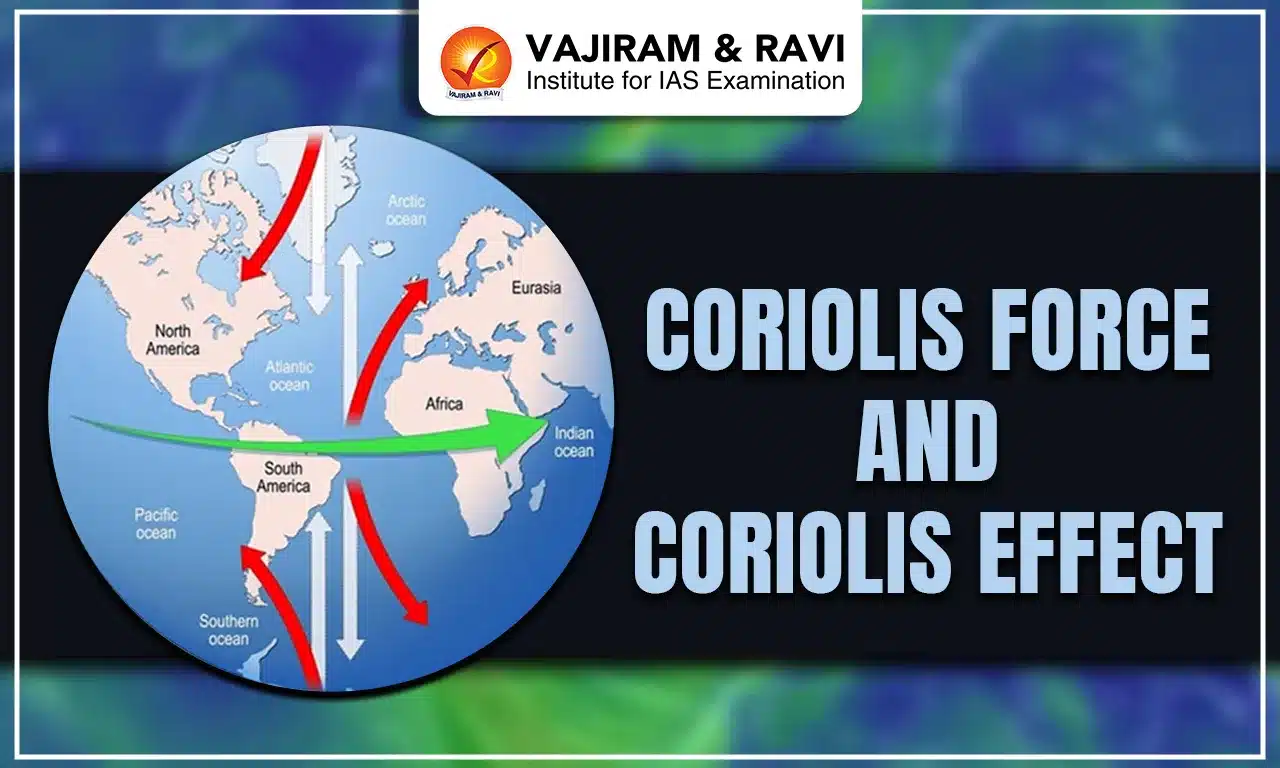
The Coriolis Force is an imaginary force that appears to act on objects moving over a rotating surface, such as the Earth. Put simply, it’s the apparent force you feel when you move along with something that is spinning. The Coriolis Effect is the actual outcome of this force; it explains why moving objects, like winds, ocean currents, or even long-range projectiles, seem to bend from their straight path. This deflection happens because the Earth is rotating, and without this spin, the motion would appear straight.
Coriolis Force
The Coriolis Force arises due to the Earth’s rotation on its axis and plays a crucial role in determining the direction of wind and ocean currents. Its strength depends on latitude, it is zero at the equator and increases toward the poles. In the Northern Hemisphere, this force deflects moving air or water to the right of its path, while in the Southern Hemisphere, the deflection is to the left. This phenomenon is a key reason why large-scale wind systems, such as trade winds, westerlies, and cyclones, rotate in specific directions in different hemispheres.
| Coriolis Force | |
|
Aspect |
Explanation |
|
Definition |
The Coriolis Force is an apparent (fictitious) force that acts on objects moving within a rotating system like the Earth, making their path appear deflected. |
|
Cause |
It arises due to Earth’s rotation on its axis. Moving objects seem to deviate from a straight line because the surface beneath them is rotating. |
|
Direction |
In the Northern Hemisphere, objects deflect to the right of their motion, while in the Southern Hemisphere, they deflect to the left. |
|
Applications |
Explains the rotation of cyclones, global wind patterns (trade winds, westerlies), ocean currents, and even the deviation in long-range artillery or missile paths. |
Coriolis Force and Coriolis Effect
The Coriolis Force is an apparent force that arises due to the Earth’s rotation. It acts perpendicular to the direction of motion and to the Earth’s axis of rotation, causing a deflection in the path of moving bodies. In the Northern Hemisphere, objects are deflected to the right, while in the Southern Hemisphere, they are deflected to the left. Though not a real force in the classical sense, it becomes significant in a rotating frame of reference, such as the Earth, and explains large-scale phenomena like global wind patterns, ocean currents, and cyclone rotation.
Coriolis Effect
The Coriolis Effect is the apparent deflection of moving objects caused by the Earth’s rotation. It plays a vital role in shaping wind patterns, ocean currents, and cyclone formation, making it highly significant in meteorology and oceanography. Coriolis Effect Features includes:
- Hemisphere Deflection: Objects curve to the right in the Northern Hemisphere and to the left in the Southern Hemisphere.
- Variation with Latitude: The effect is strongest at the poles and becomes zero at the equator.
- Dependence on Speed: Faster-moving objects experience greater deflection than slower ones.
- Direction, Not Speed: It changes only the direction of motion, not the velocity.
- Right-Angle Deflection: The deflection occurs at right angles to the movement, preventing winds from flowing directly along pressure gradients.
- Geostrophic Balance: At higher altitudes, when the Coriolis Effect balances pressure gradient force, winds flow parallel to isobars, this is known as geostrophic wind. Near the surface, friction modifies this balance.


Coriolis Force Diagram
The direction of winds is strongly influenced by the Coriolis Force, which arises from the Earth’s rotation on its axis. This force causes moving air to deflect, to the right in the Northern Hemisphere and to the left in the Southern Hemisphere.
Coriolis Force Diagram is shown below, highlighting how wind paths curve differently across hemispheres and why this deflection is zero at the equator.
Coriolis Effect Causes
The Coriolis Effect occurs because the Earth rotates on its axis. Since the Earth spins eastward (counterclockwise when viewed from above the North Pole), objects moving freely over its surface, like winds, ocean currents, or airplanes appear to curve from their path. This happens because different parts of the Earth move at different speeds; the equator spins faster than regions closer to the poles.
At the equator, there is no deflection, so an object like a plane flying exactly along it stays on course. But as soon as the object moves north or south of the equator, it begins to drift: to the right in the Northern Hemisphere and to the left in the Southern Hemisphere. The effect becomes stronger at higher latitudes and is also greater for faster-moving objects.
Coriolis Force Impact
The Coriolis Effect plays a vital role in understanding planetary and Earth motions. Its influence is especially significant in atmospheric dynamics, where it determines wind patterns, storm systems, and the rotation of cyclones.
In oceanography, the Coriolis Effect explains why major ocean currents are deflected, shaping global circulation patterns and influencing climate. One of its most important geographical outcomes is the combined deflection of winds and ocean currents.
The effect is also crucial in fields like aviation and defense, where it alters the trajectories of airplanes, missiles, and long-range projectiles. Beyond human-made systems, the Coriolis Effect underpins natural phenomena studied across multiple sciences dealing with Earth’s motion. In practice, wind movement is guided by three factors:
- It flows from high pressure to low pressure.
- The Coriolis Force, generated by Earth’s rotation, causes deflection, rightward in the Northern Hemisphere and leftward in the Southern Hemisphere.
- Friction, especially over landforms such as mountains and valleys, modifies both wind direction and speed, whereas winds move faster and more consistently over oceans.
Together, these forces create the complex wind systems that regulate weather and climate across the globe.

 Last updated on Sep, 2026
→ UPSC 2027 Notification will be released on 13 January 2027 at upsconline.nic.in.
→ Check out the latest UPSC Syllabus here.
→ Download UPSC Model Answers for Mains 2026
→ UPSC Mains Question Paper 2026 is out now for Essay & GS Paper 1, 2, 3 & 4.
→ UPSC Calendar 2027 has been released.
→ Enroll in Vajiram & Ravi’s UPSC Mains Test Series 2027 for structured answer writing practice, expert evaluation, and exam-oriented feedback.
→ Join Vajiram & Ravi’s UPSC Mentorship Program 2027 for personalized guidance, strategy planning, and one-to-one support from experienced mentors.
→ Go through the UPSC Mains Previous Year Papers to enhance your preparation.
→ UPSC has released UPSC Toppers List 2025 with the Civil Services final result on its official website.
→ Also check Best UPSC Coaching in India
Coriolis Force and Coriolis Effect FAQs
Q1. Is the Coriolis effect the same as the Coriolis force?+
Q2. What is the Coriolis force and its effect?+
Q3. What is another name for Coriolis force?+
Q4. What is Coriolis force UPSC?+
Q5. What is the full name of Coriolis?+
Tags: coriolis force and coriolis effect