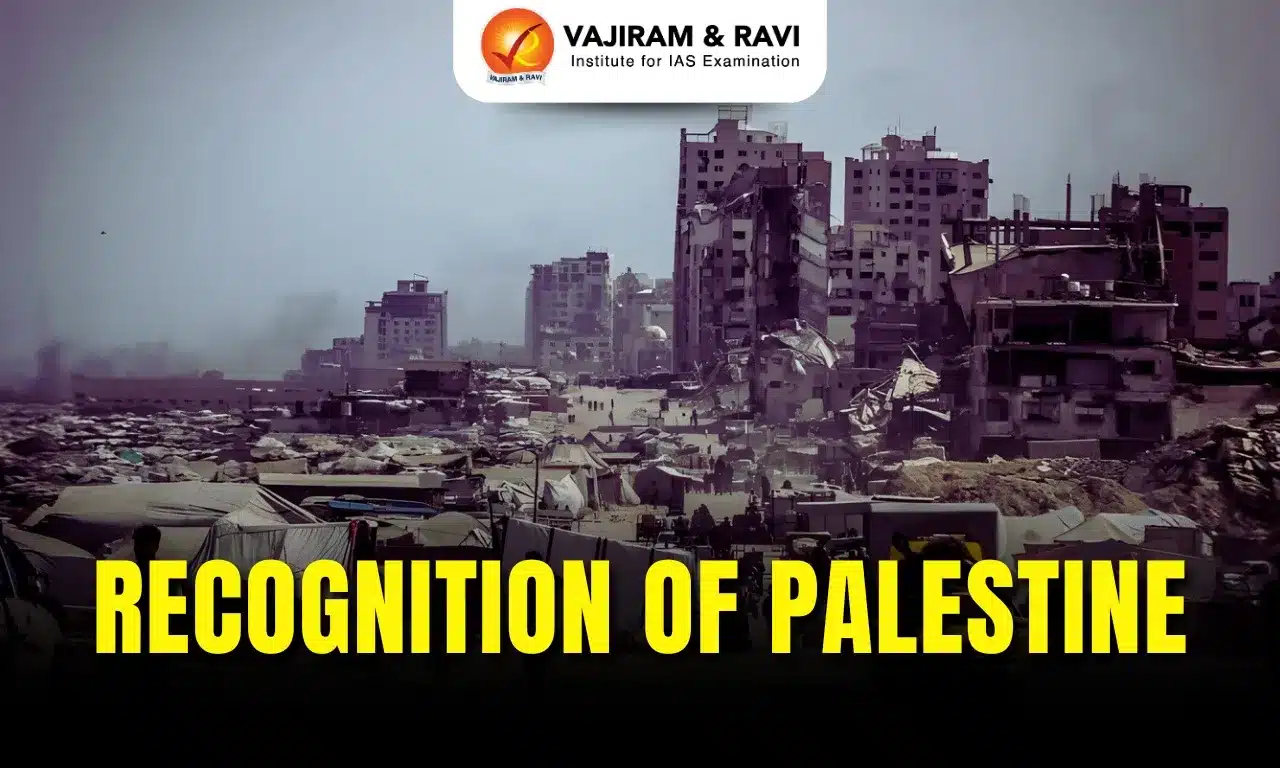
Recognition of Palestine Latest News
- At the UN General Assembly, France joined the UK, Canada, Australia, and several European nations in recognising Palestine statehood.
- Israel strongly criticised the move, calling it a reward for terrorism.
Impact of Palestine Recognition on Gaza War
- Palestine enjoys wide international recognition, has diplomatic missions, and competes in global events.
- Yet, it lacks agreed borders, a capital, and full sovereignty due to Israel’s occupation of the West Bank and Gaza.
- Recognition is thus symbolic, signaling moral and political support rather than immediate change on the ground.
- The growing recognition of Palestinian statehood adds diplomatic pressure but has little effect on the Gaza war.
- Israel continues its offensive, with Netanyahu declaring the war will persist regardless of hostage releases.
- While some European states are restricting military exports, the US maintains unconditional support, recently approving $6.4 billion in arms sales.
- Germany also remains a key supplier, alongside Washington, together accounting for over 90% of Israel’s defence imports.
- Thus, despite international momentum, recognition alone has minimal impact on halting the conflict.


The Question of Palestinian Statehood
- Under the 1933 Montevideo Convention, statehood requires defined territory, a permanent population, a government, and capacity for international relations.
- For Palestine, these pillars remain contested under Israeli occupation.
Territory
- Palestinian lands — West Bank, East Jerusalem, and Gaza — are effectively under Israel’s control.
- Settlement expansion and annexation efforts further erode prospects of territorial sovereignty.
Permanent Population
- The Gaza war has devastated the population, with over 65,000 deaths estimated and widespread famine.
- Such conditions threaten the very survival of Palestinians as a people.
Government
- The Palestinian Authority (PA) governs limited West Bank areas, while Hamas controls Gaza under blockade.
- Calls for PA reform and Hamas’ disarmament highlight governance challenges, leaving sovereignty curtailed.
International Recognition
- Global recognition strengthens Palestine’s ability to engage diplomatically, even as effective control of land, population, and governance remains compromised.
- Recognition thus primarily boosts Palestine’s lobbying capacity on the world stage.
Israel’s Response to Growing Recognition of Palestine
- Israel has reacted to increasing global recognition of Palestine by intensifying military action and deepening its occupation.
- After the UK’s recognition, Prime Minister Netanyahu vowed that a Palestinian state “will never be established” and claimed credit for blocking it despite international pressure.
- Similar defiance followed the UNGA’s vote for a two-state solution.
- Each escalation on the ground in Gaza and the West Bank strengthens Israel’s control, further diminishing the feasibility of a Palestinian state.
India’s Stand on Palestine
- India has long supported the Palestinian cause as part of its foreign policy.
- In 1974, India became the first non-Arab state to recognize the Palestine Liberation Organization (PLO).
- In 1988, India was among the first to recognize the State of Palestine.
- In 1996, India opened its Representative Office in Gaza, later moved to Ramallah in 2003.
Support at Multilateral Fora
- India has actively supported Palestine at global platforms.
- Backed UN resolutions affirming Palestinians’ right to self-determination and urging Israeli compliance with international law.
- Supported Palestine’s status as a UN non-member state and, in 2011, voted for its full membership in UNESCO.
Policy Approach
- India advocates a negotiated Two-State solution, seeking a sovereign, independent, and viable Palestinian state coexisting peacefully with Israel.
- The Two-State solution refers to establishing a Palestinian state in the West Bank and Gaza, with East Jerusalem as its capital, based on pre-1967 borders.
- It emphasizes diplomacy, dialogue, de-escalation, and early resumption of peace talks.

 Last updated on Sep, 2026
→ UPSC 2027 Notification will be released on 13 January 2027 at upsconline.nic.in.
→ Check out the latest UPSC Syllabus here.
→ Download UPSC Model Answers for Mains 2026
→ UPSC Mains Question Paper 2026 is out now for Essay & GS Paper 1, 2, 3 & 4.
→ UPSC Calendar 2027 has been released.
→ Enroll in Vajiram & Ravi’s UPSC Mains Test Series 2027 for structured answer writing practice, expert evaluation, and exam-oriented feedback.
→ Join Vajiram & Ravi’s UPSC Mentorship Program 2027 for personalized guidance, strategy planning, and one-to-one support from experienced mentors.
→ Go through the UPSC Mains Previous Year Papers to enhance your preparation.
→ UPSC has released UPSC Toppers List 2025 with the Civil Services final result on its official website.
→ Also check Best UPSC Coaching in India
Recognition of Palestine FAQs
Q1. What does “recognition of Palestine” mean in international law?+
Q2. Why has France decided to recognise Palestine now?+
Q3. How has Israel responded to countries recognising Palestine?+
Q4. Will recognition of Palestine by many countries stop the Gaza war?+
Q5. What is India’s policy on recognition of Palestine?+
Tags: mains articles recognition of Palestine upsc current affairs upsc mains current affairs