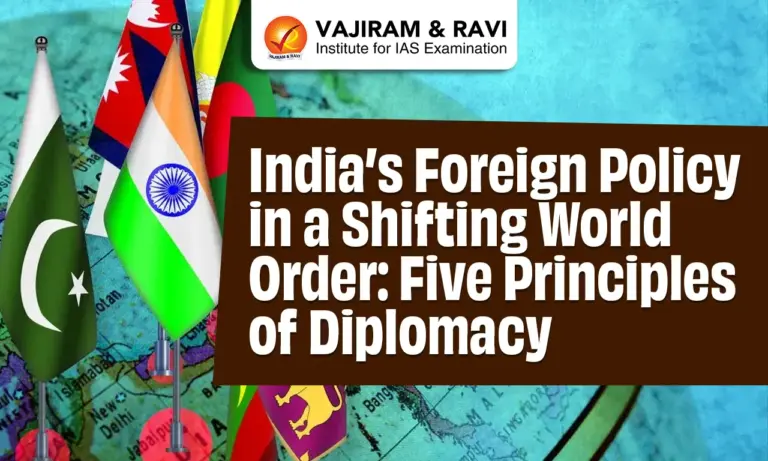
The contemporary international order is undergoing rapid transformation. Intensifying geopolitical rivalry, regional conflicts, economic fragmentation, technological competition, and weakening multilateral institutions are reshaping global politics.
Against this backdrop, five major principles can be identified as guiding pillars of India’s diplomacy in a shifting world order: reciprocity, diversification, strategic flexibility, strategic expansion, and domestic renewal.
Changing Nature of the Global Order
The present international environment is marked by several major transformations:
- The gradual decline of unipolarity and rise of multipolarity.
- Intensifying competition between the United States and China.
- Weakening of traditional Western alliances and institutions.
- Rise of issue-based coalitions such as BRICS and the Quad.
- Growing geopolitical importance of technology, supply chains, energy, and critical minerals.
- Increasing instability in regions such as West Asia, Eastern Europe, and the Indo-Pacific.
- Expanding role of middle powers such as India, Türkiye, Saudi Arabia, Brazil, and Indonesia.
These developments require India to adopt a flexible and multidimensional foreign policy approach.
India’s Foreign Policy in the Contemporary Era
India’s foreign policy has increasingly become pragmatic and interest-oriented rather than ideology-driven. India today simultaneously participates in multiple strategic platforms and engages with competing powers.
For example:
- India is part of both BRICS and the Quad.
- India maintains close relations with the United States while continuing defence ties with Russia.
- India deepens strategic cooperation with West Asian countries while also engaging with Iran.
- India strengthens ties with Europe while expanding outreach to Africa and the Indo-Pacific.
This reflects India’s evolving approach of “multi-alignment” aimed at maximising national interests while preserving strategic autonomy.


Five Principles of India’s Diplomacy
According to C. Raja Mohan, five key principles should guide India’s diplomacy in a rapidly changing world order marked by geopolitical tensions, economic uncertainty, and shifting global power balances.
Reciprocity
Reciprocity means supporting countries that consistently support India’s core strategic interests. This principle highlights that long-term diplomatic relations are built on mutual trust, reliability, and support during difficult times.
- Prime Minister Narendra Modi’s visit to the United Arab Emirates during tensions in West Asia reflected India’s support for a trusted strategic partner.
- The UAE has repeatedly supported India on sensitive issues such as Kashmir and cross-border terrorism. It is also an important source of energy, investment, and employment for millions of Indians living in the Gulf region.
- Over the years, India-UAE relations have expanded beyond trade and remittances to include defence cooperation, logistics, food security, technology, and regional coordination.
Diversification
The second principle is diversification, which refers to broadening India’s international partnerships across different regions and sectors to avoid excessive dependence on any one country or bloc.
- India’s growing engagement with Europe reflects this changing approach.
- Earlier, India’s view of Europe was shaped largely through its close ties with the Soviet Union during the Cold War. However, today Europe has become increasingly important for India in areas such as: Trade and exports, Investment and capital flows, Advanced technologies, Green energy partnerships and Higher education and skilled migration
- Prime Minister Modi’s visits to countries such as the Netherlands, Sweden, Norway, and Italy show India’s effort to deepen ties even with smaller but technologically advanced European nations.
- Similarly, trade agreements with the European Union and the European Free Trade Association reflect India’s strategy of expanding economic partnerships and reducing strategic vulnerabilities.
Strategic Flexibility
The third principle is strategic flexibility, which means maintaining freedom in foreign policy decisions and avoiding rigid alliances in an increasingly polarised international system.
- The world today is witnessing growing rivalry among major powers such as the United States, China, Russia, and Europe. In such a situation, India seeks to protect its own interests rather than becoming part of any single camp.
- India’s simultaneous participation in the BRICS and the Quadrilateral Security Dialogue reflects this flexible approach.
- India has avoided turning the Quad into a formal military alliance and instead prefers issue-based cooperation while maintaining strategic autonomy. This principle reflects India’s pragmatic diplomacy based on national interest rather than ideological alignments.
Strategic Expansion
The fourth principle is strategic expansion, especially towards regions that are becoming increasingly important in global politics and economics, such as Africa.
- Africa is emerging as a major centre of future economic growth because of its large young population, expanding markets, rich reserves of critical minerals and growing geopolitical importance
- India’s relations with Africa were historically based on anti-colonial solidarity and South-South cooperation. However, today the relationship is becoming more strategic and economic in nature.
India is expanding cooperation with African countries in:
- Trade and investment
- Infrastructure and connectivity
- Healthcare and pharmaceuticals
- Defence and maritime security
- Education and capacity building
- Digital and technological partnerships
At the same time, India faces competition from other major powers such as China, the United States, and European countries, which are also increasing their presence in Africa. Therefore, India must strengthen its engagement to secure long-term economic and strategic opportunities.
Domestic Renewal
The fifth and most important principle is domestic renewal. This principle emphasises that a country’s global influence ultimately depends on its internal strength. Nations that continuously modernise and reform themselves are better able to protect their interests and benefit from global opportunities.
India’s ability to deal with geopolitical tensions, changing global trade patterns, and technological disruptions depends on the strength of its economy and institutions. To emerge as a major global power, India must focus on:
- Economic reforms
- Manufacturing growth
- Infrastructure development
- Technological innovation
- Education and skill development
- Administrative efficiency
However, bureaucratic delays and resistance to reforms continue to remain important challenges.

 Last updated on Oct, 2026
→ UPSC 2027 Notification will be released on 13 January 2027 at upsconline.nic.in.
→ Asian Games 2026 are being held in Aichi-Nagoya, Japan, from 19 September to 4 October.
→ Check Nobel Prize 2026 Winners List here.
→ Download PIB PRiSM Monthly Magazine 2026 here.
→ Check UPSC Monthly Current Affairs Magazine The Recitals here.
→ Check out the latest UPSC Syllabus here.
→ Download UPSC Model Answers for Mains 2026
→ UPSC Mains Question Paper 2026 is out now for Essay & GS Paper 1, 2, 3 & 4.
→ UPSC Calendar 2027 has been released.
→ Enroll in Vajiram & Ravi’s UPSC Mains Test Series 2027 for structured answer writing practice, expert evaluation, and exam-oriented feedback.
→ Join Vajiram & Ravi’s UPSC Mentorship Program 2027 for personalized guidance, strategy planning, and one-to-one support from experienced mentors.
→ Go through the UPSC Mains Previous Year Papers to enhance your preparation.
→ UPSC has released UPSC Toppers List 2025 with the Civil Services final result on its official website.
→ Also check Best UPSC Coaching in India
India’s Foreign Policy in a Shifting World Order FAQs
Q1. What is meant by the changing global order?+
Q2. What is multipolarity in international relations?+
Q3. What are the five principles of India’s diplomacy in a changing world order?+
Q4. What is meant by reciprocity in diplomacy?+
Q5. Why is diversification important in India’s foreign policy?+
Q6. Why is domestic renewal considered important for foreign policy?+
Tags: indias foreign policy in a shifting world order