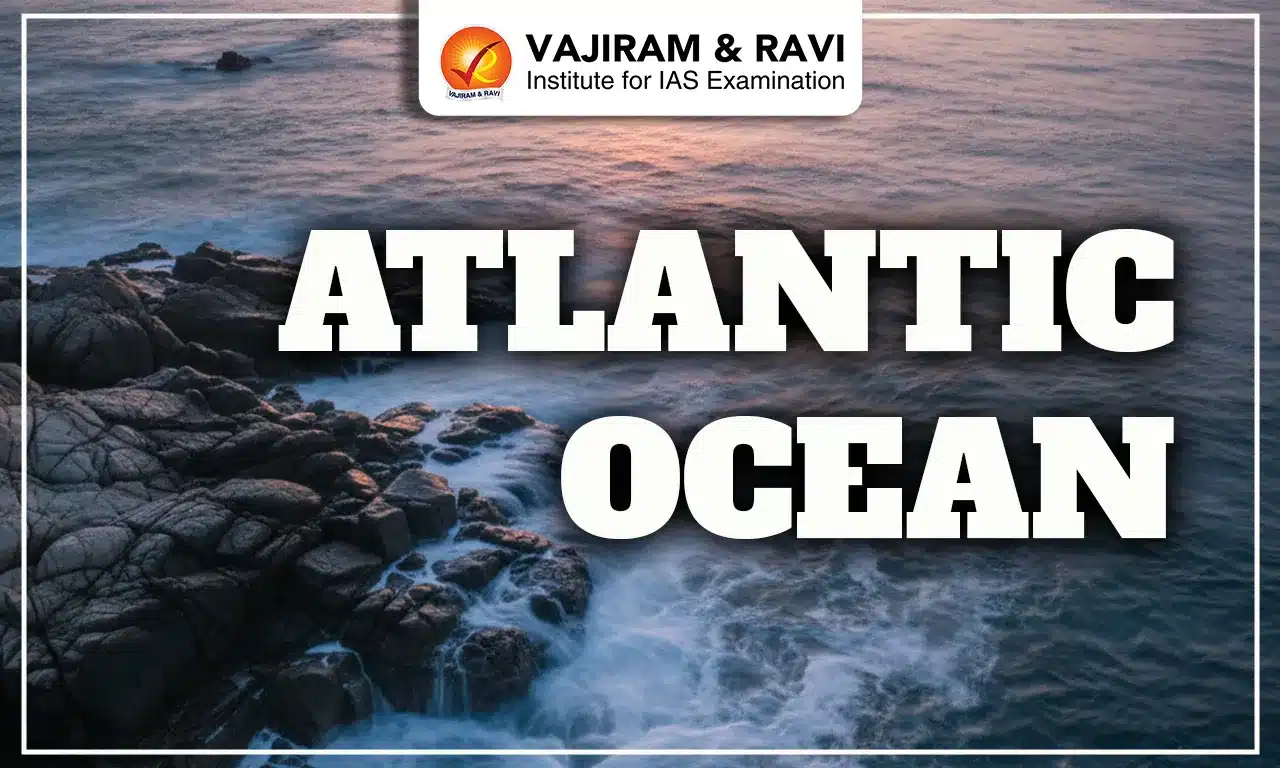
The Atlantic Ocean, the second-largest ocean on Earth, extends from the Northern to the Southern Hemisphere, covering roughly one-fifth of the planet’s surface. Its ocean currents have a profound impact on global climate, particularly shaping the weather patterns of northwestern Europe and northwestern Africa. Beyond climate, these currents support rich marine ecosystems, such as the Grand Banks off Newfoundland, Canada, which remain among the most productive fishing grounds in the world.
Atlantic Ocean
The Atlantic Ocean, a vast body of saltwater covering roughly one-fifth of the Earth’s surface, separates Europe and Africa to the east from North and South America to the west. Its name, derived from Greek mythology, means the “Sea of Atlas.” As the world’s second-largest ocean, it spans about 106.46 million sq.km and has an average depth of 3,646 meters.
Formed through the westward drift of the American continents due to plate tectonics, the Atlantic has a distinctive S-shaped outline. Its currents, influenced by wind, the Earth’s rotation, sunlight, and water density, play a key role in shaping the climate of northwestern Europe and Africa.
| Atlantic Ocean | |
|
Size |
Second largest Ocean in the world |
|
Location |
Body of water between Africa, Europe, the Arctic Ocean, the Americas, and the Southern Ocean |
|
Area |
85.133 million sq km |
|
Coastline Length |
111,866 km |
|
Ocean Volume |
23.3% of the world |
Atlantic Ocean Countries
The Atlantic Ocean comprises several important seas, each bordered by different countries. The table below lists these seas along with the nations that share their coastlines.
| Atlantic Ocean Countries | |
|
Name of Sea |
Bordering Countries |
|
Argentine Sea |
Argentina, Uruguay, Antarctica |
|
Baltic Sea |
Sweden, Denmark, Germany, Poland, Lithuania, Latvia, Estonia, Russia, Finland |
|
Black Sea |
Bulgaria, Romania, Ukraine, Russia, Georgia, Turkey |
|
Gulf of Mexico |
US, Mexico, Cuba |
|
Greenland Sea |
Greenland, Iceland, Svalbard (Norway) |
|
Caribbean Sea |
Cuba, Jamaica, Dominican Rep, Puerto Rico, Costa Rica, Nicaragua, Guatemala, Honduras Belize, Venezuela, Columbia, Panama |
|
Hudson Bay |
Quebec, Ontario, Manitoba, and Nunavut provinces of Canada |
|
Irminger Sea |
Iceland, Greenland, Canada |
|
James Bay |
Quebec and Ontario provinces of Canada |
|
Labrador Sea |
Labrador peninsula of Canada, Greenland |


Atlantic Ocean Deepest Point
The Milwaukee Depth is the Atlantic Ocean Deepest Point, reaching a depth of 8,380 meters. It is located approximately 100 miles (160 km) northwest of Puerto Rico and forms part of the Puerto Rico Trench, lying between the North Antillean Arc and the Puerto Rico Ridge.
Atlantic Ocean Water Circulation
The Atlantic Ocean, the World’s Second-Largest Ocean, covers roughly one-fifth of the Earth’s surface and is shaped by prevailing winds and surrounding landmasses. Its currents circulate vast amounts of water, playing a crucial role in regulating the climates of Northwestern Europe and Northwestern Africa. Beyond climate influence, these currents support some of the richest fishing grounds on the planet, such as the Grand Banks off Newfoundland, Canada.
Atlantic Ocean Currents
Atlantic Ocean Currents are continuous, directed movements of seawater influenced by several key factors. Solar heating warms the water, causing it to expand and drive motion. Winds blowing across the ocean surface push the water along, while gravity creates pressure differences that guide flow.
The Coriolis effect also plays a crucial role, deflecting currents to the right in the Northern Hemisphere and to the left in the Southern Hemisphere. Together, these forces shape the patterns of currents in the Atlantic Ocean.
Equatorial Atlantic Ocean Currents
The equatorial region of the Atlantic Ocean features three major currents, all influenced by the Easterly Trade Winds and the sun’s heating, making them warm currents.
- North Equatorial Current: This current flows between the equator and 10° N latitude, moving from east to west. It is formed when cold water rises along the west coast of Africa. Upon reaching the mid-Atlantic Ridge near 15° N, it turns north briefly before bending south. Near Brazil’s east coast, the current splits into the Antilles Current and the Caribbean Current.
- South Atlantic Equatorial Current: Flowing from the west coast of Africa to the east coast of South America between the equator and 20° S, this warm current splits upon reaching Brazil. One branch moves north to join the North Equatorial Current near Trinidad, while the other flows south along South America’s east coast.
- Counter-Equatorial Current: Situated between the north and south equatorial currents, this current flows eastward and is known as the Guinea Stream. It is warmer and less dense than the surrounding currents, making it a prominent feature of the equatorial Atlantic circulation.
North Atlantic Ocean Currents
In the Northern Hemisphere, the trade winds help maintain steady east-to-west currents, giving rise to several important oceanic flows in the Atlantic Ocean.
- Gulf Stream: Originating in the Gulf of Mexico around 20° N latitude, the Gulf Stream is a system of interconnected currents flowing northeast along North America’s eastern coast and reaching Western Europe near 70° N. It consists of three main components: the Florida Current (from the Florida Strait to Cape Hatteras), the Gulf Stream proper (Cape Hatteras to Grand Banks), and the North Atlantic Drift (Grand Banks to Western Europe).
- Canaries Current: This cold current flows southward along the coast of the Canary Islands after turning near Spain. It cools the warm waters off Western Africa between Madeira and Cape Verde and moves at an average speed of 8-30 nautical miles per day.
- Labrador Current: Flowing from Baffin Bay and Davis Strait near Greenland, the Labrador Current is a cold current along the coasts of Newfoundland and the Grand Banks. It carries icebergs, posing navigation hazards, and meets the warm Gulf Stream near 50° W longitude, resulting in dense fog.
South Atlantic Ocean Currents
In the Southern Hemisphere, the South Atlantic Ocean features a set of major currents that generally mirror the Northern Hemisphere’s flows but in opposite directions.
- Falkland Current: A cold current originating from the Antarctic Sea, it flows north along the east coast of South America, reaching Argentina. Around 30°S latitude, it is particularly strong and can carry icebergs from Antarctica to the coast.
- Brazilian Current: Formed when the South Equatorial Current splits at Cape São Roque in Northeast Brazil, this warm current flows south along the east coast of South America up to 40°S latitude. The Westerlies and Earth’s rotation then push it eastward, where it meets the cold Falkland Current.
- South Atlantic Drift: Also known as the Westerlies Drift or Antarctic Drift, this cold current is the eastward continuation of the Brazilian Current, driven by the Westerlies as it moves south toward the southern tip of Africa.
Benguela Current: When the South Atlantic Drift splits at Africa’s southern tip, the branch flowing up the west coast of South Africa is called the Benguela Current. This cold current eventually merges with the South Equatorial Current, completing the circuit of the South Atlantic currents.

 Last updated on Oct, 2026
→ UPSC 2027 Notification will be released on 13 January 2027 at upsconline.nic.in.
→ Check Nobel Prize 2026 Winners List here.
→ Download PIB PRiSM Monthly Magazine 2026 here.
→ Check UPSC Monthly Current Affairs Magazine The Recitals here.
→ Check out the latest UPSC Syllabus here.
→ Download UPSC Model Answers for Mains 2026
→ UPSC Mains Question Paper 2026 is out now for Essay & GS Paper 1, 2, 3 & 4.
→ UPSC Calendar 2027 has been released.
→ Enroll in Vajiram & Ravi’s UPSC Mains Test Series 2027 for structured answer writing practice, expert evaluation, and exam-oriented feedback.
→ Join Vajiram & Ravi’s UPSC Mentorship Program 2027 for personalized guidance, strategy planning, and one-to-one support from experienced mentors.
→ Go through the UPSC Mains Previous Year Papers to enhance your preparation.
→ UPSC has released UPSC Toppers List 2025 with the Civil Services final result on its official website.
→ Also check Best UPSC Coaching in India
Atlantic Ocean FAQs
Q1. In which country is the Atlantic Ocean?+
Q2. What are the 7 oceans of the world?+
Q3. Why is the Atlantic Ocean so famous?+
Q4. What 8 countries border the Atlantic Ocean?+
Q5. What is the biggest ocean?+
Tags: atlantic ocean