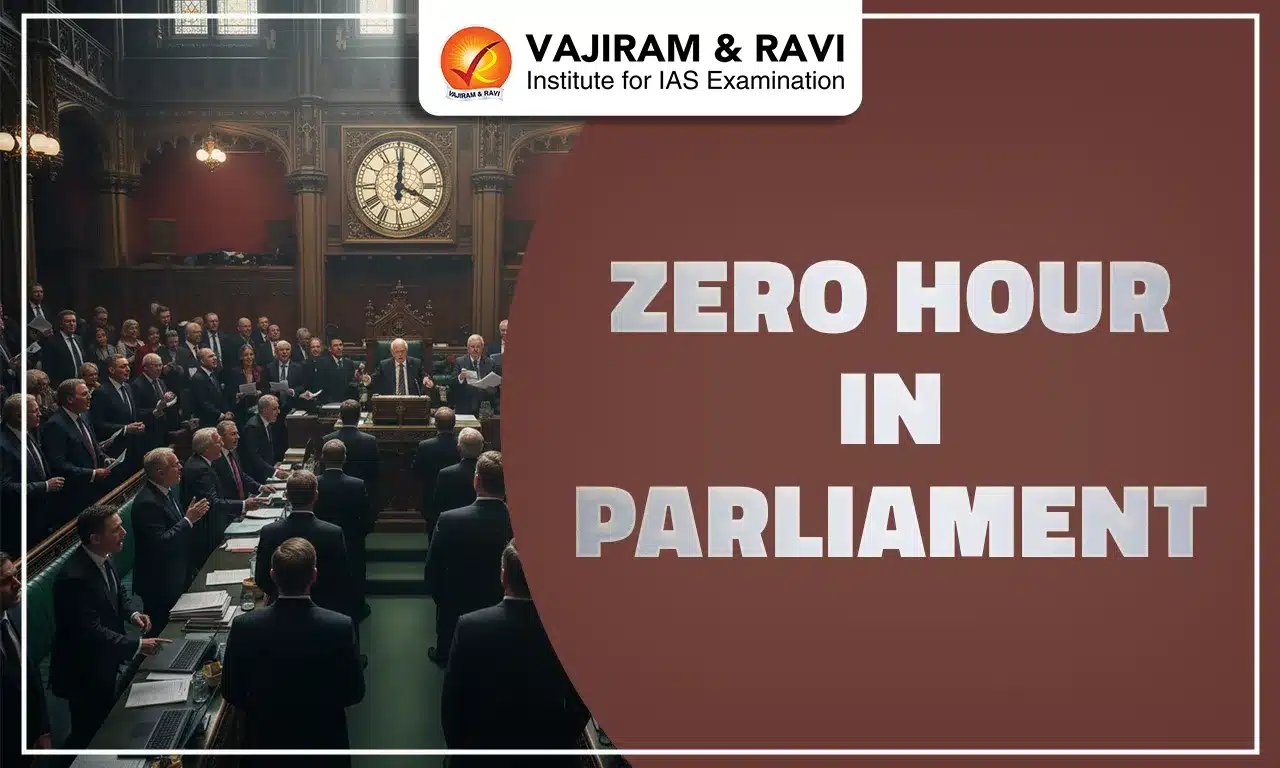
Zero Hour in the Parliament is not mentioned in the Constitution of India or Parliamentary Rules, but is still an important part of India’s Parliamentary Democracy. This gives the MPs the opportunity to raise urgent matters, hold the government accountable and make sure that public concerns are addressed properly. This informal nature of Zero Hour complements all the other parliamentary mechanisms like Question Hour and debates, thus reinforcing the democratic principles of responsiveness of citizens’ needs. In this article, we are going to cover Zero Hour, its definition and functions along with the duration, importance and impact.
Zero Hour in the Parliament of India
Zero Hour is a unique feature of the Indian Parliamentary System that starts immediately after the Question Hour, precisely at 12 noon, which is why it is called “Zero Hour.” Unlike Question Hour, Zero Hour is not mentioned in the Constitution or parliamentary rules, making it an informal, yet highly significant, component of parliamentary proceedings. During this period, Members of Parliament can raise issues of urgent public importance without prior notice, enabling them to draw the attention of the government and the House to matters that require immediate discussion. Over the years, the length and format of Zero Hour have evolved, reflecting the changing needs of parliamentary business.
Zero Hour Functions
Zero Hour refers to the period in parliamentary proceedings when MPs can raise matters of urgent public significance that have not been listed in the day’s agenda. This process allows MPs to bring up pressing issues such as natural disasters, accidents, public health emergencies, and other crises requiring immediate government attention. In practice, MPs are expected to give notice to the Lok Sabha Speaker or the Rajya Sabha Chairman by 10:00 a.m., although the approval of the Speaker or Chairman is required before the matter can be discussed. The informal nature of Zero Hour allows MPs to bypass the 10-day notice requirement typical of other parliamentary interventions, allowing for a rapid response to urgent issues.
Zero Hour is an important tool for accountability, transparency, and responsiveness in the parliamentary system. Every MP usually has three minutes to raise an issue during the 30-minute Zero Hour session in the Lok Sabha, providing a structured but flexible platform for urgent matters.


Zero Hour Origin
The practice of Zero Hour originated in India in the early 1960s. Members of Parliament started raising urgent matters immediately after Question Hour, sometimes with or without the permission of the Chairman. After the announcement of the end of Question Hour, MPs would quickly stand to highlight issues they believed required immediate attention. This practice eventually gained media coverage and recognition, formalizing the concept of Zero Hour as a recognized period for raising urgent matters in Parliament.
Zero Hour Time and Procedure
In the Lok Sabha, Zero Hour starts at 12 noon, immediately following the Question Hour, and usually lasts for 30 minutes. Every MP is allotted three minutes to present an issue. While there is no fixed time requirement under parliamentary rules, the 30-minute duration provides a practical window for discussing matters of immediate public concern. During this period, the government may respond to the issues raised, either verbally or in writing, providing clarification, updates, or the official position of the administration.
Zero Hour Importance and Impact
Zero Hour is important because it allows MPs to present urgent public issues without waiting for their inclusion in the agenda. By raising these issues, MPs can hold the government accountable, ensuring responsiveness and transparency. The topics discussed during Zero Hour can vary widely, reflecting the diverse concerns of the public and the urgency of emerging issues.
Over time, Zero Hour has addressed many important national and regional matters, including public health emergencies, national security, corruption, environmental disasters, and social issues. Notable examples include the Bhopal Gas Tragedy, the 1993 Bombay Bomb Blasts, and recent farmers’ protests. Through these interventions, Zero Hour serves as a platform for citizens’ concerns to be heard, for government accountability to be reinforced, and for transparency in governance to be promoted.
Difference Between Zero Hour and Question Hour
While Zero Hour is closely associated with Question Hour, the two differ in purpose, procedure, and formalities. While Question Hour focuses on formal queries and structured responses from Ministers, Zero Hour allows MPs to address urgent and unforeseen issues, making it a flexible tool for governance oversight.The differences in between Zero Hour and Question Hour include:
| Parameter | Zero Hour | Question Hour |
|
Timing |
Begins immediately after Question Hour |
First hour of the sitting |
|
Purpose |
To raise matters of urgent public importance |
To ask formal questions to Ministers |
|
Speaker’s Role |
Minimal involvement; approves or disapproves issues |
Conducts the proceedings |
|
Notice Requirement |
Not required |
Required in advance |
|
Type of Questions |
Not applicable |
Starred, Unstarred, Short Notice Questions |
|
Answer Format |
No formal answer required |
Oral or written answer provided |
|
Time Limit |
Not fixed; usually 30 minutes |
Fixed for each question |
|
MP’s Role |
Raises important issues |
Seeks information from Ministers |
|
Media Coverage |
Often covered by media |
Covered by media |
| Also Check Other Posts | |
| Important Articles of Indian Constitution | 9th Schedule |
| Schedules of Indian Constitution | Anti Defection Law |
| 5th Schedule | Preamble of the Indian Constitution |
| 6th Schedule | |

 Last updated on Sep, 2026
→ UPSC 2027 Notification will be released on 13 January 2027 at upsconline.nic.in.
→ Asian Games 2026 are being held in Aichi-Nagoya, Japan, from 19 September to 4 October.
→ Check out the latest UPSC Syllabus here.
→ Download UPSC Model Answers for Mains 2026
→ UPSC Mains Question Paper 2026 is out now for Essay & GS Paper 1, 2, 3 & 4.
→ UPSC Calendar 2027 has been released.
→ Enroll in Vajiram & Ravi’s UPSC Mains Test Series 2027 for structured answer writing practice, expert evaluation, and exam-oriented feedback.
→ Join Vajiram & Ravi’s UPSC Mentorship Program 2027 for personalized guidance, strategy planning, and one-to-one support from experienced mentors.
→ Go through the UPSC Mains Previous Year Papers to enhance your preparation.
→ UPSC has released UPSC Toppers List 2025 with the Civil Services final result on its official website.
→ Also check Best UPSC Coaching in India
Zero Hour in Parliament FAQs
Q1. What is the zero hour period in Parliament?+
Q2. Which country introduced zero hour in Parliament?+
Q3. What are the 4 types of Question Hour?+
Q4. What is the time duration of zero hour in the Indian Parliament?+
Q5. What is the purpose of Zero Hour in Parliament?+
Tags: zero hour in parliament