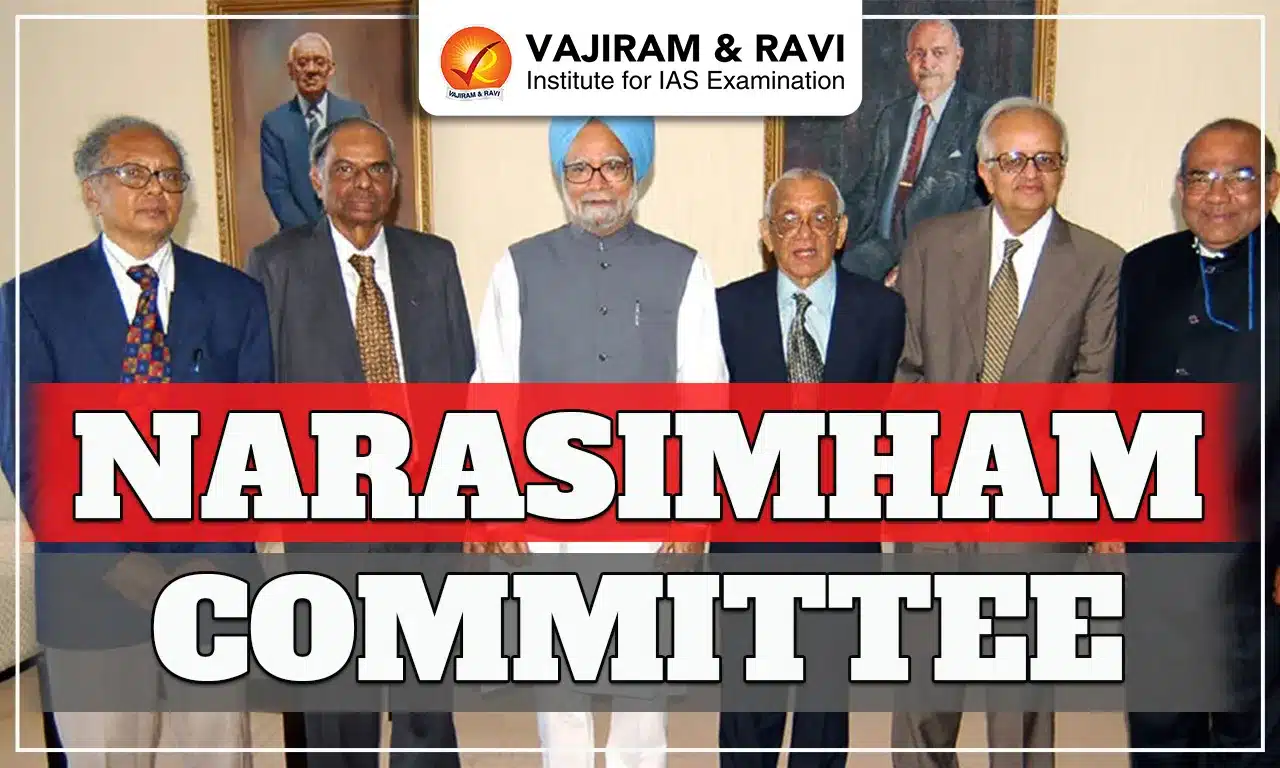
The Narasimham Committee, established in 1991, marked a watershed moment in the evolution of India’s banking and financial sector. In the wake of economic liberalisation, India faced the dual challenge of reviving economic growth while improving the efficiency, competitiveness, and stability of its banking institutions. Recognising these imperatives, the then Finance Minister of India constituted a high-powered committee under the leadership of M. Narasimham, a former Governor of the Reserve Bank of India, to evaluate the financial sector and recommend reforms to make Indian banks more resilient, efficient, and globally competitive. In this article, we are going to cover Narasimhan Committee 1 & 2, its historical background, reforms, recommendations, challenges and importance.
Narasimhan Committee
The Narasimham Committees of 1991 and 1998 were important in transforming India’s banking landscape. They addressed critical structural inefficiencies, strengthened regulation, and promoted professional management in banks. By introducing reforms in NPAs, capital adequacy, ownership structures, and regulatory frameworks, these committees laid the groundwork for a competitive, resilient, and globally aligned banking system.
A second Narasimham Committee was later formed in 1998 to address emerging challenges and ensure that India’s banking system remained robust amid evolving domestic and international economic conditions. Both committees have played an important role in shaping the modern Indian banking landscape, influencing regulatory frameworks, policy decisions, and banking practices.
Narasimhan Committee Historical Background
India underwent a big economic crisis in 1991, marked by a balance of payments deficit and dwindling foreign exchange reserves. The country faced an urgent need to stabilise its economy, liberalise trade, and improve industrial productivity. Amid this backdrop, the performance of the banking sector was identified as an important constraint. Public sector banks, which dominated the financial system, were inefficient, burdened with high non-performing assets (NPAs), and constrained by outdated regulatory mechanisms.
It became evident that the banking sector needed a comprehensive overhaul to support economic growth and strengthen financial intermediation. Banks were expected to play a more proactive role in funding industry, agriculture, and infrastructure, while also managing risks efficiently. Recognising this, Dr. Manmohan Singh, then Finance Minister, formed the Narasimham Committee in August 1991 to recommend reforms for a modern, competitive banking system.


Narasimham Committee I (1991)
The first Narasimham Committee consisted of nine members and was tasked with assessing the structure, functioning, and organisation of Indian banks. The committee submitted its report on November 16, 1991, which was subsequently reviewed by the Parliament on December 17, 1991. Its recommendations laid the foundation for liberalisation in banking and aimed at improving efficiency, competitiveness, and financial stability.
Key Recommendations of Narasimham Committee I:
- Phasing Out Directed Credit Programmes
- The committee noted that directed credit schemes, introduced post-nationalisation, had outlived their utility. It recommended phasing out mandatory lending to specific sectors to allow market-driven allocation of credit.
- Creation of Asset Reconstruction Fund (ARF) Tribunal
- With high levels of NPAs affecting bank balance sheets, the committee proposed the establishment of an ARF tribunal. The tribunal would take over a portion of bad debts to strengthen banks’ financial health and facilitate efficient recovery.
- Removal of Dual Control
- The regulation of banks was under both the Ministry of Finance and the Reserve Bank of India, creating administrative inefficiencies. The committee recommended granting sole regulatory authority to the RBI, ensuring banks’ fundamentals remained robust.
- Reduction in Statutory Requirements (CRR and SLR)
- High Cash Reserve Ratio (CRR) and Statutory Liquidity Ratio (SLR) imposed unnecessary burdens on banks. The committee suggested reducing SLR from 38.5% to 25% and CRR from 15% to 3-5% to free resources for productive lending.
- Market-Determined Interest Rates
- The committee recommended phasing out government-controlled interest rates, allowing market forces of demand and supply to determine rates. This was intended to improve efficiency and better allocate credit resources.
- Greater Autonomy for Banks
- It advocated granting more operational freedom to banks’ boards and managing directors to undertake necessary steps for improving efficiency, enhancing profitability, and managing risks.
- Reorganisation of the Banking Sector
- Public sector banks were to be rationalised through mergers and acquisitions, private banks licensed under regulatory norms, and foreign banks allowed entry with Indian partners. The committee also suggested allowing banks to open new branches freely to improve outreach and competitiveness.
Narasimham Committee II (1998)
Following the partial success of the first committee’s recommendations, the government recognised the need for second-generation reforms in the banking sector. The Narasimham Committee II was formed in 1998 under M. Narasimham’s leadership, with a mandate to modernise banks, improve governance, and address emerging risks such as NPAs, capital adequacy, and technology adoption. This committee focused on creating a robust framework for banks to operate independently, adopt international best practices, and strengthen regulatory compliance.
Key Recommendations of Narasimham Committee II:
- Introduction of Narrow Banking
- Public sector banks were heavily burdened with NPAs, sometimes as high as 20%. To mitigate this, the committee introduced the concept of narrow banking, where banks could park funds in risk-free assets to stabilize financial health and reduce exposure to bad loans.
- Government Ownership and Autonomy
- The committee highlighted the conflict between government ownership and operational autonomy. It recommended divesting controlling stakes in public sector banks to allow professional management and greater independence.
- Strengthening Capital Adequacy
- To absorb potential shocks, the committee suggested increasing the Capital Adequacy Ratio (CAR) for banks and financial institutions, ensuring they had sufficient capital buffers against risks.
- Creation of Strong Banks
- The committee advocated merging weak banks with stronger counterparts to create resilient institutions capable of competing globally. However, it cautioned against merging strong and weak banks indiscriminately, as it could compromise reform objectives.
- Reform of RBI’s Role
- The Reserve Bank of India was to focus on regulatory and supervisory functions rather than controlling operational aspects of banks. It should divest ownership stakes in financial institutions and concentrate on setting rules and ensuring compliance.
- Reduction of Non-Performing Assets
- With rising NPAs threatening banking sustainability, the committee set a target to reduce gross NPAs to 3% by 2002. It recommended the establishment of asset reconstruction companies and the introduction of the SARFAESI Act (2002) to enable efficient recovery of stressed assets.
- Regulation of Foreign Banks
- The committee suggested raising the minimum start-up capital for foreign banks from $10 million to $25 million, promoting stability and competitiveness within the Indian banking landscape.
Narasimhan Committee Government Actions and Implementation
Many recommendations of both Narasimhan Committees were accepted and gradually implemented over the years, leading to substantial changes in India’s financial sector:
- Banking Sector Reforms: Mergers, licensing of private banks, and entry of foreign banks with defined capital requirements.
- Capital Adequacy Norms: Adoption of Basel I and II norms for strengthening financial resilience.
- Reduction in CRR and SLR: Enhanced liquidity and credit availability for productive sectors.
- Autonomy of PSBs: Greater operational freedom and professionalism in management.
- Non-Performing Assets: Establishment of asset reconstruction companies and the SARFAESI Act facilitated faster recovery of bad loans.
- RBI’s Regulatory Role: Shifted to a supervisory and policy-oriented role, focusing on risk management, prudential norms, and regulatory compliance.
These measures collectively strengthened the Indian banking system, improved efficiency, and aligned it with global banking practices.
Narasimhan Committee Criticisms and Challenges
Despite the transformative impact, the Narasimham Committee faced criticisms:
- Opposition from Bank Employees’ Unions
- The United Forum of Bank Unions (UFBU), representing around 1.3 million employees, protested the reforms, especially measures concerning autonomy, mergers, and divestment. They feared job losses and weakening of public sector banks.
- Perceived Anti-Poor Orientation
- Critics argued that the committee’s recommendations focused on efficiency and profitability rather than inclusive growth, raising concerns about access to credit for small borrowers and micro-enterprises.
- Implementation Challenges
- Some reforms, particularly in NPAs and capital adequacy, required significant time and coordination. Banks and regulators faced challenges in operationalising recommendations fully.
Narasimham Committees Importance
The Narasimham Committees are considered foundational in India’s journey toward a modern, robust, and globally competitive banking system:
- Catalysts for Financial Liberalisation: They facilitated the transition from a highly controlled and inefficient banking system to a market-oriented, professionally managed sector.
- Strengthened Banking Resilience: Capital adequacy norms, NPA reduction strategies, and asset reconstruction mechanisms enhanced banks’ capacity to withstand financial shocks.
- Enhanced Regulatory Framework: The RBI emerged as an effective regulator, improving prudential norms and financial sector governance.
- Encouraged Private and Foreign Participation: By licensing private banks and allowing foreign entry under controlled conditions, the committees increased competition and efficiency.
- Foundation for Subsequent Reforms: Recommendations influenced further reforms in IT adoption, corporate governance, risk management, and financial inclusion.
While challenges remain in terms of financial inclusion and balancing efficiency with social objectives, the recommendations of the Narasimham Committees continue to serve as the cornerstone for policy-making in India’s banking sector. Their vision of strong, autonomous, and efficient banks has not only shaped regulatory reforms but also influenced India’s broader economic growth trajectory, ensuring that the banking sector contributes effectively to national development.
| Also Check Other Posts | |
| Care Economy | Mutual Funds |
| Alternative Investment Funds | GDP Deflator |

 Last updated on Oct, 2026
→ UPSC 2027 Notification will be released on 13 January 2027 at upsconline.nic.in.
→ Check Nobel Prize 2026 Winners List here.
→ Download PIB PRiSM Monthly Magazine 2026 here.
→ Check UPSC Monthly Current Affairs Magazine The Recitals here.
→ Check out the latest UPSC Syllabus here.
→ Download UPSC Model Answers for Mains 2026
→ UPSC Mains Question Paper 2026 is out now for Essay & GS Paper 1, 2, 3 & 4.
→ UPSC Calendar 2027 has been released.
→ Enroll in Vajiram & Ravi’s UPSC Mains Test Series 2027 for structured answer writing practice, expert evaluation, and exam-oriented feedback.
→ Join Vajiram & Ravi’s UPSC Mentorship Program 2027 for personalized guidance, strategy planning, and one-to-one support from experienced mentors.
→ Go through the UPSC Mains Previous Year Papers to enhance your preparation.
→ UPSC has released UPSC Toppers List 2025 with the Civil Services final result on its official website.
→ Also check Best UPSC Coaching in India
Narasimham Committee FAQs
Q1. What is the Narasimham Committee famous for?+
Q2. Who was the chairman of the first Narasimham Committee?+
Q3. What is the Narasimham Committee of 1974?+
Q4. What were the objectives of the Narasimham Committee?+
Q5. What were the benefits of the Narasimham Committee?+
Tags: narasimham committee